
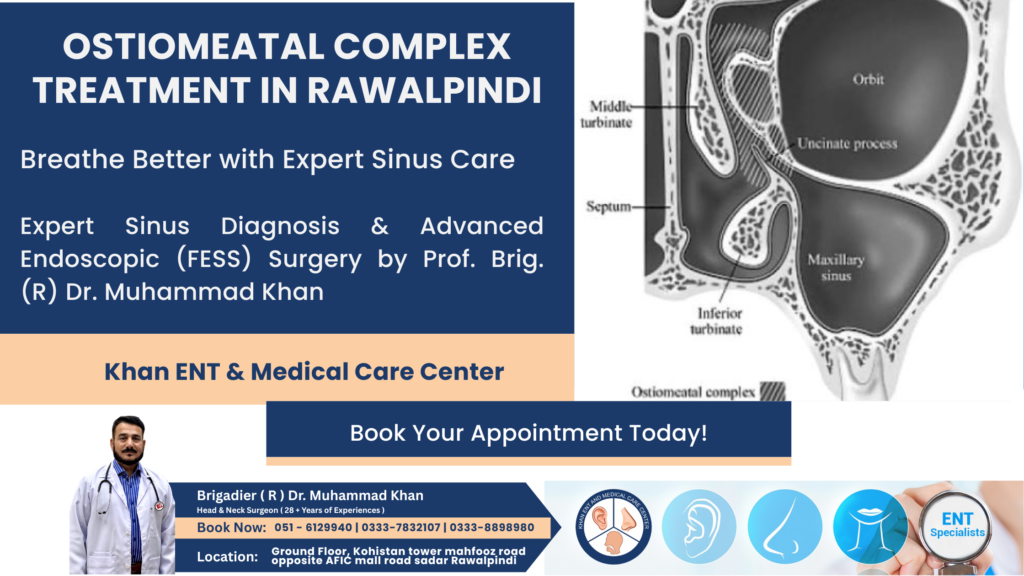
Ostiomeatal Complex Treatment in Rawalpindi is essential for patients suffering from recurrent sinus infections, chronic nasal blockage, facial pressure, headaches, and breathing difficulties. The ostiomeatal complex (OMC), also known as the osteomeatal unit (OMU), is the primary drainage pathway for the frontal sinus, maxillary sinus, and anterior ethmoid air cells. Even a small blockage in this narrow anatomical region can disrupt normal mucus drainage, resulting in chronic rhinosinusitis, recurrent infections, nasal polyps, and long-term sinus disease. If you are looking for the most trusted Ostiomeatal Complex Treatment, Prof. Brig. (R) Dr. Muhammad Khan at Khan ENT & Medical Care Center, Rawalpindi provides comprehensive diagnosis, medical management, and advanced endoscopic sinus surgery using modern ENT techniques.
What is the Ostiomeatal Complex?
The ostiomeatal complex (OMC) is one of the most important functional areas inside the nose. Rather than being a single structure, it is a collection of interconnected anatomical passages located on the lateral wall of the nasal cavity beneath the middle turbinate.
The OMC acts as the main drainage and ventilation pathway for:
- Maxillary sinuses
- Frontal sinuses
- Anterior ethmoid air cells
Healthy sinus function depends on an open and unobstructed ostiomeatal complex. When this narrow drainage pathway becomes blocked due to inflammation, infection, allergies, or anatomical abnormalities, mucus becomes trapped inside the sinuses, creating an ideal environment for bacterial growth and chronic inflammation.
This is why Ostiomeatal Complex Treatment in Rawalpindi focuses on restoring normal airflow and sinus drainage rather than simply treating the infection.
Anatomy of the Ostiomeatal Complex
The ostiomeatal complex consists of several important anatomical structures working together:
Maxillary Ostium
The natural opening through which the maxillary sinus drains.
Ethmoidal Infundibulum
A funnel-shaped passage connecting the maxillary sinus and anterior ethmoid cells to the middle meatus.
Hiatus Semilunaris
A curved groove that allows drainage from the frontal, maxillary, and anterior ethmoid sinuses.
Uncinate Process
A thin hook-shaped bone that forms part of the drainage pathway and directs mucus flow.
Ethmoid Bulla
A prominent ethmoid air cell situated above the hiatus semilunaris.
Together, these structures regulate sinus ventilation and mucociliary clearance.
Functions of the Ostiomeatal Complex
The ostiomeatal complex performs several vital functions:
- Drains mucus from the frontal sinus
- Drains mucus from the maxillary sinus
- Drains anterior ethmoid air cells
- Maintains normal sinus ventilation
- Prevents mucus accumulation
- Supports normal breathing
- Reduces bacterial growth
- Helps maintain healthy nasal physiology
What Causes Ostiomeatal Complex Blockage?
Several conditions may obstruct the OMC.
Chronic Sinusitis
Persistent inflammation narrows the drainage channels and traps mucus.
Allergic Rhinitis
Allergies cause swelling of the nasal lining, leading to narrowing of the ostiomeatal complex.
Deviated Nasal Septum
A bent nasal septum may compress the drainage pathway.
Nasal Polyps
Polyps frequently block the middle meatus and prevent sinus drainage.
Enlarged Ethmoid Bulla
An enlarged ethmoid air cell may narrow the infundibulum.
Concha Bullosa
An air-filled middle turbinate can compress the drainage pathway.
Haller Cells
These anatomical variants narrow the maxillary sinus drainage channel.
Agger Nasi Cells
Large agger nasi cells may obstruct frontal sinus drainage.
Chronic Infections
Repeated infections produce mucosal swelling and scarring.
Symptoms of Ostiomeatal Complex Obstruction
Patients requiring Ostiomeatal Complex Treatment commonly experience:
- Persistent nasal blockage
- Difficulty breathing through the nose
- Facial pain or pressure
- Headaches around the forehead and cheeks
- Thick yellow or green nasal discharge
- Postnasal drip
- Reduced sense of smell
- Recurrent sinus infections
- Ear fullness
- Chronic cough
- Bad breath
- Snoring
- Fatigue due to chronic infection
Symptoms lasting longer than 12 weeks should be evaluated by an experienced ENT specialist.
Risk Factors
You may be more likely to develop OMC obstruction if you have:
- Allergies
- Asthma
- Frequent upper respiratory infections
- Nasal trauma
- Smoking
- Air pollution exposure
- Family history of sinus disease
- Nasal anatomical variations
Diagnosis of Ostiomeatal Complex Disorders
Proper diagnosis is essential before planning Ostiomeatal Complex Treatment.
At Khan ENT & Medical Care Center, diagnosis may include:
Detailed ENT Examination
Assessment of symptoms, duration, allergy history, and previous infections.
Nasal Endoscopy
A high-definition endoscope allows direct visualization of:
- Middle meatus
- Uncinate process
- Ethmoid bulla
- Nasal polyps
- Mucosal swelling
- Purulent discharge
CT Scan of Paranasal Sinuses
CT imaging is considered the gold standard because it clearly demonstrates:
- Blocked ostiomeatal complex
- Deviated septum
- Concha bullosa
- Haller cells
- Agger nasi cells
- Sinus infection
- Bone anatomy
- Extent of disease
Allergy Assessment
When allergies are suspected as the underlying cause.
Ostiomeatal Complex Treatment
Treatment depends on the severity and underlying cause.
Medical Treatment
Many patients improve with medications, including:
- Nasal steroid sprays
- Saline nasal irrigation
- Antihistamines
- Antibiotics (when bacterial infection is present)
- Decongestants (short-term use)
- Allergy management
- Anti-inflammatory medications
Early medical management can prevent progression to chronic sinus disease.
Functional Endoscopic Sinus Surgery (FESS)
When medicines fail, Functional Endoscopic Sinus Surgery (FESS) becomes the preferred treatment.
FESS is a minimally invasive procedure performed entirely through the nostrils using an endoscope.
The surgery aims to:
- Remove blockage
- Open the natural sinus drainage pathways
- Preserve healthy tissue
- Restore mucociliary clearance
- Improve breathing
- Reduce recurrent infections
Conditions Corrected During Surgery
Depending on the findings, surgery may include:
- Uncinectomy
- Middle meatal antrostomy
- Ethmoidectomy
- Frontal recess clearance
- Removal of nasal polyps
- Concha bullosa reduction
- Septoplasty
- Correction of anatomical narrowing
Recovery After Treatment
Most patients experience:
- Improved nasal breathing
- Better sinus drainage
- Fewer infections
- Better sleep
- Reduced facial pressure
- Improved smell
- Improved quality of life
Recovery usually involves:
- Saline irrigation
- Nasal medications
- Follow-up endoscopic cleaning
- Avoiding heavy exercise for a short period
- Regular ENT review
Why Early Treatment Matters
Ignoring OMC obstruction can lead to:
- Chronic sinusitis
- Recurrent antibiotic use
- Nasal polyps
- Orbital infections
- Bone infection
- Rare intracranial complications
- Persistent headaches
- Sleep disturbances
Early Ostiomeatal Complex Treatment in Rawalpindi helps prevent these complications.
Why Choose Prof. Brig. (R) Dr. Muhammad Khan?
Residents of Rawalpindi and Islamabad prefer Prof. Brig. (R) Dr. Muhammad Khan because of his extensive expertise in diagnosing and managing complex ENT and sinus disorders.
Experienced ENT & Head and Neck Surgeon
With decades of clinical and surgical experience, Dr. Muhammad Khan has treated thousands of patients with sinus diseases, nasal obstruction, and chronic rhinosinusitis.
Advanced Endoscopic Expertise
He performs modern endoscopic evaluation and Functional Endoscopic Sinus Surgery (FESS) using evidence-based surgical principles.
Comprehensive Diagnosis
Every patient undergoes careful assessment with nasal endoscopy and imaging before surgery is recommended.
Personalized Treatment
Treatment plans are tailored to each patient’s symptoms, anatomy, CT findings, and overall health.
Ethical Patient Care
Surgery is advised only when appropriate, with an emphasis on conservative treatment whenever possible.
Trusted by Patients Across Rawalpindi & Islamabad
Patients value his military discipline, professional integrity, surgical precision, compassionate communication, and commitment to high standards of patient safety.
Why Choose Khan ENT & Medical Care Center, Rawalpindi?
At Khan ENT & Medical Care Center, Rawalpindi, patients receive:
- Comprehensive ENT consultation
- Advanced nasal endoscopy
- Accurate sinus disease diagnosis
- Modern Functional Endoscopic Sinus Surgery
- Management of chronic sinusitis
- Treatment of nasal polyps
- Septoplasty
- Allergy-related sinus care
- Long-term follow-up
Prevention Tips
You can reduce the risk of OMC blockage by:
- Treating allergies early
- Using saline nasal irrigation
- Avoiding smoking
- Managing sinus infections promptly
- Maintaining good hydration
- Avoiding unnecessary nasal trauma
- Seeking ENT evaluation for persistent nasal blockage
Frequently Asked Questions (FAQs)
What is the ostiomeatal complex?
The ostiomeatal complex is the main drainage pathway connecting the frontal, maxillary, and anterior ethmoid sinuses to the middle meatus.
What causes blockage of the ostiomeatal complex?
Common causes include allergies, chronic sinusitis, nasal polyps, deviated nasal septum, concha bullosa, Haller cells, and recurrent infections.
What are the symptoms of OMC obstruction?
Symptoms include nasal blockage, facial pressure, headache, recurrent sinus infections, postnasal drip, reduced smell, and nasal congestion.
How is an ostiomeatal complex problem diagnosed?
Diagnosis usually involves an ENT examination, nasal endoscopy, and CT scan of the paranasal sinuses.
Can medicines treat OMC blockage?
Yes. Mild to moderate cases often improve with nasal steroid sprays, saline irrigation, allergy treatment, and antibiotics when indicated.
When is surgery recommended?
Surgery is recommended when symptoms persist despite medical treatment or when significant anatomical obstruction is present.
What is Functional Endoscopic Sinus Surgery (FESS)?
FESS is a minimally invasive procedure that restores natural sinus drainage through the nostrils using an endoscope.
Is FESS painful?
Most patients experience minimal discomfort, and recovery is generally quicker than with traditional open surgery.
How long does recovery take after FESS?
Most patients return to normal activities within one to two weeks, although complete healing may take several weeks.
Where can I get expert Ostiomeatal Complex Treatment in Rawalpindi?
Prof. Brig. (R) Dr. Muhammad Khan at Khan ENT & Medical Care Center, Rawalpindi provides comprehensive diagnosis, medical treatment, and advanced endoscopic sinus surgery for patients from Rawalpindi, Islamabad, and surrounding areas.