
Nasal Cavity – Understanding Its Anatomy, Functions, Disorders & Expert ENT Care
Nasal Cavity is one of the most important structures of the upper respiratory system. It is responsible for filtering, warming, humidifying, and cleaning the air before it reaches the lungs. It also plays a vital role in smell, voice resonance, immune defense, and proper drainage of the paranasal sinuses. When it becomes blocked due to infection, allergies, nasal polyps, or a deviated nasal septum, it can significantly affect breathing, sleep, smell, and overall quality of life.
At Khan ENT & Medical Care Center, Prof. Brig. (R) Dr. Muhammad Khan, a highly experienced Senior ENT & Head & Neck Surgeon with over 30 years of surgical expertise, provides comprehensive diagnosis and advanced treatment for nasal cavity disorders using modern endoscopic techniques and evidence-based medical care.
What is the Nasal Cavity?
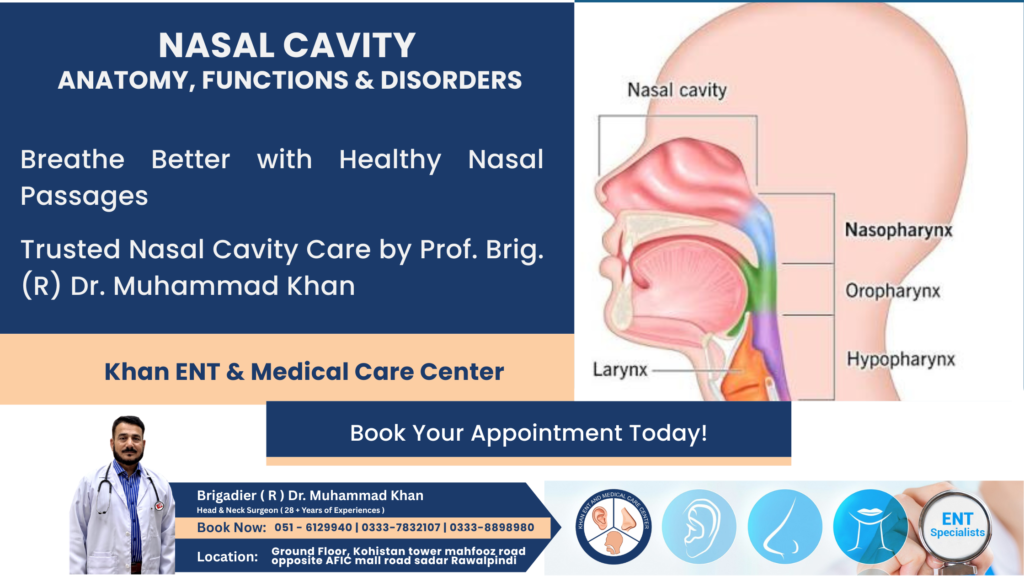
It is a hollow, air-filled chamber located behind the nose and above the roof of the mouth. It extends from the nostrils (anterior nares) to the choanae, which open into the nasopharynx.
The nasal cavity is divided into right and left halves by the nasal septum. Each half contains specialized structures that optimize breathing and protect the respiratory tract from harmful particles, allergens, bacteria, and viruses.
It forms the first section of the respiratory system and serves as the body’s natural air-conditioning unit.
Functions of the Nasal Cavity
It performs several essential functions that keep the respiratory system healthy.
Filters Inspired Air
Tiny hairs (vibrissae), mucus, and microscopic cilia trap:
- Dust
- Smoke
- Allergens
- Pollutants
- Bacteria
- Viruses
This prevents harmful particles from reaching the lungs.
Warms Air
Rich blood vessels inside the nasal cavity warm cold air before it enters the lower respiratory tract.
Humidifies Air
The moist lining of the nasal cavity adds humidity to inhaled air, protecting the lungs from dryness.
Sense of Smell
The olfactory region at the roof of the nasal cavity contains smell receptors that detect thousands of different odors.
Voice Resonance
It acts as a resonance chamber, helping produce normal speech.
Sinus Drainage
All major paranasal sinuses drain into the nasal cavity, allowing mucus to clear naturally.
Tear Drainage
The nasolacrimal duct carries tears from the eyes into the nasal cavity, explaining why your nose runs while crying.
Anatomy of the Nasal Cavity
Understanding the anatomy of the it helps explain why many ENT diseases develop.
Boundaries
Anterior
- Nostrils (Anterior Nares)
Posterior
- Choanae leading to the Nasopharynx
Roof
- Cribriform Plate of Ethmoid Bone
- Frontal Bone
- Sphenoid Bone
Floor
- Hard Palate
- Maxilla
- Palatine Bone
Medial Wall
- Nasal Septum
- Septal Cartilage
- Vomer
- Perpendicular Plate of Ethmoid
Lateral Wall
The lateral wall contains three curved bony shelves called:
- Inferior Turbinate
- Middle Turbinate
- Superior Turbinate
These are also called nasal conchae.
Regions of the Nasal Cavity
It consists of three specialized regions.
Nasal Vestibule
Located immediately inside the nostrils.
Contains:
- Hair follicles
- Sebaceous glands
Its main role is filtering large particles.
Respiratory Region
This is the largest part of the nasal cavity.
It contains:
- Ciliated pseudostratified columnar epithelium
- Goblet cells
- Mucus glands
Its primary functions include:
- Warming air
- Moistening air
- Removing microorganisms
Olfactory Region
Located near the roof of the nasal cavity.
Contains:
- Olfactory receptors
- Olfactory nerve fibers (CN I)
Responsible for the sense of smell.
Nasal Conchae (Turbinates)
The nasal cavity contains three turbinates.
- Superior turbinate
- Middle turbinate
- Inferior turbinate
Their functions include:
- Increasing surface area
- Producing turbulent airflow
- Enhancing humidification
- Improving filtration
- Conserving heat
Nasal Meatuses
Between the turbinates are passageways called meatuses.
Inferior Meatus
Receives:
- Nasolacrimal duct
Middle Meatus
Receives drainage from:
- Frontal sinus
- Maxillary sinus
- Anterior ethmoid sinus
- Middle ethmoid sinus
This region contains the important ostiomeatal complex, a common site of blockage in chronic sinusitis.
Superior Meatus
Receives drainage from:
- Posterior ethmoid air cells
Sphenoethmoidal Recess
Receives drainage from:
- Sphenoid sinus
Blood Supply of the Nasal Cavity
The nasal cavity has one of the richest blood supplies in the body.
Internal Carotid Branches
- Anterior ethmoidal artery
- Posterior ethmoidal artery
External Carotid Branches
- Sphenopalatine artery
- Greater palatine artery
- Superior labial artery
- Lateral nasal artery
These vessels form extensive anastomoses.
Kiesselbach’s Plexus (Little’s Area)
Most nosebleeds occur in Little’s Area, located on the anterior nasal septum.
This area contains an arterial network formed by:
- Anterior ethmoidal artery
- Sphenopalatine artery
- Superior labial artery
- Greater palatine artery
Nerve Supply of the Nasal Cavity
The nasal cavity receives sensory and autonomic innervation.
Olfactory Nerve (CN I)
Responsible for smell.
Trigeminal Nerve (CN V)
Provides:
- Pain sensation
- Touch
- Temperature
Facial Nerve (CN VII)
Parasympathetic fibers stimulate mucus secretion.
Sympathetic Fibers
Control blood flow to the nasal mucosa.
Common Disorders of the Nasal Cavity
Several conditions can affect the nasal cavity.
Allergic Rhinitis
Symptoms include:
- Sneezing
- Itchy nose
- Nasal blockage
- Watery eyes
- Clear nasal discharge
Acute Sinusitis
Inflammation of the sinuses causes:
- Facial pain
- Thick mucus
- Fever
- Nasal obstruction
Chronic Rhinosinusitis
Symptoms lasting more than 12 weeks may indicate chronic inflammation requiring specialist treatment.
Deviated Nasal Septum (DNS)
A bent septum narrows one side of the nasal cavity, causing:
- Difficulty breathing
- Snoring
- Recurrent sinus infections
- Headaches
Nasal Polyps
Soft, painless growths arising from the lining of the nasal cavity and sinuses.
Symptoms include:
- Blocked nose
- Reduced smell
- Mouth breathing
- Persistent congestion
Epistaxis (Nosebleeds)
Common causes include:
- Dry weather
- Trauma
- Nose picking
- Hypertension
- Blood-thinning medications
Nasal Fractures
Trauma may damage:
- Nasal bones
- Septum
- Cartilage
Prompt treatment prevents long-term deformity.
Tumors of the Nasal Cavity
Although uncommon, benign and malignant tumors can occur.
Warning signs include:
- Persistent one-sided nasal blockage
- Frequent nosebleeds
- Facial swelling
- Loss of smell
Early diagnosis significantly improves treatment outcomes.
Symptoms of Nasal Cavity Problems
Patients should consult an ENT specialist if they experience:
- Persistent blocked nose
- Difficulty breathing
- Facial pressure
- Recurrent sinus infections
- Frequent nosebleeds
- Loss of smell
- Snoring
- Mouth breathing
- Thick nasal discharge
- Headaches
Diagnosis of Nasal Cavity Disorders
Modern ENT evaluation may include:
- Complete ENT examination
- Nasal endoscopy
- Fiber-optic examination
- CT Scan of Nose & Sinuses
- MRI (when required)
- Allergy testing
- Smell assessment
- Nasal cultures
- Biopsy of suspicious lesions
Treatment of Nasal Cavity Disorders
Treatment depends on the underlying cause.
Medical Treatment
- Antihistamines
- Nasal steroid sprays
- Saline irrigation
- Antibiotics
- Decongestants (short-term use)
- Allergy management
Surgical Treatment
Advanced procedures include:
- Functional Endoscopic Sinus Surgery (FESS)
- Septoplasty
- Turbinate Reduction
- Nasal Polypectomy
- Endoscopic Tumor Removal
- Endoscopic CSF Leak Repair
- Endoscopic Management of Sinonasal Diseases
When Should You See an ENT Specialist?
Seek specialist care if you have:
- Nasal blockage lasting more than 2 weeks
- Frequent sinus infections
- Difficulty breathing through the nose
- Persistent loss of smell
- Recurrent nosebleeds
- Facial pain
- Snoring with poor sleep
- Nasal polyps
- Deviated nasal septum
- Suspicion of nasal tumors
Why Choose Prof. Brig. (R) Dr. Muhammad Khan?
Residents of Rawalpindi and Islamabad trust Prof. Brig. (R) Dr. Muhammad Khan for expert diagnosis and treatment of nasal cavity disorders because of his extensive experience, ethical practice, and patient-focused care. As a retired military consultant and former Professor of ENT, he brings more than 30 years of expertise in managing simple to highly complex ENT conditions.
At Khan ENT & Medical Care Center, Rawalpindi, patients benefit from:
- Comprehensive ENT evaluation
- Advanced nasal endoscopy
- Modern diagnostic facilities
- Expertise in Functional Endoscopic Sinus Surgery (FESS)
- Septoplasty and turbinate surgery
- Nasal polyp treatment
- Head and neck surgical expertise
- Personalized treatment plans
- Evidence-based care
- Compassionate follow-up and long-term management
Whether you are experiencing chronic nasal blockage, recurrent sinus infections, nasal polyps, or require advanced endoscopic sinus surgery, Prof. Brig. (R) Dr. Muhammad Khan provides trusted, high-quality ENT care for patients from Rawalpindi, Islamabad, and surrounding regions.
How to Keep Your Nasal Cavity Healthy
Maintain a healthy nasal cavity by:
- Staying well hydrated
- Using saline nasal sprays when needed
- Avoiding smoking
- Managing allergies promptly
- Treating sinus infections early
- Wearing protective masks in dusty environments
- Avoiding unnecessary use of nasal decongestant sprays
- Seeking ENT consultation for persistent symptoms
Frequently Asked Questions (FAQs)
What is the nasal cavity?
The nasal cavity is the air-filled space behind the nose that filters, warms, humidifies, and cleans inhaled air while supporting smell and sinus drainage.
What are the main functions of the nasal cavity?
Its main functions include breathing, air filtration, humidification, warming inspired air, smell, sinus drainage, tear drainage, and voice resonance.
What causes nasal cavity blockage?
Common causes include allergies, sinus infections, deviated nasal septum, nasal polyps, enlarged turbinates, tumors, and chronic inflammation.
What are nasal turbinates?
Turbinates (nasal conchae) are curved bony structures inside the nasal cavity that increase surface area to warm, humidify, and filter inhaled air.
Why do I lose my sense of smell?
Loss of smell may occur due to viral infections, allergies, nasal polyps, chronic sinusitis, head injury, aging, or damage to the olfactory nerve.
What is a deviated nasal septum?
A deviated septum is a displacement of the nasal septum that can cause nasal obstruction, snoring, recurrent sinus infections, and breathing difficulties.
What is Functional Endoscopic Sinus Surgery (FESS)?
FESS is a minimally invasive procedure performed using an endoscope to restore normal sinus drainage and treat chronic sinus disease, nasal polyps, and certain nasal cavity conditions.
Why do nosebleeds usually occur from one area?
Most nosebleeds originate from Kiesselbach’s plexus (Little’s Area), a richly vascularized region on the front part of the nasal septum.
How are nasal cavity disorders diagnosed?
Diagnosis may involve an ENT examination, nasal endoscopy, CT scan, allergy testing, imaging studies, and biopsy when necessary.
When should I consult an ENT specialist for nasal cavity problems?
You should consult an ENT specialist if you have persistent nasal blockage, repeated sinus infections, frequent nosebleeds, loss of smell, facial pain, or symptoms lasting longer than two weeks despite treatment.