
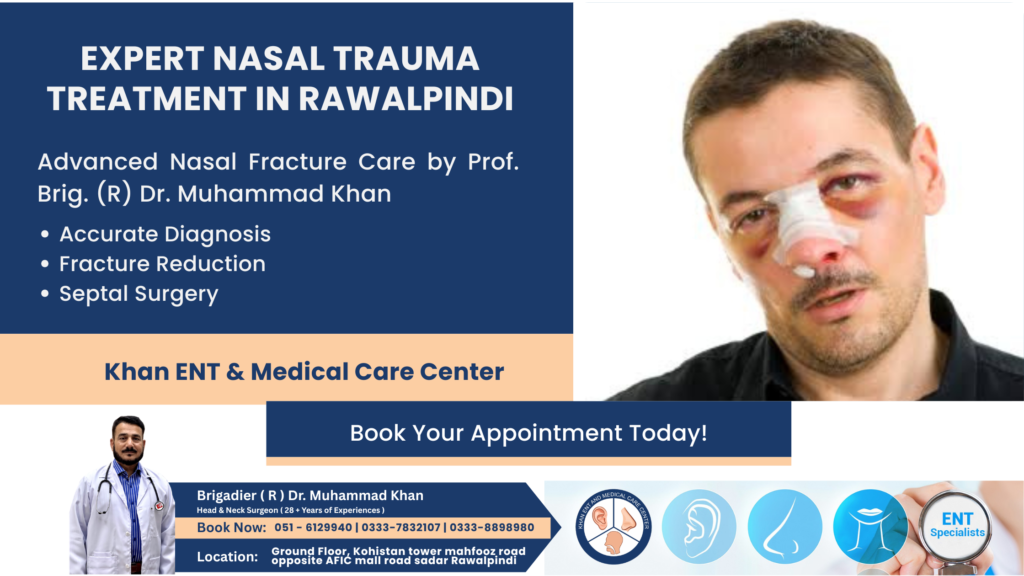
Nasal Trauma Treatment is essential for restoring the normal appearance and function of the nose after an injury. Whether caused by a road traffic accident, sports injury, workplace trauma, fall, or physical assault, nasal trauma should never be ignored. Prompt Nasal Trauma Treatment reduces the risk of permanent nasal deformity, breathing problems, chronic nasal blockage, septal deviation, and cosmetic complications. While minor injuries may heal with conservative care, displaced fractures, septal hematomas, or associated facial injuries require immediate evaluation by an experienced ENT surgeon.
If you are looking for expert Nasal Trauma Treatment in Rawalpindi or Islamabad, Prof. Brig. (R) Dr. Muhammad Khan, Senior ENT & Head & Neck Surgeon at Khan ENT & Medical Care Center, Rawalpindi, provides comprehensive evaluation, advanced nasal fracture management, septal surgery, and reconstructive procedures using modern ENT techniques.
What Is Nasal Trauma?
Nasal trauma refers to any injury affecting the external nose, nasal bones, cartilage, nasal septum, or surrounding soft tissues. Since the nose is the most prominent part of the face, it is the facial bone most commonly injured.
Early Nasal Trauma Treatment is important because even seemingly minor injuries may hide serious complications such as:
- Nasal bone fractures
- Septal hematoma
- Septal abscess
- Nasal obstruction
- Septal deviation
- Facial fractures
- Cerebrospinal fluid (CSF) leak
- Cosmetic nasal deformity
Ignoring these injuries can lead to lifelong breathing difficulties and permanent changes in facial appearance.
Common Causes of Nasal Trauma
Many everyday accidents can result in nasal injuries, including:
- Road traffic accidents
- Sports injuries
- Falls
- Physical assaults
- Workplace accidents
- Bicycle accidents
- Cricket or football injuries
- Martial arts injuries
- Childhood accidents
- Domestic injuries
People involved in contact sports are at particularly high risk of requiring Nasal Trauma Treatment.
Symptoms of Nasal Trauma
Symptoms vary depending on the severity of injury.
Common symptoms include:
- Severe nasal pain
- Swelling over the nose
- Bruising around the eyes
- Nosebleeds (epistaxis)
- Crooked nose
- Difficulty breathing
- Nasal blockage
- Tenderness
- Clicking sensation
- Facial swelling
- Headache
- Watery nasal discharge
- Loss of smell (occasionally)
If breathing becomes difficult or the nose becomes visibly crooked, urgent Nasal Trauma Treatment should be sought.
Signs That Require Emergency Nasal Trauma Treatment
Seek immediate medical attention if you notice:
- Continuous heavy nosebleed
- Clear watery fluid leaking from the nose
- Severe facial injuries
- Double vision
- Loss of consciousness
- Severe headache
- Septal swelling inside both nostrils
- Difficulty breathing
- Deformed nose
- Fever following injury
These signs may indicate serious complications requiring emergency ENT evaluation.
How Is Nasal Trauma Diagnosed?
Diagnosis begins with a detailed history followed by careful examination by an ENT specialist.
The evaluation includes:
Medical History
Your ENT surgeon will ask:
- How did the injury occur?
- When did it happen?
- Was there immediate deformity?
- Is there nasal obstruction?
- Is there previous nasal surgery?
- Was there loss of consciousness?
Physical Examination
The ENT specialist examines:
- External nose
- Nasal bones
- Septum
- Nasal airway
- Skin injuries
- Facial bones
- Eye movements
- Nasal bleeding
The examination identifies fractures, septal hematomas, deformities, and airway obstruction.
Nasal Endoscopy
Modern Nasal Trauma Treatment often includes nasal endoscopy.
This allows visualization of:
- Septal injury
- Internal bleeding
- Mucosal tears
- Septal hematoma
- Hidden fractures
CT Scan
CT scan is recommended when:
- Facial fractures are suspected
- High-energy trauma occurred
- Eye injuries exist
- Skull base injury is suspected
- Multiple facial bones are injured
Routine X-rays are usually unnecessary because they provide limited information in isolated nasal injuries.
Types of Nasal Trauma
Simple Nasal Injury
Minor swelling without fracture usually responds to conservative treatment.
Nasal Bone Fracture
The nasal bones break due to significant force.
Treatment depends on:
- Degree of displacement
- Breathing difficulty
- Cosmetic deformity
Septal Hematoma
A septal hematoma is one of the most serious complications requiring emergency Nasal Trauma Treatment.
Blood collects between the cartilage and its covering, cutting off the blood supply.
Without immediate drainage, it may cause:
- Cartilage death
- Saddle nose deformity
- Infection
- Septal abscess
Septal Abscess
Untreated hematomas can become infected.
Symptoms include:
- Fever
- Increasing pain
- Severe blockage
- Pus
- Facial swelling
Immediate surgical drainage and antibiotics are essential.
Septal Deviation
Trauma may permanently bend the nasal septum.
Symptoms include:
- Chronic nasal blockage
- Snoring
- Mouth breathing
- Recurrent sinus infections
Persistent obstruction may require septoplasty.
Nasal Trauma Treatment Options
The best Nasal Trauma Treatment depends on the severity of injury.
Conservative Treatment
Minor injuries without displacement often heal naturally.
Treatment includes:
- Ice packs
- Head elevation
- Pain medications
- Nasal decongestants
- Rest
- Avoiding contact sports
Most swelling improves within one week.
Treatment of Nosebleeds
Traumatic nosebleeds are common.
Initial treatment includes:
- Leaning forward
- Pinching the nostrils
- Applying ice
- Nasal packing if needed
Persistent bleeding requires ENT evaluation.
Septal Hematoma Drainage
This is an ENT emergency.
Treatment involves:
- Local anesthesia
- Small incision
- Drainage
- Internal nasal drain
- Nasal packing
- Antibiotics
Prompt drainage prevents permanent nasal collapse.
Closed Reduction of Nasal Fracture
Closed reduction is the most common procedure for Nasal Trauma Treatment.
It is recommended when:
- The nose is visibly displaced
- Nasal bones have shifted
- Breathing is affected
The procedure should ideally be performed within 7–14 days after injury, before the bones heal in the wrong position.
Under local or general anesthesia, the ENT surgeon gently repositions the fractured bones and stabilizes them with internal packing (if required) and an external nasal splint.
Open Reduction Surgery
Some injuries cannot be corrected with simple manipulation.
Open surgery is recommended when:
- Multiple fractures exist
- Septal fragments are locked
- Previous reduction failed
- Severe deformity exists
- Delayed presentation occurs
The surgeon repairs the nasal framework through carefully planned incisions.
Septoplasty
Trauma often causes permanent septal deviation.
Septoplasty improves:
- Nasal breathing
- Airflow
- Sleep quality
- Snoring
- Sinus drainage
Functional Rhinoplasty
Some patients require reconstruction after severe trauma.
Functional rhinoplasty restores:
- Nasal appearance
- Airway
- Structural support
Recovery After Nasal Trauma Treatment
Recovery depends on injury severity.
General recovery timeline:
- Swelling improves: 1–2 weeks
- Bruising fades: 10–14 days
- Nasal splint removal: about 1 week
- Bone healing: approximately 6 weeks
- Return to sports: after 6 weeks (or as advised)
Patients should avoid nose blowing, heavy lifting, and contact sports during recovery.
Home Care After Nasal Trauma Treatment
Follow these instructions:
- Apply ice for the first 48 hours.
- Sleep with your head elevated.
- Avoid smoking.
- Do not blow your nose forcefully.
- Take prescribed medicines.
- Attend follow-up appointments.
- Avoid trauma during healing.
- Wear protective gear during sports.
Good postoperative care significantly improves healing.
Possible Complications of Untreated Nasal Trauma
Without proper Nasal Trauma Treatment, patients may develop:
- Crooked nose
- Chronic nasal blockage
- Septal deviation
- Persistent nosebleeds
- Septal perforation
- Saddle nose deformity
- Chronic sinusitis
- Cosmetic deformity
- Sleep-disordered breathing
- Loss of smell
- Facial asymmetry
Early treatment minimizes these risks.
Why Choose Prof. Brig. (R) Dr. Muhammad Khan for Nasal Trauma Treatment?
Residents of Rawalpindi and Islamabad trust Prof. Brig. (R) Dr. Muhammad Khan because of his extensive experience in ENT and Head & Neck Surgery. As a retired military consultant and senior ENT surgeon, he has managed a wide range of simple and complex nasal injuries with precision and patient-centered care.
At Khan ENT & Medical Care Center, Rawalpindi, patients benefit from:
- Comprehensive ENT assessment
- Advanced nasal endoscopy
- Accurate diagnosis of nasal fractures
- Expert closed and open reduction procedures
- Septoplasty for post-traumatic nasal obstruction
- Management of septal hematoma and abscess
- Functional nasal reconstruction
- Modern surgical techniques
- Personalized follow-up care
- Ethical, evidence-based treatment
Whether your injury is recent or has resulted in long-term breathing problems, timely consultation can help restore both nasal function and appearance.
Preventing Nasal Injuries
Although accidents cannot always be avoided, the following measures reduce risk:
- Wear helmets during motorcycle riding.
- Use seat belts.
- Wear protective face guards during sports.
- Follow workplace safety measures.
- Prevent falls in elderly individuals.
- Supervise children during play.
Frequently Asked Questions (FAQs)
What is the best treatment for nasal trauma?
Treatment depends on the severity of the injury. Minor injuries may require ice and pain relief, while displaced fractures often need closed reduction within 7–14 days.
How soon should I see an ENT specialist after a nasal injury?
Ideally within 24–72 hours, especially if you have a crooked nose, nasal blockage, or persistent bleeding.
Can a broken nose heal without surgery?
Yes. Minor, non-displaced fractures often heal without surgery, but displaced fractures may require reduction.
What is a septal hematoma?
It is a collection of blood inside the nasal septum that requires emergency drainage to prevent cartilage damage and nasal collapse.
Do I need a CT scan for every nasal injury?
No. CT scans are mainly recommended when facial fractures, eye injuries, or skull base injuries are suspected.
How long does recovery after nasal fracture treatment take?
Most swelling improves within 1–2 weeks, while complete bone healing generally takes about 6 weeks.
Can nasal trauma cause breathing problems?
Yes. Fractures or a deviated septum can narrow the nasal airway and lead to chronic nasal obstruction.
When is surgery needed for nasal trauma?
Surgery may be required for severe fractures, delayed injuries, significant deformity, persistent nasal obstruction, or complex septal damage.
Can children develop nasal fractures?
Yes. Children can sustain nasal injuries and should be assessed promptly, as early treatment often leads to better outcomes.
Where can I get expert Nasal Trauma Treatment in Rawalpindi?
You can consult Prof. Brig. (R) Dr. Muhammad Khan at Khan ENT & Medical Care Center, Rawalpindi, for comprehensive diagnosis, fracture management, septal surgery, and advanced ENT care.