
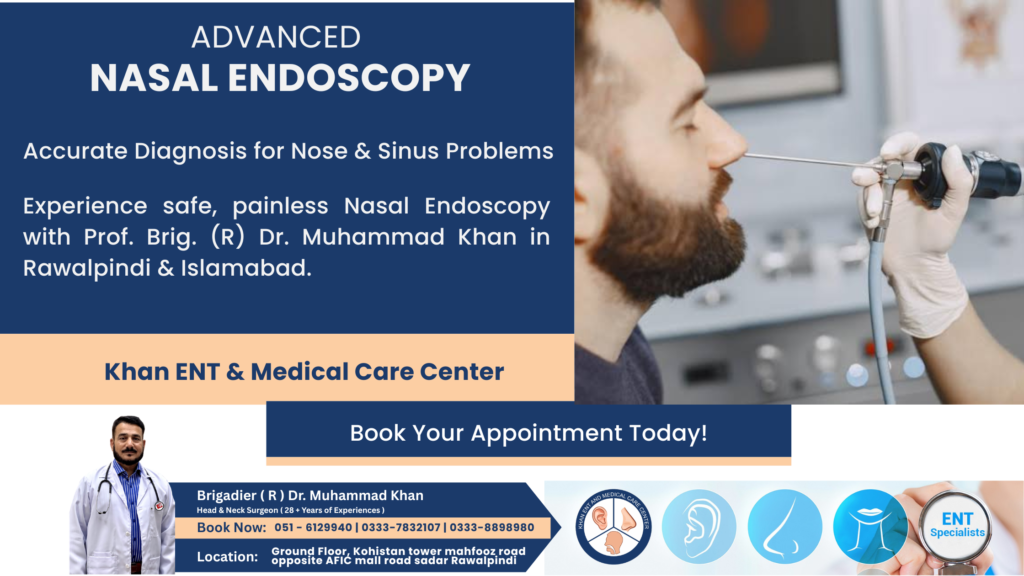
Nasal Endoscopy is one of the most accurate and reliable diagnostic procedures used by ENT specialists to examine the inside of the nose, nasal passages, and sinuses. If you suffer from persistent nasal blockage, chronic sinus infections, recurrent nosebleeds, nasal polyps, or loss of smell, Nasal Endoscopy helps identify the exact cause without the need for major surgery. This safe, quick, and minimally invasive procedure enables ENT specialists to diagnose nasal and sinus diseases with exceptional precision and recommend the most effective treatment.
At Khan ENT & Medical Care Center, Prof. Brig. (R) Dr. Muhammad Khan, one of the leading ENT specialists in Rawalpindi and Islamabad, performs comprehensive nasal examinations using modern nasal endoscopy techniques to provide accurate diagnosis and personalized treatment for patients of all ages.
What is Nasal Endoscopy?
Nasal Endoscopy is a specialized ENT procedure that allows doctors to examine the internal structures of the nose and paranasal sinuses using a thin tube called an endoscope. The endoscope contains a high-definition camera and bright light that transmit real-time images to a monitor, allowing detailed evaluation of areas that cannot be seen during a routine nasal examination.
Unlike X-rays, Nasal Endoscopy provides direct visualization of the nasal cavity, sinus openings, turbinates, septum, adenoids, and nasopharynx.
The procedure is commonly performed in an ENT clinic and usually takes only 5 to 10 minutes without requiring hospitalization.
Why is Nasal Endoscopy Performed?
An ENT specialist recommends Nasal Endoscopy when symptoms persist despite medication or when a detailed examination is required.
Common reasons include:
- Chronic nasal blockage
- Recurrent sinus infections
- Persistent nasal congestion
- Nasal polyps
- Deviated nasal septum (DNS)
- Frequent nosebleeds
- Loss of smell (Anosmia)
- Facial pain and sinus pressure
- Allergic rhinitis
- Chronic headaches related to sinus disease
- Nasal discharge lasting several weeks
- Suspected tumors or growths
- Sleep-related breathing problems
- Snoring evaluation
- Foreign body inside the nose (especially in children)
Conditions Diagnosed by Nasal Endoscopy
One of the biggest advantages of Nasal Endoscopy is its ability to diagnose numerous ENT disorders accurately.
These include:
Chronic Sinusitis
Inflamed sinuses with blocked drainage pathways can be directly visualized, allowing accurate diagnosis and treatment planning.
Nasal Polyps
Soft, painless growths inside the nose are easily detected using Nasal Endoscopy, even when they are small.
Deviated Nasal Septum (DNS)
The procedure clearly shows the severity of septal deviation and whether surgery is required.
Allergic Rhinitis
Persistent inflammation caused by allergies can be evaluated in detail.
Sinus Infections
Doctors can identify pus, swelling, infected secretions, fungal infections, and blocked sinus openings.
Enlarged Turbinates
Swollen turbinates are a common cause of nasal obstruction and breathing difficulty.
Nasal Tumors
Although uncommon, benign and malignant growths can be detected early with Nasal Endoscopy.
Adenoid Enlargement
In both children and adults, enlarged adenoids can be accurately assessed.
Cerebrospinal Fluid (CSF) Leak
The procedure helps identify suspected CSF leakage from the nose.
Source of Nosebleeds
Persistent nosebleeds can often be traced to a specific bleeding point.
Types of Nasal Endoscopy
Flexible Nasal Endoscopy
A flexible endoscope bends easily inside the nasal cavity, making the examination comfortable for most patients.
It is commonly used for:
- Routine ENT examination
- Voice disorders
- Throat examination
- Nasal obstruction
- Pediatric patients
Rigid Nasal Endoscopy
Rigid endoscopes provide higher image quality and excellent visualization.
They are preferred for:
- Sinus disease evaluation
- Nasal polyps
- Surgical planning
- Functional Endoscopic Sinus Surgery (FESS)
How to Prepare for Nasal Endoscopy
Most patients require little or no preparation before Nasal Endoscopy.
Before your appointment:
- Inform your ENT specialist about blood-thinning medications.
- Mention any allergies to local anesthetics.
- Bring previous CT scans or MRI reports if available.
- Continue routine medications unless instructed otherwise.
- Eat normally unless your doctor advises differently.
What Happens During a Nasal Endoscopy?
The procedure is simple and performed in the outpatient department.
Step 1: Nasal Decongestant
A medicated nasal spray is applied to reduce swelling.
Step 2: Local Anesthetic
A numbing spray minimizes discomfort.
Step 3: Endoscope Insertion
The ENT specialist gently inserts the endoscope into one nostril.
Step 4: Examination
The doctor examines:
- Nasal septum
- Turbinates
- Sinus openings
- Nasopharynx
- Adenoids
- Mucosa
- Polyps
- Infection
- Bleeding
Step 5: Repeat on the Other Side
Both nasal passages are examined carefully.
The entire Nasal Endoscopy usually takes less than 10 minutes.
Does Nasal Endoscopy Hurt?
One of the most common concerns patients have is whether Nasal Endoscopy is painful.
The answer is No.
Most patients only feel:
- Mild pressure
- Tickling sensation
- Slight watering of the eyes
- Temporary numbness
The local anesthetic makes the examination comfortable.
What Can Be Seen During Nasal Endoscopy?
Nasal Endoscopy provides detailed visualization of:
- Nasal cavity
- Nasal septum
- Inferior, middle, and superior turbinates
- Sinus drainage pathways
- Ethmoid sinuses
- Sphenoid sinus opening
- Maxillary sinus opening
- Nasopharynx
- Adenoids
- Eustachian tube openings
- Polyps
- Tumors
- Bleeding vessels
- Thick mucus
- Fungal infection
Benefits of Nasal Endoscopy
The popularity of Nasal Endoscopy continues to grow because of its many advantages.
Benefits include:
- Quick procedure
- Highly accurate diagnosis
- No hospital admission
- Minimal discomfort
- No external incision
- Immediate results
- Safe for adults and children
- Helps avoid unnecessary surgery
- Guides biopsy precisely
- Assists in planning sinus surgery
Risks of Nasal Endoscopy
Nasal Endoscopy is considered extremely safe.
Rare complications include:
- Mild nosebleed
- Temporary throat numbness
- Sneezing
- Allergic reaction to local anesthetic
- Mild infection (rare)
- Fainting in anxious patients (very uncommon)
Most patients return to normal activities immediately after the examination.
Recovery After Nasal Endoscopy
Recovery is almost immediate.
Patients may notice:
- Mild nasal irritation
- Temporary numbness
- Slight blood-stained mucus
These symptoms usually disappear within a few hours.
Avoid eating or drinking until the numbness completely wears off if your throat was also anesthetized.
When Should You Have a Nasal Endoscopy?
You should consult an ENT specialist if you have:
- Nasal blockage lasting more than 3 weeks
- Recurrent sinus infections
- Persistent facial pain
- Difficulty breathing through the nose
- Frequent nosebleeds
- Loss of smell
- Snoring
- Sleep apnea symptoms
- Nasal growth
- Chronic allergies not responding to medication
Early diagnosis leads to better treatment outcomes.
Nasal Endoscopy vs CT Scan
Many patients wonder whether Nasal Endoscopy or a CT scan is better.
The answer is that both complement each other.
Nasal Endoscopy:
- Directly visualizes the inside of the nose.
- Detects inflammation, polyps, bleeding, and discharge.
- Provides immediate findings.
CT Scan:
- Shows the deeper anatomy of the sinuses.
- Evaluates bone structures.
- Helps plan surgery.
In many cases, your ENT specialist may recommend both for the most accurate diagnosis.
Why Choose Prof. Brig. (R) Dr. Muhammad Khan for Nasal Endoscopy?
When it comes to Nasal Endoscopy in Rawalpindi and Islamabad, choosing an experienced ENT specialist is essential for accurate diagnosis and safe treatment.
Prof. Brig. (R) Dr. Muhammad Khan is one of the region’s most experienced ENT consultants, with extensive expertise in diagnosing and managing disorders of the nose, sinuses, ear, throat, and head & neck. Patients trust him for his thorough clinical assessment, evidence-based treatment approach, and compassionate care.
Residents of Rawalpindi and Islamabad prefer Prof. Brig. (R) Dr. Muhammad Khan because he offers:
- Comprehensive ENT evaluation using modern endoscopic equipment.
- Accurate diagnosis of complex nasal and sinus conditions.
- Personalized treatment plans tailored to each patient.
- Expertise in medical and surgical management, including Functional Endoscopic Sinus Surgery (FESS) when indicated.
- Care for both adults and children in a professional, patient-focused environment.
- Emphasis on avoiding unnecessary procedures while ensuring timely intervention when required.
Whether you have chronic sinusitis, nasal blockage, allergies, recurrent nosebleeds, or nasal polyps, early evaluation with Nasal Endoscopy can help identify the underlying problem and guide the most appropriate treatment.
Frequently Asked Questions (FAQs)
1. What is Nasal Endoscopy used for?
Nasal Endoscopy is used to diagnose sinus infections, nasal polyps, deviated septum, tumors, allergies, chronic nasal blockage, and unexplained nosebleeds.
2. Is Nasal Endoscopy painful?
No. Most patients experience only mild pressure or temporary discomfort because the nose is numbed before the procedure.
3. How long does Nasal Endoscopy take?
The procedure usually takes between 5 and 10 minutes.
4. Do I need anesthesia?
Only a local anesthetic spray is typically required. General anesthesia is not needed for routine diagnostic nasal endoscopy.
5. Can children undergo Nasal Endoscopy?
Yes. Children can safely undergo Nasal Endoscopy when performed by an experienced ENT specialist.
6. Is Nasal Endoscopy safe?
Yes. It is considered a very safe procedure with minimal risk of complications.
7. Can I eat after Nasal Endoscopy?
If your throat has been numbed, wait about one hour before eating or drinking to avoid choking.
8. Can Nasal Endoscopy detect cancer?
Yes. It can identify suspicious growths, and if needed, your doctor may perform a biopsy for laboratory analysis.
9. Will I need a CT scan after Nasal Endoscopy?
Not always. Your ENT specialist may recommend a CT scan if additional information is needed, particularly before sinus surgery.
10. Where can I get Nasal Endoscopy in Rawalpindi and Islamabad?
You can undergo Nasal Endoscopy with Prof. Brig. (R) Dr. Muhammad Khan at his ENT clinics through Khan ENT & Medical Care Center, where modern diagnostic facilities and expert ENT care are available.