
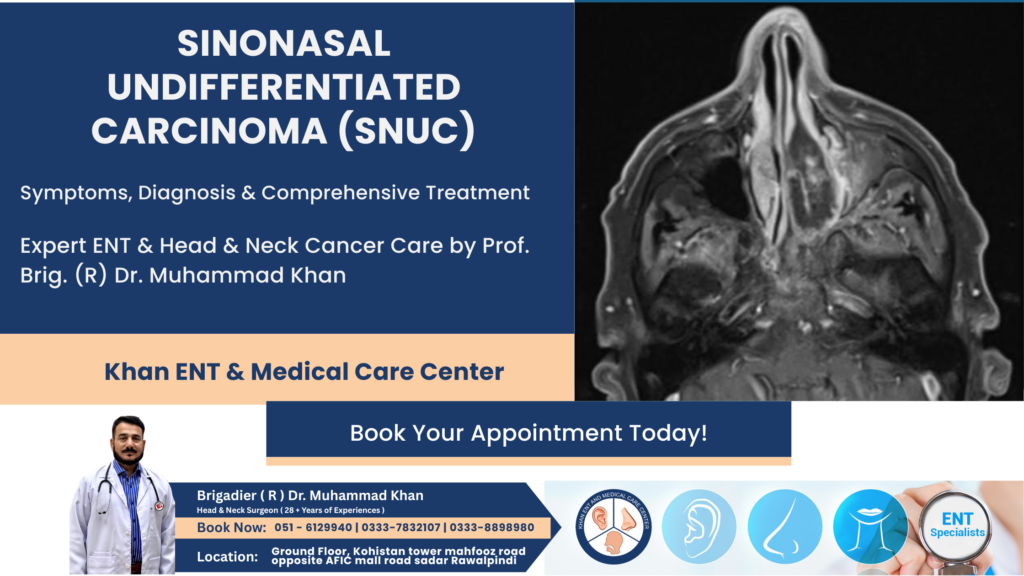
Sinonasal Undifferentiated Carcinoma
Sinonasal Undifferentiated Carcinoma (SNUC) is a rare, highly aggressive cancer that develops in the nasal cavity and paranasal sinuses. Although it accounts for only a small percentage of sinonasal cancers, It is one of the most dangerous tumors affecting the nose and sinuses because it grows rapidly, destroys surrounding bone, and frequently spreads into the eyes, skull base, brain, and nearby tissues before diagnosis. Early recognition of it symptoms and prompt evaluation by an experienced ENT and Head & Neck Surgeon can significantly improve treatment outcomes. At Khan ENT & Medical Care Center, Rawalpindi, Prof. Brig. (R) Dr. Muhammad Khan, a highly experienced ENT & Head and Neck Surgeon with more than 30 years of surgical expertise, provides comprehensive diagnosis, treatment planning, and long-term management for patients with complex nasal, sinus, and head & neck tumors.
What is Sinonasal Undifferentiated Carcinoma?
It is an extremely rare epithelial malignancy originating from the lining of the nasal cavity or paranasal sinuses. Unlike many other cancers, this tumor lacks identifiable squamous, glandular, or neuroendocrine differentiation under microscopic examination.
Because it is undifferentiated, the cancer cells appear highly abnormal and divide rapidly. The disease is often diagnosed at an advanced stage because the nasal cavity provides enough space for tumors to enlarge before causing significant symptoms.
This aggressive cancer was first described in 1986 and remains one of the most challenging sinonasal malignancies to diagnose and treat.
How Common is Sinonasal Undifferentiated Carcinoma?
Although cancers of the nasal cavity and paranasal sinuses are themselves uncommon, it represents only about 3–5% of all sinonasal cancers.
It most commonly affects:
- Adults between 50–60 years
- Men more than women
- Patients without any clearly established risk factors
Because of its rarity, treatment should ideally be managed by an experienced multidisciplinary ENT oncology team.
Where Does Sinonasal Undifferentiated Carcinoma Develop?
The tumor commonly begins in:
- Nasal cavity
- Ethmoid sinus
- Maxillary sinus
- Less commonly sphenoid sinus
- Frontal sinus
As Sinonasal Undifferentiated Carcinoma enlarges, it may spread into:
- Orbit (eye socket)
- Skull base
- Brain
- Cranial nerves
- Oral cavity
- Neck lymph nodes
Causes of Sinonasal Undifferentiated Carcinoma
The exact cause of Sinonasal Undifferentiated Carcinoma remains unknown.
Unlike several other head and neck cancers, current research has not established strong associations with:
- Human papillomavirus (HPV)
- Epstein-Barr Virus (EBV)
- Smoking alone
- Alcohol use
Recent molecular studies have identified mutations involving:
- IDH2 mutation (most common)
- IDH1 mutation
- Other genetic abnormalities in selected cases
Researchers continue investigating why these mutations occur.
Risk Factors
Although no definite risk factors have been confirmed, certain factors may increase concern:
- Long-standing nasal symptoms
- Occupational chemical exposure
- Previous sinonasal tumors
- Chronic sinus disease (rare association)
- Male gender
- Middle-aged and older adults
Symptoms of Sinonasal Undifferentiated Carcinoma
The symptoms often resemble chronic sinusitis during the early stages, leading to delayed diagnosis.
Common symptoms include:
- Persistent nasal blockage
- Frequent nosebleeds (epistaxis)
- Facial pain
- Facial swelling
- Headache
- Nasal discharge
- Loss of smell
- Double vision
- Blurred vision
- Bulging eye (proptosis)
- Reduced vision
- Eye movement problems
- Numbness of the face
- Tooth pain
- Loose upper teeth
- Difficulty opening the mouth
- Ear blockage
- Hearing problems
- Neck swelling
Advanced Sinonasal Undifferentiated Carcinoma may also produce:
- Cranial nerve paralysis
- Brain involvement
- Difficulty swallowing
- Weight loss
- Persistent fatigue
Any persistent unilateral nasal blockage with recurrent bleeding should never be ignored.
How Does Sinonasal Undifferentiated Carcinoma Spread?
Because this cancer is highly aggressive, it may spread by:
Local invasion
The tumor grows into:
- Orbit
- Skull base
- Brain
- Oral cavity
- Facial bones
Lymphatic spread
Cancer may spread to:
- Neck lymph nodes
Distant metastasis
Less commonly:
- Lung
- Liver
- Bone
- Brain
Diagnosis of Sinonasal Undifferentiated Carcinoma
Early diagnosis requires careful evaluation by an ENT Head & Neck Surgeon.
Diagnostic investigations include:
Medical History
Your doctor evaluates:
- Duration of symptoms
- Nosebleeds
- Facial pain
- Vision changes
- Headaches
Nasal Endoscopy
A rigid or flexible nasal endoscope allows direct visualization of suspicious growths inside the nasal cavity.
CT Scan
CT imaging evaluates:
- Bone destruction
- Sinus involvement
- Tumor size
- Skull base invasion
MRI Scan
MRI provides superior evaluation of:
- Brain extension
- Orbital invasion
- Soft tissue spread
- Cranial nerves
PET-CT Scan
Useful for:
- Detecting metastasis
- Cancer staging
- Monitoring treatment response
Biopsy
Biopsy remains the gold standard for diagnosing it.
Microscopic examination confirms:
- Poorly differentiated malignant cells
- Extensive necrosis
- High mitotic activity
Immunohistochemistry (IHC)
Special laboratory tests help distinguish Sinonasal Undifferentiated Carcinoma from:
- Olfactory neuroblastoma
- Lymphoma
- Melanoma
- Neuroendocrine carcinoma
- NUT carcinoma
- SMARCB1-deficient carcinoma
- Squamous cell carcinoma
Staging of Sinonasal Undifferentiated Carcinoma
Doctors use imaging and pathology findings to determine:
- Tumor size
- Bone invasion
- Orbital involvement
- Skull base extension
- Lymph node spread
- Distant metastasis
Most patients unfortunately present with Stage III or Stage IV disease.
Treatment of Sinonasal Undifferentiated Carcinoma
Treatment requires a multidisciplinary approach involving ENT surgeons, head & neck surgeons, radiation oncologists, medical oncologists, neuroradiologists, and pathologists.
Surgery
Whenever feasible, surgery aims to remove the entire tumor with clear margins.
Procedures may include:
- Endoscopic skull base surgery
- Endoscopic sinus surgery
- Craniofacial resection
- Maxillectomy
- Orbital preservation or orbital surgery when necessary
- Neck dissection in selected patients
Radiation Therapy
Modern radiation techniques include:
- Intensity-Modulated Radiation Therapy (IMRT)
- Image-guided radiotherapy
Radiation significantly reduces local recurrence.
Chemotherapy
Chemotherapy may be given:
- Before surgery (induction chemotherapy)
- After surgery
- Along with radiation
Common drugs include platinum-based chemotherapy combinations.
Combined Treatment
Research consistently shows the best survival outcomes with:
- Surgery
- Chemotherapy
- Radiotherapy
This multimodality approach offers the greatest chance of long-term disease control.
Prognosis of Sinonasal Undifferentiated Carcinoma
It has an aggressive clinical course.
Prognosis depends on:
- Stage at diagnosis
- Complete tumor removal
- Response to chemotherapy
- Radiation effectiveness
- Presence of metastasis
- Overall health
Patients treated at specialized centers generally achieve better outcomes than those receiving fragmented care.
Possible Complications
Untreated Sinonasal Undifferentiated Carcinoma may lead to:
- Blindness
- Brain invasion
- Skull base destruction
- Cranial nerve palsy
- Severe facial deformity
- Metastatic cancer
- Death
Prompt diagnosis is therefore essential.
Recovery and Follow-Up
After treatment, patients require lifelong surveillance.
Follow-up usually includes:
- Nasal endoscopy
- MRI or CT scans
- PET scans when indicated
- Regular physical examinations
- Monitoring for recurrence
Early detection of recurrence offers the best opportunity for successful treatment.
Can Sinonasal Undifferentiated Carcinoma Be Prevented?
There is currently no proven method to prevent Sinonasal Undifferentiated Carcinoma.
However, early medical evaluation is recommended for:
- Persistent nasal obstruction
- Recurrent nosebleeds
- Facial swelling
- Vision changes
- Chronic unilateral sinus symptoms
Ignoring these warning signs can delay diagnosis.
Why Choose Prof. Brig. (R) Dr. Muhammad Khan for Sinonasal Undifferentiated Carcinoma in Rawalpindi?
Patients from Rawalpindi, Islamabad, and surrounding regions benefit from expert evaluation by Prof. Brig. (R) Dr. Muhammad Khan, one of Pakistan’s senior ENT & Head and Neck Surgeons with over 30 years of experience.
At Khan ENT & Medical Care Center, Rawalpindi, patients receive:
- Comprehensive ENT and Head & Neck cancer evaluation
- Advanced nasal endoscopy
- Early diagnosis of nasal and sinus tumors
- Personalized treatment planning
- Coordination with oncology specialists
- Surgical expertise for complex sinonasal diseases
- Evidence-based follow-up care
- Compassionate patient-centered management
Residents of Rawalpindi and Islamabad often prefer Prof. Brig. (R) Dr. Muhammad Khan because of his extensive military medical background, academic experience, ethical practice, precise surgical planning, and commitment to delivering high-quality ENT and Head & Neck care.
For patients diagnosed with Sinonasal Undifferentiated Carcinoma, early referral to an experienced ENT Head & Neck Surgeon can make a significant difference in treatment planning and long-term outcomes.
When Should You See an ENT Specialist?
Book an ENT consultation immediately if you experience:
- Nasal blockage lasting more than four weeks
- Repeated nosebleeds
- Facial swelling
- Persistent facial pain
- Double vision
- Bulging eye
- Chronic headaches with nasal symptoms
- Unexplained loss of smell
- Persistent one-sided sinus symptoms
Early diagnosis saves lives.
Frequently Asked Questions (FAQs)
What is Sinonasal Undifferentiated Carcinoma?
Sinonasal Undifferentiated Carcinoma is a rare and highly aggressive cancer that develops in the nasal cavity or paranasal sinuses.
Is Sinonasal Undifferentiated Carcinoma curable?
Early-stage disease treated with surgery, chemotherapy, and radiotherapy has the best chance of long-term control, but prognosis depends on the stage and extent of disease.
What are the first symptoms of Sinonasal Undifferentiated Carcinoma?
Persistent nasal blockage, recurrent nosebleeds, facial pain, headaches, and one-sided nasal symptoms are among the earliest warning signs.
Is Sinonasal Undifferentiated Carcinoma hereditary?
Most cases are not inherited, and no clear hereditary pattern has been established.
How is Sinonasal Undifferentiated Carcinoma diagnosed?
Diagnosis involves nasal endoscopy, CT or MRI scans, biopsy, and immunohistochemistry.
Does Sinonasal Undifferentiated Carcinoma spread quickly?
Yes. It can rapidly invade nearby structures such as the orbit, skull base, brain, and may spread to lymph nodes or distant organs.
What is the best treatment for Sinonasal Undifferentiated Carcinoma?
A combination of surgery, chemotherapy, and radiotherapy is generally considered the most effective treatment approach when appropriate.
Can Sinonasal Undifferentiated Carcinoma affect vision?
Yes. Tumor extension into the orbit may cause blurred vision, double vision, proptosis, or even vision loss.
Who should I consult for Sinonasal Undifferentiated Carcinoma in Rawalpindi?
Patients should consult an experienced ENT & Head and Neck Surgeon such as Prof. Brig. (R) Dr. Muhammad Khan at Khan ENT & Medical Care Center, Rawalpindi for comprehensive evaluation and treatment planning.
Can Sinonasal Undifferentiated Carcinoma recur after treatment?
Yes. Regular follow-up with clinical examinations, nasal endoscopy, and imaging is essential because recurrence can occur even after successful treatment.