
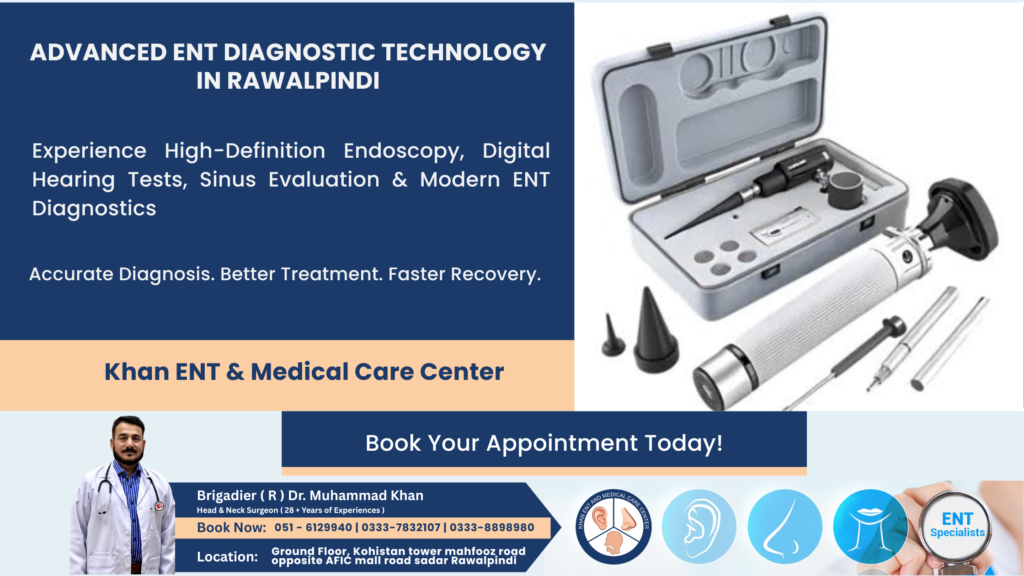
ENT Diagnostic Technology has revolutionized the way ear, nose, and throat conditions are diagnosed and treated. Modern technology allows ENT specialists to detect diseases earlier, diagnose conditions more accurately, and provide personalized treatment plans for better patient outcomes. From high-definition endoscopy and digital audiology systems to advanced imaging and AI-powered diagnostic tools, technology has become an essential part of modern ENT care.
At Khan ENT & Medical Care Center, we utilize the latest technology to ensure precise diagnosis and effective treatment for patients suffering from hearing loss, sinus disorders, throat infections, sleep apnea, dizziness, allergies, and other ENT conditions.
What is ENT Diagnostic Technology?
ENT Diagnostic Technology refers to advanced medical equipment, digital tools, imaging systems, and diagnostic techniques used by ENT specialists to evaluate diseases affecting the ear, nose, throat, head, and neck.
These technologies help specialists:
- Detect diseases at an early stage
- Identify the exact cause of symptoms
- Improve treatment planning
- Reduce diagnostic errors
- Monitor disease progression
- Enhance patient safety
Modern technology enables ENT specialists to see structures that were previously difficult to examine, leading to faster and more accurate diagnoses.
Importance of ENT Diagnostic Technology
The effectiveness of ENT treatment depends largely on accurate diagnosis. Many ENT conditions have similar symptoms, making diagnosis challenging without advanced equipment.
Benefits of ENT Diagnostic Technology include:
- Earlier disease detection
- More accurate diagnosis
- Better treatment outcomes
- Reduced need for exploratory surgery
- Faster recovery
- Improved patient comfort
- Personalized treatment plans
Common Conditions Diagnosed Using ENT Diagnostic Technology
Modern technology is used to diagnose:
Ear Conditions
- Hearing loss
- Ear infections
- Tinnitus
- Vertigo
- Balance disorders
- Eardrum perforations
- Cholesteatoma
Nose Conditions
- Chronic sinusitis
- Nasal polyps
- Deviated nasal septum
- Allergic rhinitis
- Nasal obstruction
- Chronic nasal congestion
Throat Conditions
- Tonsillitis
- Sore throat
- Vocal cord disorders
- Hoarseness
- Swallowing disorders
- Throat infections
Head and Neck Conditions
- Thyroid disorders
- Salivary gland diseases
- Neck masses
- Head and neck cancers
Advanced Endoscopic Technology in ENT Diagnosis
One of the biggest breakthroughs is high-definition endoscopy.
Nasal Endoscopy
Nasal endoscopy uses a thin camera-equipped scope to examine:
- Nasal passages
- Sinus openings
- Nasopharynx
This procedure helps diagnose:
- Sinus infections
- Nasal polyps
- Deviated septum
- Chronic nasal blockage
Benefits
- Real-time visualization
- Quick procedure
- Minimal discomfort
- Accurate diagnosis
Laryngoscopy
Laryngoscopy allows ENT specialists to examine:
- Voice box (larynx)
- Vocal cords
- Throat structures
This advanced technology helps diagnose:
- Hoarseness
- Vocal cord nodules
- Laryngeal cancer
- Swallowing disorders
High-definition video laryngoscopy provides exceptional detail for early disease detection.
Advanced Hearing Assessment Technology
Modern audiology equipment is a major part of ENT Diagnostic Technology.
Pure Tone Audiometry
This test measures hearing ability across different frequencies.
Used for diagnosing:
Tympanometry
Tympanometry evaluates middle ear function.
It helps detect:
- Ear infections
- Fluid behind the eardrum
- Eustachian tube dysfunction
Otoacoustic Emission (OAE) Testing
OAE testing measures inner ear function.
It is commonly used for:
- Newborn hearing screening
- Early hearing loss detection
Auditory Brainstem Response (ABR)
ABR testing evaluates nerve pathways between the ear and brain.
Useful for:
- Infants
- Neurological hearing disorders
- Hidden hearing loss
These technologies make hearing diagnosis more accurate than ever before.
Advanced Imaging Technology in ENT
Imaging is one of the most powerful forms of ENT Diagnostic Technology.
CT Scan
CT imaging provides detailed views of:
- Sinuses
- Nasal cavity
- Temporal bone
- Skull base
CT scans help diagnose:
- Chronic sinusitis
- Tumors
- Bone abnormalities
MRI Scan
MRI provides exceptional soft tissue visualization.
Used for diagnosing:
- Acoustic neuroma
- Head and neck tumors
- Inner ear disorders
- Nerve-related conditions
Ultrasound Technology
Ultrasound is widely used for:
- Thyroid evaluation
- Neck masses
- Salivary gland disorders
Benefits include:
- Radiation-free imaging
- Quick diagnosis
- Real-time assessment
Vestibular Diagnostic Technology for Dizziness and Balance Disorders
Patients with vertigo and balance issues benefit from advanced vestibular testing.
Common Vestibular Technologies
- Videonystagmography (VNG)
- Electronystagmography (ENG)
- Caloric testing
- Balance assessments
These tests help identify:
- Inner ear disorders
- Vestibular neuritis
- Ménière’s disease
- Balance dysfunction
Sleep Apnea Diagnostic Technology
Sleep disorders often have ENT causes.
Modern ENT Diagnostic Technology helps diagnose:
- Obstructive sleep apnea
- Snoring disorders
- Airway obstruction
Diagnostic tools include:
- Sleep studies
- Nasal airway evaluation
- Endoscopic airway assessment
Accurate diagnosis leads to effective treatment and better sleep quality.
Benefits of Modern ENT Diagnostic Technology
Advanced ENT Diagnostic Technology offers several benefits:
Accurate Diagnosis
Modern equipment improves diagnostic precision.
Early Disease Detection
Conditions can be identified before symptoms worsen.
Better Treatment Planning
Specialists can create personalized treatment plans.
Minimally Invasive Evaluation
Many diagnostic procedures require no surgery.
Improved Patient Experience
Less discomfort and faster results.
Enhanced Safety
Reduces unnecessary procedures and treatments.
Future of ENT Diagnostic Technology
The future of ENT Diagnostic Technology is exciting.
Emerging innovations include:
- AI-assisted diagnosis
- Robotic diagnostics
- Augmented reality surgical planning
- Digital pathology
- Remote monitoring systems
- Tele-ENT consultations
These advancements will continue improving patient care and diagnostic accuracy.
Why Choose Advanced ENT Diagnostic Technology in Rawalpindi?
Patients seeking ENT care in Rawalpindi should choose clinics that offer:
- High-definition endoscopy
- Digital audiology systems
- Advanced imaging facilities
- Modern diagnostic equipment
- Experienced ENT specialists
At Khan ENT & Medical Care Center, we use modern technology to provide comprehensive evaluation and evidence-based treatment for all ENT conditions.
ENT Diagnostic Technology has transformed ENT healthcare by making diagnosis faster, safer, and more accurate. From digital endoscopy and advanced hearing tests to AI-powered imaging and vestibular assessments, these innovations help ENT specialists provide superior patient care.
Patients suffering from hearing loss, sinus problems, throat disorders, allergies, dizziness, or sleep apnea can greatly benefit from modern technology. Early diagnosis leads to better treatment outcomes, faster recovery, and improved quality of life.
If you are experiencing any ear, nose, or throat symptoms, schedule an evaluation with an experienced ENT specialist who uses advanced technology for accurate diagnosis and personalized treatment.
Frequently Asked Questions (FAQs)
What is ENT Diagnostic Technology?
ENT Diagnostic Technology refers to modern tools and equipment used to diagnose ear, nose, throat, head, and neck conditions accurately.
Is nasal endoscopy painful?
No. Nasal endoscopy is generally well tolerated and causes minimal discomfort.
How does technology help patients?
It enables accurate diagnosis, early detection, and personalized treatment planning.
What tests are used to diagnose hearing loss?
Audiometry, tympanometry, OAE testing, and ABR testing are commonly used.
Can ENT Diagnostic Technology detect cancer?
Yes. Advanced imaging, endoscopy, and biopsy guidance help detect ENT cancers early.
What imaging tests are used in ENT diagnosis?
CT scans, MRI scans, and ultrasound are commonly used.
How is dizziness diagnosed by an ENT specialist?
Vestibular tests such as VNG, ENG, and caloric testing help diagnose balance disorders.
Is AI used in ENT diagnosis?
Yes. Artificial intelligence assists with image analysis, disease detection, and treatment planning.
What is laryngoscopy used for?
Laryngoscopy evaluates the vocal cords and throat to diagnose hoarseness, voice disorders, and throat diseases.
Where can I get advanced ENT diagnostic services in Rawalpindi?
You can visit Khan ENT & Medical Care Center for advanced ENT Diagnostic Technology, comprehensive evaluations, and expert ENT care.