
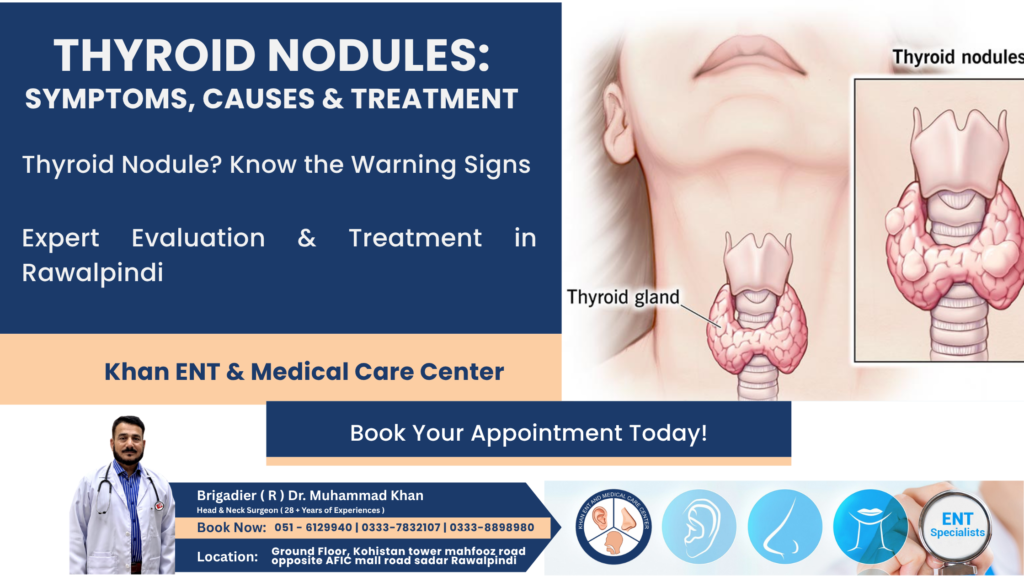
Thyroid Nodules: Symptoms, Causes & Treatment covers the evaluation and management of lumps that develop within the thyroid gland. Thyroid nodules are very common, and most are benign (noncancerous). However, a small percentage can be associated with thyroid cancer, so a newly discovered thyroid nodule should be properly evaluated by an experienced specialist.
The thyroid is a small, butterfly-shaped gland at the front of your neck. It produces hormones that help regulate metabolism, body temperature, heart rate, energy use and other important body functions. A thyroid nodule may be solid, fluid-filled or a combination of both. Some people have one nodule, while others develop multiple nodules.
For residents of Rawalpindi and Islamabad, evaluation by an experienced ENT and Head & Neck Surgeon can help determine whether a thyroid nodule requires observation, further testing or surgery. Prof. Brig. (R) Dr. Muhammad Khan, Senior ENT & Head & Neck Surgeon at Khan ENT & Medical Care Center, Rawalpindi, provides specialist assessment and surgical management of thyroid and neck conditions.
What Are Thyroid Nodules?
Thyroid nodules are abnormal areas of tissue that form within the thyroid gland. They may develop as a single nodule or as multiple nodules, sometimes resulting in a multinodular goiter.
Most thyroid nodules do not cause symptoms and are discovered during a routine neck examination or incidentally during an ultrasound, CT scan or other imaging test.
Although most thyroid nodules are benign, doctors evaluate them carefully because some nodules can be malignant. The purpose of thyroid nodule assessment is to determine the risk of cancer and whether treatment is necessary.
Thyroid Nodules Symptoms
Many thyroid nodules produce no symptoms. A small nodule may be impossible to see or feel. Larger nodules, however, can cause noticeable changes in the neck.
Common thyroid nodules symptoms include:
- A lump or swelling at the front of the neck.
- A visible enlargement of the thyroid.
- A feeling of pressure or fullness in the neck.
- Difficulty swallowing.
- Difficulty breathing, particularly when lying down.
- Hoarseness or a change in the voice.
- Neck discomfort or, less commonly, pain.
Some thyroid nodules produce excessive thyroid hormone. These are called hyperfunctioning thyroid nodules and may cause symptoms of hyperthyroidism, including rapid heartbeat, tremors, sweating, nervousness, increased appetite, unexplained weight loss and difficulty sleeping.
It is important to remember that thyroid nodules symptoms do not always indicate cancer. However, a persistent or enlarging neck lump should be assessed by a qualified healthcare professional.
What Causes Thyroid Nodules?
The exact reason why many thyroid nodules develop is not always known. Several conditions and risk factors can contribute to their formation.
Common causes include:
Benign overgrowth of thyroid tissue:
An overgrowth of normal thyroid cells can form a benign thyroid adenoma or colloid nodule.
Thyroid cysts:
Some nodules contain fluid and are called thyroid cysts. They are usually benign, although solid components may require further evaluation.
Multinodular goiter:
A thyroid gland containing multiple nodules may become enlarged. This is known as a multinodular goiter.
Thyroid inflammation:
Inflammatory thyroid conditions can sometimes produce nodular changes.
Iodine deficiency:
Inadequate iodine intake can contribute to thyroid enlargement and nodule formation in susceptible populations.
Thyroid cancer:
A small proportion of thyroid nodules are cancerous. Risk assessment is therefore an important part of Thyroid Nodules: Symptoms, Causes & Treatment.
Who Is at Higher Risk of Thyroid Nodules?
Thyroid nodules can occur in people of any age, but certain factors increase the likelihood of developing them.
Risk factors may include:
- Increasing age.
- Female sex.
- A personal or family history of thyroid disease.
- Family history of thyroid cancer.
- Previous radiation exposure to the head or neck.
- Iodine deficiency.
- Certain inherited conditions.
A history of radiation exposure and a strong family history of thyroid cancer are particularly important when assessing the risk of a suspicious thyroid nodule.
How Are Thyroid Nodules Diagnosed?
The first step in Thyroid Nodules: Symptoms, Causes & Treatment is an appropriate evaluation. Your doctor may examine your neck and thyroid gland and ask about symptoms, medical history and family history.
Thyroid Function Blood Tests
Blood tests commonly measure thyroid-stimulating hormone (TSH) and other thyroid hormone levels. Thyroid hormone levels can be normal even when a thyroid nodule is present.
Thyroid Ultrasound
Ultrasound is one of the most important tests for evaluating thyroid nodules. It can show the size, location and appearance of a nodule and help determine whether it is solid, cystic or mixed.
Ultrasound can also identify features that may increase or decrease concern for malignancy and can guide a fine-needle aspiration biopsy when appropriate.
Fine-Needle Aspiration Biopsy
A fine-needle aspiration (FNA) biopsy uses a thin needle to collect cells from a thyroid nodule. The sample is examined by a pathologist to determine whether the nodule appears benign, suspicious or malignant.
Not every thyroid nodule requires a biopsy. The decision depends on factors such as nodule size, ultrasound appearance and overall risk.
Thyroid Scan
In selected patients, a thyroid uptake or radionuclide scan may be recommended, particularly when blood tests indicate that the thyroid is producing excessive hormones.
Thyroid Nodules Treatment
Thyroid nodules treatment depends on the nodule’s size, ultrasound characteristics, biopsy results, thyroid function, symptoms and overall risk.
Observation and Regular Monitoring
Many benign thyroid nodules do not require immediate treatment. Instead, your doctor may recommend periodic examinations and ultrasound monitoring.
This approach is often appropriate when a nodule is small, benign-appearing and not causing symptoms.
Treatment for Overactive Nodules
A thyroid nodule that produces excessive thyroid hormone may require treatment for hyperthyroidism. Depending on the individual situation, treatment can include medication, radioactive iodine or surgery.
Thyroid Surgery
Surgery may be recommended when a nodule is:
- Confirmed or strongly suspected to be cancerous.
- Large and causing swallowing or breathing problems.
- Producing significant pressure or discomfort.
- Increasing in size or showing concerning changes.
- Indeterminate on testing and requiring surgical diagnosis.
- Associated with a large multinodular goiter.
Depending on the condition, surgery may involve removal of part of the thyroid (thyroid lobectomy/hemithyroidectomy) or removal of most or all of the thyroid (thyroidectomy).
The appropriate operation depends on the diagnosis and individual patient factors.
When Should You Worry About a Thyroid Nodule?
Most thyroid nodules are not cancerous. Nevertheless, certain findings should prompt timely medical evaluation.
See a doctor if you notice:
- A new lump in the neck.
- A thyroid lump that is growing.
- Persistent hoarseness or voice changes.
- Difficulty swallowing.
- Difficulty breathing.
- Neck swelling or pressure.
- A hard or fixed neck lump.
- A thyroid nodule combined with a personal or family history of thyroid cancer.
- Previous radiation exposure involving the neck.
Difficulty breathing or rapidly increasing neck swelling requires urgent medical assessment.
Why Choose Prof. Brig. (R) Dr. Muhammad Khan in Rawalpindi?
Residents of Rawalpindi and Islamabad seeking evaluation of thyroid nodules can benefit from consultation with an experienced ENT and Head & Neck Surgeon.
Prof. Brig. (R) Dr. Muhammad Khan is a Senior ENT & Head & Neck Surgeon with extensive experience in the assessment and surgical management of thyroid and head & neck conditions. At Khan ENT & Medical Care Center, Rawalpindi, patients can receive specialist evaluation for thyroid nodules, neck masses and conditions that may require surgical treatment.
Patients may prefer an experienced specialist because thyroid and neck surgery requires careful assessment of the anatomy, thyroid function, imaging findings and potential risks before an operation is recommended.
Frequently Asked Questions About Thyroid Nodules
Are thyroid nodules dangerous?
Most thyroid nodules are benign and do not cause serious problems. However, a small proportion may be cancerous, which is why appropriate evaluation is important.
What are the most common thyroid nodules symptoms?
Most thyroid nodules cause no symptoms. Larger nodules may cause a visible neck lump, swallowing difficulty, breathing problems, neck pressure or voice changes.
Can thyroid nodules become cancerous?
Some thyroid nodules are cancerous, but most are benign. Ultrasound, clinical assessment and, when indicated, fine-needle aspiration help determine the likelihood of cancer.
How are thyroid nodules diagnosed?
Evaluation may include a neck examination, thyroid blood tests, ultrasound and, for selected nodules, ultrasound-guided fine-needle aspiration biopsy.
Does every thyroid nodule require a biopsy?
No. Biopsy is recommended based on factors such as the nodule’s size, ultrasound appearance and individual cancer risk.
Can thyroid nodules disappear on their own?
Some cystic nodules can decrease in size, but others remain stable or grow. Follow-up depends on the type and characteristics of the nodule.
When does a thyroid nodule require surgery?
Surgery may be recommended for cancerous or suspicious nodules, large nodules causing swallowing or breathing problems, or selected nodules that cannot be adequately diagnosed without surgical removal.
Can thyroid nodules cause difficulty swallowing?
Yes. A large thyroid nodule or multinodular goiter can put pressure on the esophagus and cause difficulty swallowing.
Can thyroid nodules cause hoarseness?
They can. A large thyroid nodule or thyroid mass may affect structures involved in voice production. Persistent hoarseness should be medically evaluated.
Who should I see for thyroid nodules in Rawalpindi or Islamabad?
An experienced ENT and Head & Neck Surgeon can evaluate thyroid nodules and determine whether observation, additional testing or surgery is appropriate. Prof. Brig. (R) Dr. Muhammad Khan provides specialist thyroid and head & neck surgical care at Khan ENT & Medical Care Center, Rawalpindi.