
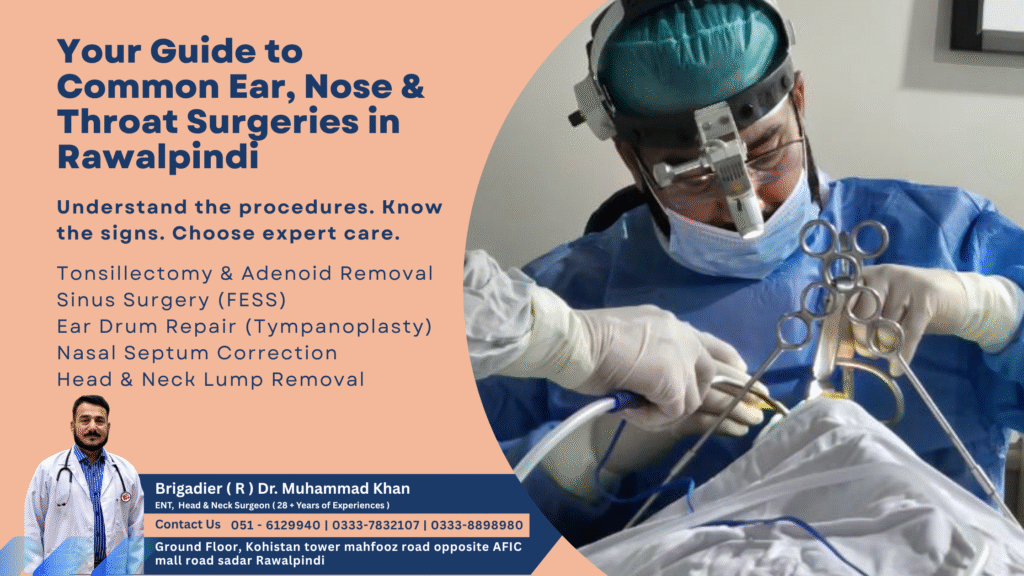
Your Guide to Common Ear, Nose & Throat Surgeries in Rawalpindi explains the most common ENT operations, when surgery is needed, and how expert treatment can improve your health.
ENT (Ear, Nose, and Throat) conditions range from mild discomfort to chronic diseases that significantly affect your quality of life. Although medications and non-invasive treatments successfully manage many ENT problems, some conditions eventually require surgery. Therefore, understanding the available surgical options helps patients make informed decisions and seek treatment at the right time.
Your Guide to Common Ear, Nose & Throat Surgeries in Rawalpindi helps patients understand when ENT surgery is needed, the available treatment options, and what to expect before and after surgery.
Common ENT Surgeries in Rawalpindi
ENT specialists recommend surgery when medications, nasal sprays, or other conservative treatments fail to relieve symptoms. In addition, surgeons perform ENT procedures to correct structural abnormalities, remove blockages, restore hearing, and improve breathing. As a result, many patients experience faster recovery and a better quality of life. (like antibiotics, nasal sprays, or therapy) fail to provide relief. They may also be required for structural corrections, removing growths or blockages, or addressing hearing loss.
Modern ENT surgeons perform these procedures using advanced and minimally invasive techniques. Consequently, patients often experience less discomfort, shorter hospital stays, and faster recovery. and often using minimally invasive techniques, ensuring faster recovery and better outcomes. Khan ENT Clinic offers a full range of diagnostic tools and surgical procedures to manage ENT conditions effectively.
Tonsillectomy & Adenoidectomy
What It Is
Tonsillectomy is the removal of the tonsils, while adenoidectomy involves the removal of the adenoid glands located behind the nasal cavity
When It’s Needed
- Recurrent tonsillitis or strep throat
- Breathing problems or sleep apnea
- Chronic ear infections due to enlarged adenoids
Procedure & Recovery
During surgery, the ENT surgeon performs both procedures under general anesthesia. Afterward, most patients return home the same day and recover within one to two weeks. and recover within 1–2 weeks
Functional Endoscopic Sinus Surgery (FESS)
What It Is
FESS is a minimally invasive technique used to clear blocked sinuses and restore normal drainage.
When It’s Needed
- Chronic sinusitis not responding to medication
- Nasal polyps
- Sinus headaches or facial pain
Procedure & Recovery
First, the surgeon inserts a thin endoscope into the nasal cavity. Then, the surgeon removes the blockage and restores normal sinus drainage. As a result, most patients resume normal activities within one week. to navigate and remove blockages. Recovery is generally smooth, with most patients resuming routine activities in 1 week.
Septoplasty (Nasal Septum Correction)
What It Is
Septoplasty is a surgical procedure to correct a deviated nasal septum that obstructs airflow.
When It’s Needed
- Difficulty breathing through the nose
- Frequent nosebleeds
- Snoring or sleep apnea
Procedure & Recovery
During septoplasty, the surgeon straightens the deviated septum through small internal incisions. Consequently, airflow improves, and most patients recover within one to two weeks., the septum is straightened through small incisions. Recovery usually takes 1–2 weeks
Tympanoplasty (Eardrum Repair)
What It Is
Tympanoplasty repairs a perforated eardrum and sometimes reconstructs the small bones in the middle ear.
When It’s Needed
- Persistent ear infections
- Hearing loss due to a ruptured eardrum
- Chronic ear drainage
Procedure & Recovery
The surgeon usually completes tympanoplasty within one to two hours. After surgery, hearing gradually improves, and most patients recover within two to four weeks. 1–2 hours. Patients can expect to recover within 2–4 weeks, with hearing gradually improving post-surgery.
Mastoidectomy
What It Is
A mastoidectomy involves removing infected mastoid air cells from the skull behind the ear.
When It’s Needed
- Chronic ear infections (mastoiditis)
- Cholesteatoma (abnormal skin growth in the ear)
Procedure & Recovery
The ENT surgeon performs mastoidectomy under general anesthesia. After surgery, patients receive antibiotics, attend follow-up visits, and gradually return to their normal routine. under general anesthesia and may require a few days of hospitalization. Recovery includes rest, antibiotics, and follow-up checks.
Myringotomy with Tube Insertion
What It Is
A small incision is made in the eardrum to drain fluid and insert a ventilation tube.
When It’s Needed
- Fluid buildup in the ear
- Frequent ear infections
- Hearing problems in children
Procedure & Recovery
ENT surgeons commonly perform this outpatient procedure for children. Furthermore, most children recover quickly, and the ventilation tubes usually fall out naturally after several months. in children and requires minimal recovery time. Tubes often fall out on their own after a few months.
Endoscopic Nasal Polyp Removal
What It Is
Polyps are soft, painless, non-cancerous growths in the nasal passages. They can obstruct airflow and cause sinus issues.
When It’s Needed
- Chronic nasal congestion
- Loss of smell or taste
- Recurring sinus infections
Procedure & Recovery
The surgeon removes nasal polyps using an endoscope. Afterwards, patients use saline rinses and nasal sprays to reduce inflammation and prevent recurrence. using an endoscope. Recovery is short and includes saline rinses and nasal sprays to prevent recurrence.
Vocal Cord Surgery (Phonomicrosurgery)
What It Is
This surgery corrects vocal cord nodules, polyps, or other abnormalities causing voice problems.
When It’s Needed
- Persistent hoarseness
- Voice fatigue
- Vocal cord lesions
Procedure & Recovery
The surgeon uses microscopic instruments to remove vocal cord lesions with great precision. Following surgery, patients should rest their voice to promote proper healing. under microscopy, this surgery allows vocal restoration. Voice rest is crucial during the recovery phase.
Head and Neck Lump Removal
What It Is
Surgical excision of cysts, benign tumors, or suspicious lumps in the neck or head region.
When It’s Needed
- Lumps that persist or grow
- Swelling in lymph nodes
- Suspected malignancies
Procedure & Recovery
First, the ENT specialist evaluates the lump with ultrasound, FNAC, and blood tests. Then, the surgeon removes the lump under local or general anesthesia. Finally, the laboratory examines the tissue when necessary.
Common ENT Surgeries in Rawalpindi
Before undergoing ENT surgery, it’s important to undergo a proper diagnostic evaluation. At Khan ENT Clinic & Life Care Lab, we offer
- Blood Tests (CBC, LFT, RFT, Coagulation Profile)
- Thyroid & Diabetes Screening
- ECG & Chest X-Ray
- Audiology Tests (PTA, Tympanometry)
- Nasal Endoscopy & Laryngoscopy
Because we provide comprehensive in-house diagnostics, we can assess surgical risks accurately, plan treatment effectively, and improve patient safety.
Recovery After ENT Surgeries in Rawalpindi
After surgery, every patient receives personalized recovery instructions. Additionally, patients should complete all prescribed medications, maintain good hygiene, avoid heavy lifting, attend follow-up appointments, and follow dietary or voice-rest recommendations whenever necessary.
- Follow medication and antibiotic courses as prescribed
- Maintain hygiene and avoid dusty environments
- Attend all follow-up appointments
- Avoid heavy lifting or strenuous activity
- Voice or dietary rest (if required)
At our clinic, we offer continued monitoring, wound care, and rehabilitation (including audiology support when needed)
Why Choose Prof. Brig. (R) Dr. Muhammad Khan Clinic
- 30+ Years of Surgical ENT Experience
- Certified ENT Surgeon – Prof. Brig. (R) Dr. Muhammad Khan
- Advanced Diagnostic & Audiology Facilities On-Site
- Affordable Surgical Packages & Lab Testing
- Trusted by Thousands of Satisfied Patients
Overall, understanding common ENT surgeries helps you recognize when surgical treatment may become necessary. Most importantly, early consultation with an experienced ENT surgeon leads to accurate diagnosis, timely treatment, and better long-term outcomes.
Book a Consultation Today
After reading Your Guide to Common Ear, Nose & Throat Surgeries in Rawalpindi, if you or your loved one is experiencing persistent ear, nose, or throat symptoms, don’t delay seeking expert ENT care. Schedule a consultation with Prof. Brig. (R) Dr. Muhammad Khan for a comprehensive evaluation and personalized treatment plan.
Your Guide to Common Ear, Nose & Throat Surgeries in Rawalpindi is designed to help patients understand the most frequently performed ENT procedures and make informed decisions about their treatment.
- Call or WhatsApp: 0333-7832107
- Location: Opposite AFIC, Saddar, Rawalpindi