
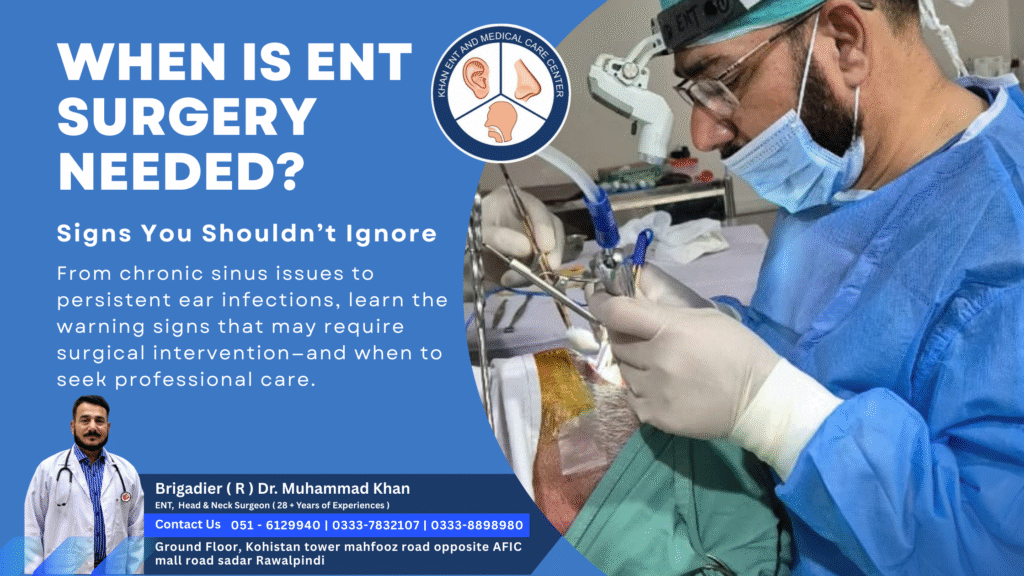
Understanding ENT Problems
ENT problems issues related to the ear, nose, and throat are among the most common health concerns people face. From mild ear infections to chronic sinus congestion and voice disorders, these conditions can significantly impact quality of life.
While medications and therapies often solve minor issues, some cases require surgical intervention. If left untreated, these conditions may worsen and lead to permanent damage or life-threatening complications.
In this article, we’ll cover:
- When ENT surgery becomes necessary
- The top signs you should never ignore
- How to prepare for ENT surgery
- The role of ENT Surgeon in Rawalpindi
- Recovery, risks, and benefits of surgery
What Is ENT Surgery?
ENT surgery refers to surgical procedures involving the Ear (E), Nose (N), and Throat (T). The medical specialty is known as Otolaryngology, and the surgeon is called an ENT Specialist or Otolaryngologist.
These surgeries are typically required when:
- Infections do not respond to medical treatment
- There is structural damage (like a deviated septum or perforated eardrum)
- Persistent symptoms interfere with daily life
- A mass, cyst, or tumor is detected
- Breathing, hearing, or swallowing is affected
When Is ENT Surgery Needed?
Here are the top conditions that commonly lead to ENT surgical intervention:
Chronic Ear Infections (Otitis Media)
If a child or adult suffers from recurring ear infections, surgery might be necessary. Accumulated fluid in the ear, hearing loss, or eardrum perforation may require tympanoplasty or grommet (tube) insertion.
Signs to watch:
- Persistent pain or drainage
- Hearing difficulty
- Balance issues or vertigo
Deviated Nasal Septum or Chronic Nasal Blockage
Difficulty breathing through the nose often results from a deviated nasal septum. This condition may also lead to sleep apnea or snoring.
Surgical Option:
- Septoplasty to straighten the nasal bone and improve airflow
Chronic Sinusitis
If nasal inflammation continues for 12 weeks or longer, despite medication, it’s likely chronic sinusitis.
Surgical Option:
- Endoscopic Sinus Surgery (FESS) to remove blockages
Voice Disorders or Vocal Cord Issues
Voice changes lasting more than two weeks should never be ignored. This may indicate nodules, polyps, or even early signs of cancer.
Surgical Option:
- Microlaryngeal surgery or voice recovery injections
Tonsillitis and Adenoid Issues
Recurrent throat infections or difficulty breathing in children may signal enlarged tonsils or adenoids.
Surgical Option:
Neck Lumps, Thyroid Nodules, or Swelling
A painless swelling in the neck could be a thyroid nodule, cyst, or lymph node enlargement, sometimes indicating cancer.
Surgical Option:
- FNAC (biopsy) followed by thyroid surgery or neck dissection
Warning Signs You Should Never Ignore
If you experience any of the following, consult an ENT surgeon immediately:
- Continuous ear pain or drainage
- Hearing loss not improving with treatment
- Nosebleeds without trauma
- Snoring with daytime fatigue
- Sore throat lasting more than 2 weeks
- Voice hoarseness or change
- Lump in the neck, throat, or jaw area
- Difficulty breathing or swallowing
How ENT Surgeons Diagnose Your Condition
Before recommending surgery, your ENT doctor will perform a complete examination, including:
- Clinical History & Physical Exam
- Nasal Endoscopy / Laryngoscopy
- Audiometry & Tympanometry
- BERA/ASSR for children’s hearing
- CT Scans / MRI (as needed)
- FNAC (for neck masses)
Meet Your ENT Surgeon in Rawalpindi — Prof. Brig. (R) Dr. Muhammad Khan
With more than 30+ years of ENT surgical experience, Dr. Muhammad Khan is one of the most trusted names in ENT care across Rawalpindi and Islamabad.
- Certified Otolaryngologist
- Head & Neck Surgeon
- ENT clinic near CMH Rawalpindi & Mega Medical Complex
- Expertise in voice, hearing, nasal & thyroid surgeries
- Safe and ethical ENT procedures for adults and children
ENT Surgeries Offered at Our Clinic
| Area | Surgery / Procedure |
| Ear | Tympanoplasty, Mastoidectomy, Grommet Insertion |
| Nose | Septoplasty, FESS, Turbinoplasty, Nasal Polyp Removal |
| Throat | Tonsillectomy, Microlaryngeal Surgery, Voice Injections |
| Neck | Thyroidectomy, FNAC, Neck Mass Removal, Salivary Gland Surgery |
All procedures follow global ENT standards with post-operative care and long-term follow-up.
Benefits of ENT Surgery
- Permanent relief from recurring infections
- Better breathing and voice clarity
- Improved hearing
- Less reliance on antibiotics
- Early cancer detection and removal
- Restored quality of life
ENT Surgery: What to Expect
Consultation & Diagnostic Testing
A detailed exam to confirm the need for surgery.
Pre-operative Evaluation
Blood tests, imaging, and anesthesia prep.
The Surgery Itself
Performed under local or general anesthesia depending on complexity.
Post-operative Care
Pain control, antibiotics, dietary care, and follow-ups.
Recovery Time and Aftercare
Recovery depends on the surgery but typically includes:
- 3–7 days rest for minor procedures
- Soft diet post-throat surgery
- Avoiding water in ears after eardrum repair
- No shouting or loud talking post-vocal surgery
- Regular follow-up for healing assessment
Serving All Nearby Areas in Rawalpindi & Islamabad
Our ENT surgery clinic is easily accessible from:
- CMH Rawalpindi
- Mega Medical Complex
- Bahria Town Phases 4, 6 & 7
- DHA Phase 1 & 2
- Westridge, Chaklala, Peshawar Road
- Islamabad Sectors F-10, F-11, G-13
Don’t Ignore the Signs
Not all ENT problems require surgery, but when they do, timing matters. Delaying treatment can lead to worsening symptoms, irreversible damage, or more complex operations later.
If you’re searching for the best ENT surgeon in Rawalpindi to evaluate or perform ENT surgery, Prof. Dr. Muhammad Khan provides expert care with compassion and surgical precision.