
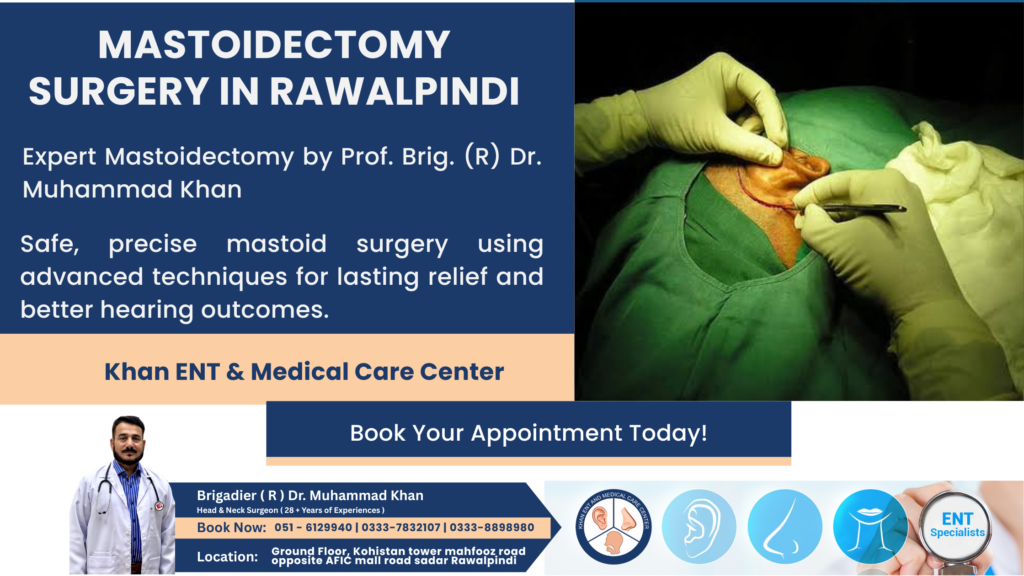
The human ear is a remarkable organ responsible for hearing, balance, and communication. However, when chronic infections or serious ear diseases occur, they can affect not just the eardrum or middle ear but extend into the mastoid bone the honeycomb-like bone located behind the ear. This is where a procedure called mastoidectomy becomes essential to protect hearing and prevent life-threatening complications.
At Khan ENT & Medical Care Center, we offer advanced diagnostic and surgical solutions for complex ear conditions, led by the Best ENT Surgeon in Rawalpindi – Expert in Ear, Nose & Throat Surgeries. Our goal is to restore your ear health through world-class care, minimally invasive techniques, and personalized follow-ups.
What is a Mastoidectomy?
A mastoidectomy is a surgical procedure performed to remove infected or damaged air cells within the mastoid bone. These cells can become infected when chronic ear diseases especially middle ear infections spread deeper into the skull.
The surgery helps:
- Eliminate infection and inflammation
- Improve drainage from the middle ear
- Prevent serious complications such as brain infection or bone erosion
- Protect or restore hearing
Mastoidectomy is a vital treatment when medications and non-surgical methods fail to control the condition.
Causes That Lead to a Mastoidectomy
While middle ear infections are common and usually treatable, they may become severe if left untreated. Below are the leading causes requiring mastoidectomy:
Chronic Suppurative Otitis Media (CSOM)
A long-term ear infection with continuous discharge may damage the mastoid bone and hearing structures. When antibiotics alone cannot resolve the condition, surgery becomes necessary.
Cholesteatoma
A non-cancerous but destructive growth inside the ear that forms due to repeated infections. If ignored, cholesteatoma can erode:
- Middle ear bones
- Mastoid bone
- Facial nerve
- Inner ear structures
Mastoidectomy helps remove the cholesteatoma completely.
Mastoiditis
A severe and painful infection of the mastoid bone commonly seen in children but can affect adults too. It requires urgent treatment to avoid life-threatening complications.
Ear Infections Complicated by Sinus or Throat Diseases
Chronic ENT problems can contribute to recurrent ear infections. A targeted mastoidectomy helps break this infection cycle.
Tumors or Irregular Growths
Rare but serious tumors affecting the ear may require surgical removal of affected bone.
When to Seek Medical Attention
If you or your child experiences any of the following, consult an ENT specialist immediately:
- Persistent ear discharge for weeks or months
- Hearing loss or muffled hearing
- Constant ringing or buzzing in the ear (tinnitus)
- Dizziness, loss of balance, or vertigo
- Smelly discharge indicating deep infection
- Pain, swelling, or redness behind the ear
Timely diagnosis can prevent complications and the need for more extensive surgery.
Types of Mastoidectomy
The Best ENT Surgeon in Rawalpindi – Expert in Ear, Nose & Throat Surgeries at Khan ENT & Medical Care Center will recommend the right technique based on your condition:
Simple / Cortical Mastoidectomy
Removes infected mastoid air cells while preserving the middle ear structures.
Canal-Wall-Up Mastoidectomy
Maintains the ear canal wall while removing deeper disease—better for hearing preservation.
Canal-Wall-Down Mastoidectomy
Used in advanced disease; creates a larger cavity to prevent infection recurrence.
Radical Mastoidectomy
Reserved for severe cases—focuses on controlling disease rather than restoring hearing.
Modified Radical Mastoidectomy
Balances disease removal and hearing preservation where possible.
Each technique is customized with precision and care for best clinical outcomes.
How the Procedure Works – Step-by-Step
A mastoidectomy is performed under general anesthesia. At Khan ENT & Medical Care Center, patient safety and comfort remain our top priorities.
Here’s what you can expect:
Before Surgery
- Detailed examination by ENT specialist
- Hearing test (Audiometry)
- Imaging such as CT scan to evaluate mastoid disease
- Guidance on medication adjustments
During Surgery
- A small incision is made behind the ear
- Diseased mastoid air cells are removed using advanced microscopic instruments
If needed, the surgeon may:
- Repair the eardrum
- Remove cholesteatoma
- Improve hearing bones (ossiculoplasty)
- The incision is closed with minimal visible scarring
Duration: 1–3 hours depending on disease severity.
After Surgery
- Ear dressing applied to protect the surgical site
- Same-day or next-day discharge in most cases
- Detailed post-surgery home care instructions
State-of-the-art care ensures faster healing and long-term success.
Recovery After Mastoidectomy
Healing time varies but most patients recover within weeks.
Common After-Effects
- Mild ear pain or discomfort
- Temporary dizziness
- Slight hearing changes during healing
- Drainage for a few days
These typically resolve with proper follow-ups.
Recovery Tips
To ensure smooth healing:
- Keep the ear dry—no water exposure
- Take prescribed antibiotics and pain medications
- Avoid blowing your nose forcefully
- Sleep on the opposite side of the surgery
- Attend all follow-up appointments
- Inform your doctor if you experience fever, severe pain, or heavy discharge
The ENT specialist will monitor healing and hearing restoration through checkups.
Benefits of Mastoidectomy
- Removes the source of chronic infection permanently
Prevents dangerous complications such as:
- Facial nerve paralysis
- Inner ear damage
- Brain abscess or meningitis
- Improves ear hygiene and function
- Helps preserve or reconstruct hearing
It is a life-changing solution for those suffering from persistent ear diseases.
Why Choose Khan ENT & Medical Care Center?
We take pride in being recognized for excellence in ENT care. Our center offers:
- Advanced surgical technology for precision results
- Latest ear-saving techniques focused on hearing restoration
- Individualized treatment plans for adults and children
- Professional and caring environment
- Highly experienced ENT specialist and surgical team
Our surgeon is known as the Best ENT Surgeon in Rawalpindi – Expert in Ear, Nose & Throat Surgeries, with vast expertise in mastoid surgery, tympanoplasty, cochlear procedures, and endoscopic ear surgeries.
Frequently Asked Questions (FAQs)
Will a mastoidectomy improve my hearing?
Yes, in many cases hearing improves, especially when infection and cholesteatoma are removed early.
Is it a painful surgery?
Post-surgery discomfort is minimal and easily managed with prescribed medication.
How soon can children return to school?
Usually 1–2 weeks—depending on the healing process.
Can the infection come back?
Follow-up visits and preventive care reduce recurrence significantly.
Book Your Consultation Today
Chronic ear infections should never be ignored. Early treatment prevents complications, protects hearing, and ensures better quality of life.
If you or a loved one is suffering from persistent ear problems—
Visit Khan ENT & Medical Care Center for expert care and advanced mastoidectomy procedures.