
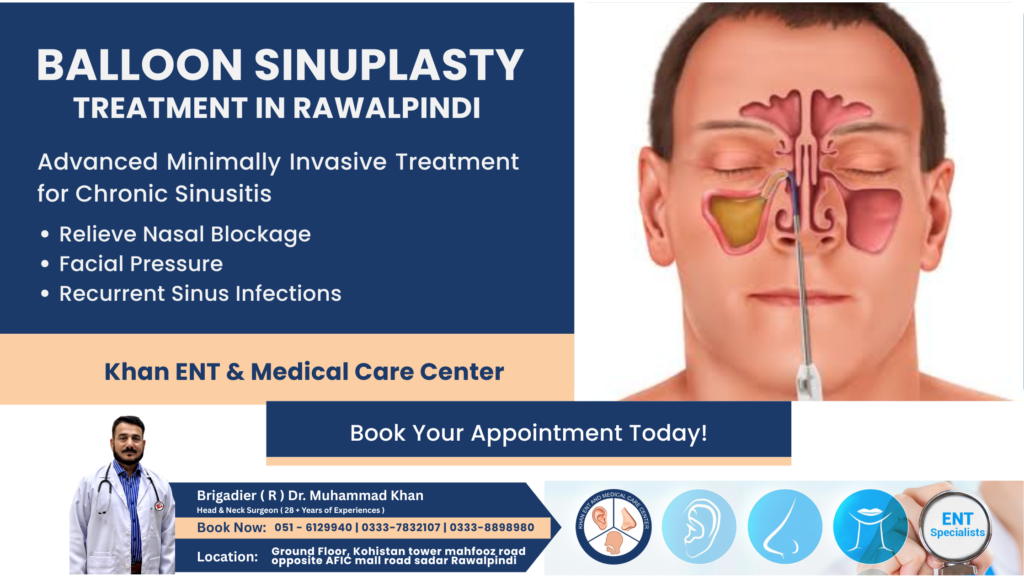
Balloon Sinuplasty is a safe, minimally invasive treatment for chronic sinusitis that helps open blocked sinus passages without making surgical cuts. If you have been struggling with persistent sinus infections, facial pressure, nasal blockage, headaches, or difficulty breathing despite medications, it may be the ideal solution. This advanced procedure restores normal sinus drainage, reduces inflammation, and allows patients to return to their daily routine much faster than traditional sinus surgery.
At Khan ENT & Medical Care Center, Prof. Brig. (R) Dr. Muhammad Khan, Senior ENT & Head & Neck Surgeon, provides comprehensive evaluation and advanced treatment for chronic sinus diseases using evidence-based techniques. Patients from Rawalpindi, Islamabad, and surrounding areas trust his expertise because of his extensive surgical experience, accurate diagnosis, ethical care, and patient-focused treatment plans.
What Is Balloon Sinuplasty?
It is an advanced ENT procedure designed to treat chronic sinusitis and recurrent sinus infections. Instead of removing tissue or bone, the surgeon inserts a small flexible balloon catheter into the blocked sinus opening. The balloon is then gently inflated, widening the natural drainage pathway while preserving healthy tissue.
Once the sinus opening is enlarged, mucus, trapped secretions, bacteria, and inflammatory material drain naturally. The balloon is then removed, leaving the sinus passage permanently widened in most patients.
Unlike conventional sinus surgery, Balloon Sinuplasty does not involve external incisions, stitches, or removal of large amounts of tissue, making it one of the least invasive treatments for chronic sinus disease.
What Conditions Can Balloon Sinuplasty Treat?
It is recommended for patients suffering from:
- Chronic sinusitis lasting more than 12 weeks
- Recurrent sinus infections
- Persistent nasal congestion
- Facial pain and pressure
- Chronic headaches caused by sinus blockage
- Difficulty breathing through the nose
- Postnasal drip
- Thick nasal discharge
- Reduced sense of smell
- Chronic sinus inflammation resistant to medication
Many patients have already tried antibiotics, nasal steroid sprays, allergy medications, saline rinses, or decongestants without lasting relief. Balloon Sinuplasty is often considered when these conservative treatments fail.
Symptoms That May Indicate You Need Balloon Sinuplasty
You may be a candidate of it, if you experience:
- Constant blocked nose
- Frequent sinus infections
- Facial pressure around the eyes and cheeks
- Persistent headaches
- Thick yellow or green nasal mucus
- Postnasal drip
- Bad breath caused by chronic sinus infection
- Difficulty sleeping because of nasal blockage
- Reduced smell and taste
- Symptoms lasting longer than three months
If these symptoms continue despite medical treatment, an ENT specialist should evaluate your sinuses.
How Does Balloon Sinuplasty Work?
Balloon Sinuplasty works by restoring the natural drainage system of the sinuses.
The procedure involves several simple steps:
- The ENT surgeon examines the nasal cavity using a nasal endoscope.
- A very thin guide catheter is inserted into the blocked sinus opening.
- A small balloon is advanced into the sinus passage.
- The balloon is gently inflated to widen the blocked opening.
- The balloon remains inflated for a few seconds.
- The balloon is deflated and removed.
- The enlarged opening allows mucus to drain normally.
Because the natural anatomy is preserved, healing is generally much faster than traditional surgery.
Who Is a Good Candidate for Balloon Sinuplasty?
The best candidates include patients who have:
- Chronic rhinosinusitis without large nasal polyps
- Recurrent acute sinus infections
- CT scan confirming blocked sinus openings
- Failed medical treatment
- Frequent antibiotic use
- Persistent facial pain
- Chronic nasal obstruction
- Sinus disease affecting the frontal, maxillary, or sphenoid sinuses
Children may also benefit from it in selected cases after specialist evaluation.
Who Is Not a Candidate for Balloon Sinuplasty?
It may not be suitable for patients with:
- Extensive nasal polyps
- Sinus tumors
- Fungal sinusitis
- Certain anatomical abnormalities
- Severe ethmoid sinus disease
- Skull base defects
- Advanced sinus complications
In these situations, Functional Endoscopic Sinus Surgery (FESS) may be a better treatment option.
Balloon Sinuplasty Procedure Step by Step
Before the procedure, your ENT specialist will review your medical history and perform:
- Complete ENT examination
- Nasal endoscopy
- CT scan of the paranasal sinuses
- Review of previous treatments
During Operate:
- Local anesthesia or general anesthesia may be used.
- An endoscope provides a clear view inside the nose.
- The balloon catheter is guided into the blocked sinus.
- The balloon is inflated to widen the opening.
- Saline irrigation may be performed.
- The balloon is removed.
- No stitches are required.
The procedure usually takes 20 to 60 minutes, depending on the number of sinuses being treated.
Benefits of Balloon Sinuplasty
Balloon Sinuplasty offers several important advantages over traditional sinus surgery.
Minimally Invasive
No external cuts or incisions are required.
Preserves Healthy Tissue
Unlike traditional surgery, Balloon Sinuplasty widens the natural sinus opening without removing significant tissue.
Less Pain
Patients generally experience much less discomfort.
Minimal Bleeding
Bleeding is usually very limited.
Faster Recovery
Most patients return to work within one to three days.
Improved Breathing
The enlarged sinus openings allow better airflow.
Better Sinus Drainage
Mucus drains naturally, reducing infections.
Long-Term Relief
Many patients enjoy years of symptom improvement after Balloon Sinuplasty.
Balloon Sinuplasty vs Traditional Sinus Surgery (FESS)
| Balloon Sinuplasty | Functional Endoscopic Sinus Surgery |
| Minimally invasive | More extensive procedure |
| Preserves tissue | Tissue removal may be necessary |
| Less bleeding | Slightly more bleeding |
| Faster recovery | Longer recovery |
| Minimal pain | Moderate discomfort |
| Office-based in selected patients | Usually operating room |
| Ideal for selected chronic sinusitis | Better for complex disease |
Both procedures are highly effective when performed for the correct indications.
Recovery After Balloon Sinuplasty
Recovery following Balloon Sinuplasty is generally straightforward.
Most patients can expect:
First 24 Hours
- Mild congestion
- Slight bloody drainage
- Mild facial pressure
First Week
- Improved nasal breathing
- Reduced facial pressure
- Continued saline irrigation
Two Weeks
- Most swelling resolves
- Normal activities resume
- Significant symptom improvement
One Month
- Full healing in most patients
- Improved quality of life
- Better sleep
- Easier breathing
Recovery Tips
For optimal healing:
- Avoid blowing your nose for 24–48 hours.
- Use saline nasal rinses regularly.
- Sleep with your head elevated.
- Drink plenty of fluids.
- Avoid heavy lifting for one week.
- Take medications exactly as prescribed.
- Attend scheduled follow-up appointments.
Risks of Balloon Sinuplasty
Although it is considered very safe, possible complications include:
- Mild bleeding
- Temporary swelling
- Infection
- Reaction to anesthesia
- Persistent congestion
- Rare injury to nearby structures
- Recurrence of sinus symptoms
Serious complications are uncommon when the procedure is performed by an experienced ENT surgeon.
Success Rate of Balloon Sinuplasty
Clinical studies have demonstrated excellent long-term outcomes.
Most patients report:
- Significant reduction in sinus infections
- Better breathing
- Improved sleep
- Less facial pain
- Reduced dependence on antibiotics
- Better quality of life
- Long-lasting symptom relief
Patient satisfaction remains consistently high years after treatment.
Why Choose Prof. Brig. (R) Dr. Muhammad Khan for Balloon Sinuplasty?
Choosing the right ENT surgeon is one of the most important decisions when considering Balloon Sinuplasty.
Residents of Rawalpindi and Islamabad choose Prof. Brig. (R) Dr. Muhammad Khan because he offers:
- More than 30 years of ENT surgical experience
- Senior ENT & Head and Neck Surgeon
- Former Professor of ENT
- Retired Military Consultant
- Comprehensive diagnosis before recommending surgery
- Personalized treatment plans
- Advanced endoscopic ENT procedures
- Evidence-based management
- Ethical patient care
- Modern surgical techniques
- Comprehensive follow-up care
At Khan ENT & Medical Care Center every patient undergoes a detailed assessment to determine whether Balloon Sinuplasty, Functional Endoscopic Sinus Surgery (FESS), or continued medical treatment is the most appropriate option. The goal is always to provide the safest, most effective, and least invasive treatment possible.
Patients throughout Rawalpindi, Islamabad, Wah Cantt, Taxila, Gujar Khan, Chakwal, Attock, Murree, and Azad Kashmir regularly seek consultation with Prof. Brig. (R) Dr. Muhammad Khan for chronic sinus disease because of his extensive expertise and commitment to quality ENT care.
When Should You See an ENT Specialist?
You should arrange an ENT consultation if you have:
- Sinus symptoms lasting over 12 weeks
- More than four sinus infections per year
- Persistent nasal blockage
- Facial pain
- Recurrent headaches
- Poor response to medications
- Difficulty breathing through your nose
- Frequent antibiotic use
- Loss of smell
- Abnormal CT scan findings
Early diagnosis often prevents complications and improves treatment outcomes.
Frequently Asked Questions (FAQs)
What is Balloon Sinuplasty?
Balloon Sinuplasty is a minimally invasive procedure that widens blocked sinus openings using a small inflatable balloon without removing significant tissue.
Is Balloon Sinuplasty painful?
No. Most patients experience only mild pressure during the procedure and minimal discomfort afterward.
How long does Balloon Sinuplasty take?
The procedure usually takes between 20 and 60 minutes, depending on the number of sinuses treated.
Is Balloon Sinuplasty permanent?
In many patients, the enlarged sinus openings remain open permanently, providing long-term symptom relief.
What is the recovery time after Balloon Sinuplasty?
Most patients return to normal activities within one to three days and recover fully within one to two weeks.
Is Balloon Sinuplasty better than traditional sinus surgery?
For appropriately selected patients with chronic sinusitis, Balloon Sinuplasty offers faster recovery, less pain, and minimal tissue disruption. More complex cases may require Functional Endoscopic Sinus Surgery (FESS).
Who is the ideal candidate for Balloon Sinuplasty?
Patients with chronic or recurrent sinusitis who have not improved with medications and have CT-confirmed sinus blockage are often good candidates.
Can Balloon Sinuplasty be performed under local anesthesia?
Yes. Many Balloon Sinuplasty procedures can be safely performed under local anesthesia in selected patients.
What are the risks of Balloon Sinuplasty?
Risks are uncommon but may include mild bleeding, infection, temporary swelling, anesthesia-related reactions, or recurrence of symptoms.
Where can I get Balloon Sinuplasty in Rawalpindi?
Patients seeking expert evaluation for Balloon Sinuplasty can consult Prof. Brig. (R) Dr. Muhammad Khan at Khan ENT & Medical Care Center, where comprehensive diagnosis and advanced ENT treatment are provided using modern evidence-based techniques.