
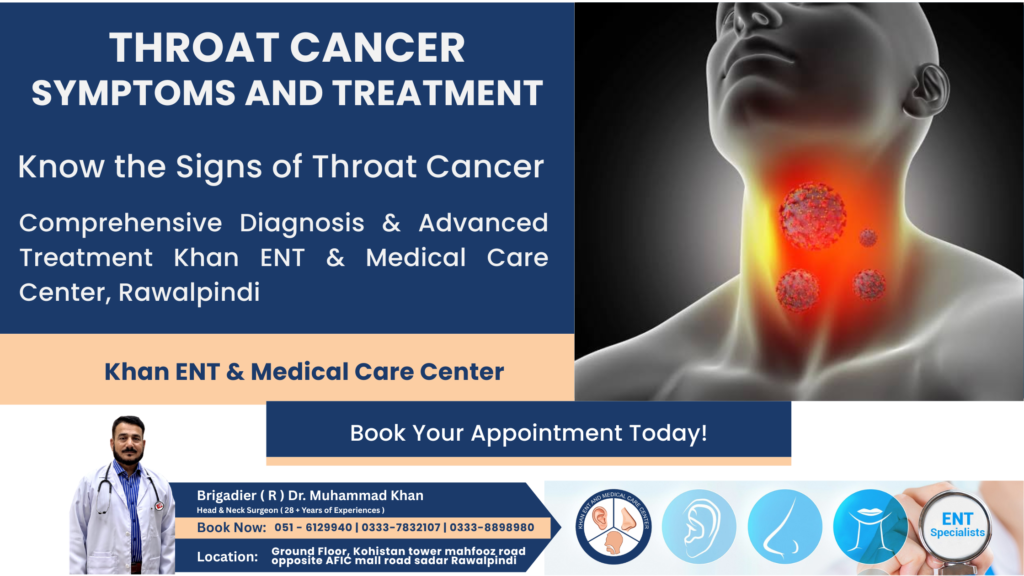
Throat Cancer Symptoms and Treatment is one of the most searched topics by people experiencing persistent sore throat, hoarseness, difficulty swallowing, or a neck lump. While many throat problems are caused by infections or allergies, symptoms that persist for more than two weeks should never be ignored. Early diagnosis significantly improves treatment outcomes and survival rates.
If you or a loved one has persistent throat symptoms, consulting an experienced ENT specialist is the first and most important step. At Khan ENT & Medical Care Center, Prof. Brig. (R) Dr. Muhammad Khan, Senior ENT & Head & Neck Surgeon, provides comprehensive evaluation, diagnosis, and surgical management of throat and voice box cancers for patients from Rawalpindi, Islamabad, DHA, Bahria Town, Cantt, and surrounding areas.
What is Throat Cancer?
Throat cancer is a type of head and neck cancer that develops in the throat (pharynx) or voice box (larynx). It occurs when cells grow abnormally and form a tumor that can invade nearby tissues or spread to other parts of the body.
The throat consists of several important structures involved in breathing, swallowing, and speaking. Depending on where the cancer begins, throat cancer is classified into different types.
Types of Throat Cancer
Oropharyngeal Cancer
Develops in the middle part of the throat behind the mouth. It commonly affects the tonsils and base of the tongue and is increasingly associated with Human Papillomavirus (HPV).
Nasopharyngeal Cancer
Starts behind the nose in the upper throat. This type is relatively uncommon but may be linked with Epstein-Barr Virus (EBV).
Hypopharyngeal Cancer
Occurs in the lower throat above the esophagus and windpipe. It is often diagnosed at a later stage because symptoms appear late.
Laryngeal Cancer
Develops in the voice box (larynx), which contains the vocal cords.
Laryngeal cancer includes:
- Glottic cancer (vocal cords)
- Supraglottic cancer (upper larynx)
- Subglottic cancer (below the vocal cords)
Throat Cancer Symptoms and Treatment
Recognizing Throat Cancer Symptoms and Treatment early can save lives. Many symptoms resemble common throat infections, but unlike infections, cancer symptoms usually do not improve with routine medications.
Common Symptoms of Throat Cancer
Watch for the following warning signs:
- Persistent sore throat lasting more than two weeks
- Hoarseness or voice changes
- Difficulty swallowing (Dysphagia)
- Pain while swallowing
- Lump in the neck
- Lump inside the throat
- Ear pain, especially on one side
- Persistent cough
- Coughing up blood
- Difficulty breathing
- Bad breath
- Unexplained weight loss
- Persistent mouth ulcers
- Enlarged tonsil on one side
- Feeling that something is stuck in the throat
If these symptoms persist, immediate ENT evaluation is strongly recommended.
Early Signs of Throat Cancer
Many patients ignore early symptoms because they resemble tonsillitis or laryngitis.
Early warning signs include:
- Mild hoarseness lasting several weeks
- Frequent throat irritation
- One-sided ear pain
- Neck swelling
- Difficulty swallowing solid food
- Persistent throat discomfort
- Voice fatigue
- Small painless neck lump
Early diagnosis greatly increases the chances of successful treatment.
What Causes Throat Cancer?
Throat cancer develops when genetic changes cause cells to grow uncontrollably.
Although the exact cause is not always known, several established risk factors significantly increase the likelihood of developing the disease.
Major Risk Factors
Tobacco Use
Smoking cigarettes, cigars, pipes, or chewing tobacco is the strongest risk factor for throat cancer.
Heavy Alcohol Consumption
Excessive alcohol intake increases the risk dramatically, especially when combined with smoking.
HPV Infection
Human Papillomavirus (HPV), particularly HPV-16, has become one of the leading causes of oropharyngeal cancer.
Epstein-Barr Virus (EBV)
Associated mainly with nasopharyngeal cancer.
Occupational Exposure
Long-term exposure to:
- Wood dust
- Formaldehyde
- Asbestos
- Industrial chemicals
may increase risk.
Poor Diet
A diet lacking fruits and vegetables reduces protective antioxidants.
Gastroesophageal Reflux Disease (GERD)
Long-standing acid reflux may contribute to chronic throat irritation.
Age and Gender
Most throat cancers occur after age 50 and are more common in men, though women can also develop the disease.
How is Throat Cancer Diagnosed?
Early diagnosis is the key to better survival.
An ENT specialist may perform:
Physical Examination
The neck, mouth, throat, and lymph nodes are carefully examined.
Flexible Laryngoscopy
A thin camera is passed through the nose to visualize the throat and vocal cords.
Endoscopy
Allows detailed examination of deeper throat structures under anesthesia when necessary.
Biopsy
A tissue sample is taken for microscopic confirmation. This is the only definitive way to diagnose throat cancer.
Imaging Studies
Depending on findings, your ENT surgeon may recommend:
These tests determine the size and spread of cancer.
Throat Cancer Staging
Doctors classify throat cancer into stages:
Stage I
Small localized tumor.
Stage II
Larger tumor without lymph node involvement.
Stage III
Cancer has spread to nearby lymph nodes.
Stage IV
Cancer has spread extensively to surrounding tissues or distant organs.
Earlier stages generally have much better treatment outcomes.
Throat Cancer Symptoms and Treatment Options
Treatment depends on:
- Cancer location
- Stage
- Patient’s age
- Overall health
- HPV status
Surgery
Surgery is often the preferred treatment for localized tumors.
Procedures may include:
- Laser surgery
- Partial laryngectomy
- Total laryngectomy
- Neck dissection
- Tumor excision
The goal is complete tumor removal while preserving speech and swallowing whenever possible.
Radiation Therapy
High-energy radiation destroys cancer cells.
It may be used:
- Alone
- Before surgery
- After surgery
- Along with chemotherapy
Chemotherapy
Anti-cancer medicines help destroy rapidly dividing cells.
Chemotherapy is commonly combined with radiation for advanced disease.
Targeted Therapy
Certain medicines specifically attack proteins that help cancer grow while causing fewer side effects than traditional chemotherapy.
Immunotherapy
Immunotherapy strengthens the body’s immune system to recognize and destroy cancer cells.
It is mainly used for recurrent or advanced throat cancer.
Can Throat Cancer Be Cured?
Yes.
Many patients are completely cured, especially when cancer is detected early.
HPV-related throat cancers generally respond better to treatment.
Success depends upon:
- Early diagnosis
- Cancer stage
- Overall health
- Prompt treatment
- Regular follow-up
How to Reduce Your Risk
You can lower your risk by:
- Stop smoking completely.
- Avoid chewing tobacco.
- Limit alcohol consumption.
- Receive the HPV vaccine when appropriate.
- Eat plenty of fruits and vegetables.
- Maintain good oral hygiene.
- Treat acid reflux promptly.
- Attend regular ENT checkups if you have persistent symptoms.
Why Choose Prof. Brig. (R) Dr. Muhammad Khan for Throat Cancer Evaluation?
Residents of Rawalpindi and Islamabad seeking expert care for Throat Cancer Symptoms and Treatment should consult Prof. Brig. (R) Dr. Muhammad Khan, Senior ENT & Head & Neck Surgeon.
Why patients trust him:
- Over 30 years of ENT and Head & Neck surgical experience
- Retired military consultant
- Former Professor of ENT
- Expertise in head and neck tumor diagnosis
- Advanced endoscopic throat examination
- Comprehensive cancer evaluation
- Voice box and throat surgery expertise
- Ethical, evidence-based treatment
- Personalized patient care
- Modern diagnostic facilities
Patients from Rawalpindi, Islamabad, Bahria Town, DHA, Westridge, Chaklala, and nearby cities regularly visit Khan ENT & Medical Care Center for specialized ENT and head & neck surgical consultation.
When Should You See an ENT Specialist?
Book an appointment immediately if you have:
- Hoarseness lasting more than two weeks
- Difficulty swallowing
- Persistent sore throat
- Neck lump
- One-sided ear pain
- Blood in saliva
- Persistent cough
- Unexplained weight loss
- Enlarged tonsil
- Difficulty breathing
Early evaluation can make a life-saving difference.
Frequently Asked Questions (FAQs)
What are the earliest symptoms of throat cancer?
Persistent hoarseness, sore throat, difficulty swallowing, one-sided ear pain, and a neck lump are among the earliest symptoms.
Is every sore throat a sign of throat cancer?
No. Most sore throats are caused by infections or allergies. However, symptoms lasting longer than two weeks should be evaluated by an ENT specialist.
Can throat cancer be cured?
Yes. Early-stage throat cancer has a high cure rate when diagnosed and treated promptly.
Who is at the highest risk of throat cancer?
People who smoke, use tobacco, consume excessive alcohol, have HPV infection, or are exposed to industrial chemicals are at higher risk.
How is throat cancer diagnosed?
Diagnosis involves physical examination, flexible laryngoscopy, endoscopy, biopsy, CT scan, MRI, PET scan, and other imaging studies.
What is the best treatment for throat cancer?
Treatment depends on the stage and may include surgery, radiation therapy, chemotherapy, targeted therapy, immunotherapy, or a combination of these.
Can HPV cause throat cancer?
Yes. HPV, especially HPV-16, is now one of the leading causes of oropharyngeal cancer.
Is hoarseness always caused by throat cancer?
No. Hoarseness is commonly caused by infections, vocal strain, or reflux. Persistent hoarseness lasting more than two weeks should be evaluated.
When should I consult an ENT specialist?
Seek medical attention if you have persistent throat symptoms, difficulty swallowing, a neck lump, voice changes, or unexplained weight loss for more than two weeks.
Why should patients in Rawalpindi and Islamabad choose Prof. Brig. (R) Dr. Muhammad Khan?
Prof. Brig. (R) Dr. Muhammad Khan offers over three decades of experience in ENT and Head & Neck Surgery, advanced diagnostic expertise, ethical patient care, and comprehensive management of throat and voice box diseases at Khan ENT & Medical Care Center, making him a trusted choice for patients across Rawalpindi and Islamabad.