
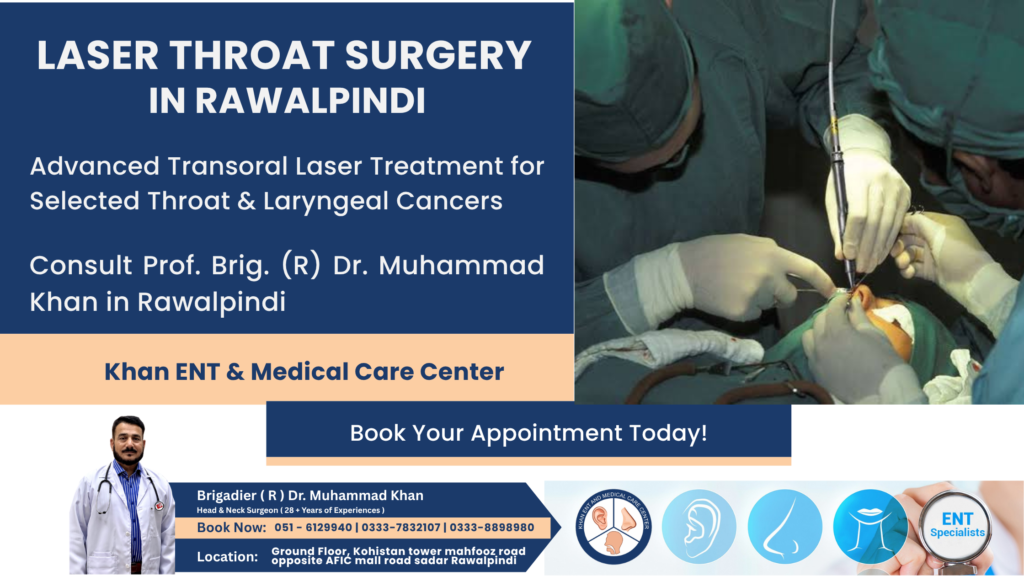
Laser Throat Surgery in Rawalpindi is an advanced minimally invasive surgical approach used to treat selected cancers and abnormal lesions of the throat and larynx through the mouth. Also known as transoral laser microsurgery or endoscopic laser surgery, this technique allows an ENT and head and neck surgeon to reach carefully selected tumors without making a traditional external incision in the neck.
For patients seeking Laser Throat Surgery in Rawalpindi, proper diagnosis, cancer staging, tumor location, and assessment of the larynx are essential before deciding whether laser surgery is appropriate. At Khan ENT & Medical Care Center, Rawalpindi, Prof. Brig. (R) Dr. Muhammad Khan provides specialist ENT and head and neck surgical evaluation for patients with suspected or confirmed laryngeal and throat conditions.
What Is Laser Throat Surgery?
Laser throat surgery is a transoral surgical technique in which a highly focused laser is used to remove abnormal or cancerous tissue through the mouth.
Instead of approaching the tumor through an incision in the neck, the surgeon uses specialized laryngoscopes, endoscopes, surgical instruments and magnification to visualize the affected area. The laser can then be used with precision to cut or remove selected abnormal tissue.
This approach is particularly important in laryngeal surgery because the surgeon may be able to remove the tumor while preserving as much healthy laryngeal tissue and function as possible.
Laser surgery is an established treatment option for appropriately selected early laryngeal cancers. Depending on the location and extent of disease, other treatments such as radiotherapy, chemotherapy, open surgery or combined treatment may be more appropriate.
Laser Throat Surgery in Rawalpindi for Laryngeal Cancer
The larynx, commonly called the voice box, is responsible for important functions including voice production, airway protection and breathing.
Laryngeal cancer can develop in different parts of the voice box, including the vocal cords and areas above or below them. Treatment depends on factors such as tumor location, size, depth, stage, lymph-node involvement and the patient’s overall health.
For carefully selected tumors, Laser Throat Surgery in Rawalpindi may provide a way to remove the cancer through the mouth while avoiding a traditional external surgical approach.
The goal is not simply to remove visible abnormal tissue. The surgeon must determine whether the entire tumor can be safely removed with appropriate oncological margins while maintaining useful laryngeal function.
How Does Transoral Laser Surgery Work?
Laser throat surgery is performed under general anesthesia.
The surgeon introduces a specialized laryngoscope through the mouth to obtain a clear view of the larynx. Magnification and endoscopic visualization allow detailed examination of the tumor.
A surgical laser can then be directed precisely at the affected tissue. Depending on the tumor, the surgeon may remove the lesion in carefully planned sections for pathological examination.
The surgical wound inside the larynx may then heal naturally. Because the procedure is performed through the mouth, there is generally no external neck incision for the primary tumor removal.
The exact surgical technique varies according to the location and characteristics of the tumor.
Who May Benefit From Laser Throat Surgery?
Laser surgery is not suitable for every patient with throat or laryngeal cancer.
It may be considered when:
- The tumor can be adequately reached through the mouth.
- The cancer can be removed safely using an endoscopic approach.
- The tumor’s location and extent allow preservation of important laryngeal structures.
- There is adequate exposure of the larynx.
- The patient can safely undergo general anesthesia.
- Imaging and examination do not show disease requiring a different surgical approach.
- The overall cancer treatment plan supports transoral surgery.
Early laryngeal cancers are among the conditions in which laser surgery may be considered. Selected more advanced tumors can sometimes also be managed using transoral techniques, but suitability requires detailed specialist assessment.
When Laser Throat Surgery May Not Be Suitable
An important part of Laser Throat Surgery in Rawalpindi is determining when laser surgery should not be performed.
The procedure may be unsuitable when the tumor is too extensive, cannot be adequately visualized, has significant spread outside the larynx, or cannot be removed while preserving sufficient functional laryngeal structures.
Limited mouth opening, restricted neck movement, difficult anatomy and inadequate access can also make transoral surgery challenging.
In such circumstances, the specialist may recommend another treatment, such as open surgery, radiotherapy, chemotherapy, chemoradiotherapy or a combination of treatments.
The correct treatment should therefore be based on the individual patient’s examination, pathology and imaging rather than on the desire to have laser surgery alone.
Advantages of Laser Throat Surgery
One of the major advantages of transoral laser surgery is that the surgeon approaches the tumor directly through the natural opening of the mouth.
Potential advantages can include:
No External Neck Incision
Because the primary tumor is approached through the mouth, there is generally no external neck incision for the transoral component of surgery.
This can avoid an external surgical scar.
Precise Tumor Removal
The focused laser and magnified surgical view can allow precise removal of selected abnormal tissue.
Potential Preservation of Laryngeal Function
For appropriately selected patients, transoral surgery can help preserve important structures involved in voice and swallowing.
Recovery May Be Faster
Recovery can be quicker than with some open laryngeal procedures because the operation does not require the same external tissue disruption. However, recovery varies according to the extent and location of surgery.
Reduced Surgical Trauma
Because the surgeon works from inside the throat toward the tumor, surrounding external tissues may be less disturbed than with traditional open approaches.
However, laser surgery is still a significant cancer treatment and should not be described as risk-free or suitable for everyone.
Laser Surgery Versus Open Throat Surgery
Traditional open laryngeal surgery may require an incision through the neck to reach the tumor. In contrast, transoral laser surgery reaches selected tumors through the mouth.
For suitable patients, transoral surgery may reduce external tissue disruption and may help preserve laryngeal function.
However, open surgery remains an important treatment for cancers that cannot be safely or completely removed through the mouth.
The treatment decision should therefore be based on cancer stage, tumor anatomy, functional goals and the patient’s overall condition.
Laser Surgery Versus Radiotherapy
Radiotherapy is another important treatment for selected laryngeal cancers.
For some early laryngeal cancers, both surgery and radiotherapy may be treatment options. The decision requires consideration of tumor characteristics as well as expected voice, swallowing and long-term functional outcomes.
Laser surgery may be attractive for selected patients because it provides direct removal of the tumor and preserves radiotherapy as a potential treatment option for certain future situations.
However, this does not mean laser surgery is automatically better than radiotherapy. The most appropriate treatment depends on the individual cancer.
What Tests Are Needed Before Laser Throat Surgery?
A thorough assessment is essential before Laser Throat Surgery in Rawalpindi.
The evaluation may include:
- Detailed medical history
- Examination of the mouth and throat
- Flexible or office laryngoscopy
- Direct laryngoscopy under anesthesia when required
- Biopsy and pathological examination
- CT or MRI imaging when appropriate
- Assessment of the neck and lymph nodes
- Evaluation of voice and swallowing
- General preoperative assessment
The purpose of these investigations is to determine the exact location and extent of disease and whether the tumor can be safely treated through the mouth.
What Happens After Laser Throat Surgery?
After surgery, patients are monitored for recovery from anesthesia, breathing, swallowing and possible bleeding.
Some patients experience throat discomfort, temporary hoarseness or difficulty swallowing. The severity depends on the amount and location of tissue removed.
A speech and language specialist may be involved when voice or swallowing rehabilitation is needed.
Some patients may initially require soft or liquid foods before returning gradually to their normal diet.
Recovery varies considerably between patients. Your surgeon should provide individualized instructions regarding diet, voice use, medication and follow-up.
Possible Risks and Complications
Although Laser Throat Surgery in Rawalpindi can be minimally invasive, it is still surgery and carries potential risks.
Possible complications can include:
- Throat pain
- Temporary or persistent voice changes
- Swallowing difficulty
- Bleeding
- Infection
- Dental or lip injury
- Tongue numbness or weakness
- Airway swelling
- Breathing difficulties
- Need for additional treatment
- Tumor recurrence
Significant airway swelling is uncommon but may occasionally require temporary airway support. Bleeding after throat surgery can also require urgent medical assessment.
Your surgeon should discuss the expected benefits, limitations and risks before treatment.
Can Laser Surgery Preserve the Voice?
Voice preservation is an important consideration when treating laryngeal cancer.
Because transoral laser surgery can remove selected tumors while preserving portions of the larynx, it may help maintain useful voice function in appropriately selected patients.
However, preserving the larynx does not guarantee a completely normal voice.
The final voice quality can depend on the tumor location, amount of tissue removed, vocal-cord involvement, healing and other factors. Voice therapy may help some patients achieve the best possible functional outcome.
Why Choose Prof. Brig. (R) Dr. Muhammad Khan in Rawalpindi?
Patients looking for Laser Throat Surgery in Rawalpindi should focus on more than the equipment used during surgery. The surgeon’s experience in ENT, laryngology and head and neck surgery, together with accurate diagnosis and treatment planning, is critically important.
Prof. Brig. (R) Dr. Muhammad Khan is a senior ENT and Head & Neck Surgeon providing specialist surgical care at Khan ENT & Medical Care Center, Rawalpindi.
Residents of Rawalpindi and Islamabad may prefer specialist evaluation with Dr. Muhammad Khan because they can access dedicated ENT and head and neck surgical care locally rather than travelling to another city for an initial assessment.
His specialist approach focuses on careful clinical evaluation, appropriate investigation, individualized surgical planning and consideration of the patient’s voice, swallowing and airway functions.
For patients with suspected laryngeal cancer, the most important step is obtaining an accurate diagnosis and understanding all appropriate treatment options before choosing surgery.
Laser Throat Surgery in Rawalpindi: When Should You Seek Evaluation?
Persistent hoarseness should not always be attributed to a simple throat infection.
You should seek an ENT assessment if you have persistent or unexplained:
- Hoarseness or voice change
- Difficulty swallowing
- Pain when swallowing
- Persistent throat discomfort
- A lump in the neck
- Blood in saliva
- Persistent cough
- Breathing difficulty
- Unexplained weight loss
- Ear pain associated with throat symptoms
These symptoms do not necessarily mean cancer. However, persistent symptoms should be evaluated by an ENT specialist, particularly in people with significant tobacco or alcohol exposure.
Early evaluation can help identify the cause and allow appropriate treatment to begin without unnecessary delay.
Frequently Asked Questions About Laser Throat Surgery in Rawalpindi
Is Laser Throat Surgery in Rawalpindi used for throat cancer?
Yes. Transoral laser surgery can be used for selected cancers of the larynx and certain other throat regions. Suitability depends on the tumor’s location, size, extent and accessibility.
Is laser surgery suitable for every laryngeal cancer patient?
No. Laser surgery is appropriate only for selected patients. Extensive disease, difficult anatomy or tumor spread may require another treatment approach.
Does laser throat surgery leave a neck scar?
For the primary transoral procedure, the surgeon works through the mouth, so there is generally no external neck incision. Additional procedures, such as neck dissection, may require a neck incision.
Is Laser Throat Surgery painful?
Some throat pain or discomfort can occur after surgery. Your medical team can provide appropriate pain management.
Can laser surgery remove vocal-cord cancer?
Laser surgery can be used for selected vocal-cord and early glottic cancers. The exact approach depends on the tumor’s size, depth and location.
Will my voice change after laser throat surgery?
Your voice may become temporarily or permanently different after surgery. The effect depends on how much and which part of the vocal tissue must be removed. Voice therapy may be recommended.
How long does recovery take after laser throat surgery?
Recovery varies according to the type and extent of surgery. Some patients recover relatively quickly, while others need more time for voice and swallowing to improve.
Is laser surgery better than radiotherapy?
Neither treatment is universally better. For some early laryngeal cancers, both may be appropriate. Your specialist should compare the potential cancer-control and functional outcomes for your specific condition.
Can laser surgery prevent the need for total laryngectomy?
In appropriately selected cases, transoral surgery may provide an organ-preserving treatment option. However, it cannot replace total laryngectomy when the cancer is too extensive for safe or complete transoral removal.
Where can I get an evaluation for Laser Throat Surgery in Rawalpindi?
Patients seeking Laser Throat Surgery in Rawalpindi can arrange an ENT and head and neck evaluation with Prof. Brig. (R) Dr. Muhammad Khan at Khan ENT & Medical Care Center, Rawalpindi. A detailed examination, laryngoscopy and appropriate imaging or biopsy can help determine whether transoral laser surgery is suitable.
Expert Evaluation for Laser Throat Surgery in Rawalpindi
Laser Throat Surgery in Rawalpindi can offer an important organ-preserving treatment option for carefully selected laryngeal and throat tumors. Its major advantages include transoral access, precise tissue removal and avoidance of an external neck incision for the primary procedure.
However, successful cancer treatment depends on accurate diagnosis, appropriate staging, careful patient selection and experienced surgical planning.
If you have persistent hoarseness, a throat lesion, difficulty swallowing or a suspected laryngeal tumor, early specialist evaluation is important.
For specialist ENT and head and neck surgical assessment in Rawalpindi and Islamabad, consult Prof. Brig. (R) Dr. Muhammad Khan at Khan ENT & Medical Care Center, Rawalpindi to discuss your diagnosis and whether a transoral laser approach may be appropriate for you.