
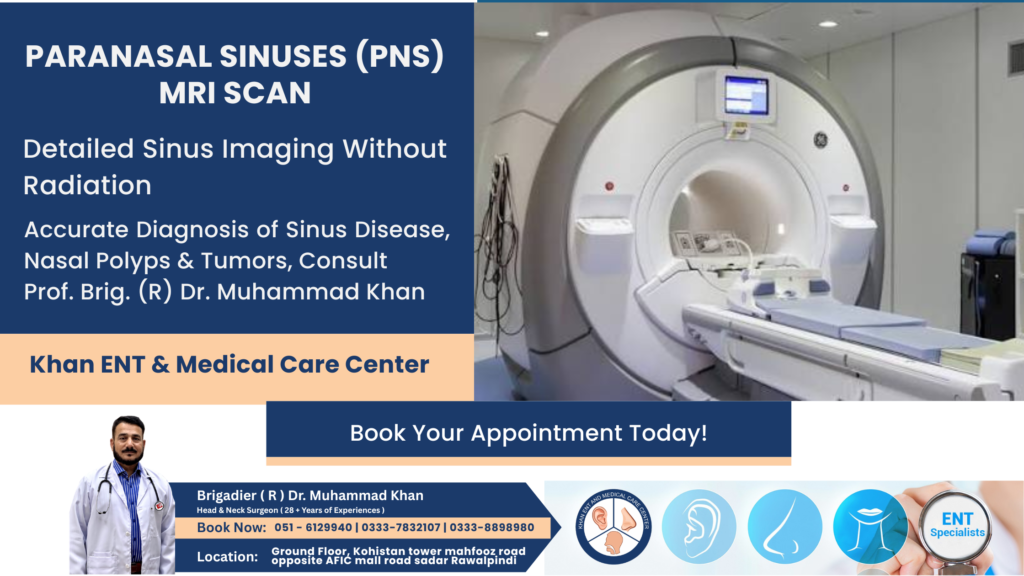
Paranasal Sinuses (PNS) MRI Scan is an advanced, non-invasive imaging test that provides highly detailed pictures of the soft tissues, nasal cavity, paranasal sinuses, surrounding nerves, eyes, and nearby structures without using harmful ionizing radiation. A MRI Scan is often recommended when doctors need a more detailed assessment of sinus diseases, nasal tumors, polyps, infections, or complications that cannot be fully evaluated by routine X-rays or even CT scans. If you are experiencing persistent sinus symptoms, unexplained facial pain, recurrent nosebleeds, or suspected nasal masses, a MRI Scan can play a vital role in establishing an accurate diagnosis and planning effective treatment.
At Khan ENT & Medical Care Center, Rawalpindi, Prof. Brig. (R) Dr. Muhammad Khan, Senior ENT Specialist & Head and Neck Surgeon, carefully evaluates MRI findings alongside clinical examination, nasal endoscopy, hearing assessment, and other diagnostic investigations to ensure every patient receives precise and personalized treatment.
What is a Paranasal Sinuses (PNS) MRI Scan?
A Paranasal Sinuses (PNS) MRI Scan (Magnetic Resonance Imaging) is a diagnostic imaging procedure that uses a powerful magnetic field, radiofrequency waves, and advanced computer technology to create high-resolution images of the paranasal sinuses and surrounding soft tissues.
Unlike CT scans or conventional X-rays, a MRI Scan does not expose patients to ionizing radiation, making it a safer imaging option in selected clinical situations.
The scan provides detailed visualization of:
- Maxillary sinuses
- Frontal sinuses
- Ethmoid sinuses
- Sphenoid sinuses
- Nasal cavity
- Nasal septum
- Soft tissues around the nose
- Eye sockets (orbits)
- Brain structures adjacent to the sinuses
- Blood vessels
- Cranial nerves
Because MRI excels in soft tissue imaging, a MRI Scan is especially valuable when doctors suspect tumors, fungal infections, orbital complications, intracranial extension of disease, or recurrent sinus disease.
Why is a Paranasal Sinuses (PNS) MRI Scan Performed?
Your ENT specialist may recommend a MRI Scan if symptoms persist despite treatment or if more detailed imaging is required.
Common reasons include:
- Chronic sinusitis
- Recurrent sinus infections
- Persistent nasal blockage
- Nasal polyps
- Frequent nosebleeds
- Facial swelling
- Loss of smell
- Persistent facial pain
- Headaches associated with sinus disease
- Suspected sinus tumors
- Benign nasal masses
- Malignant sinonasal cancers
- Orbital cellulitis
- Brain abscess related to sinus infection
- Fungal sinusitis
- Congenital abnormalities
- Cerebrospinal fluid (CSF) leak
- Mucocele
- Encephalocele
- Inverted papilloma
- Osteomyelitis of sinus bones
A MRI Scan is also frequently ordered before complex sinus surgery to help surgeons understand the extent of disease.
Conditions Diagnosed with a Paranasal Sinuses (PNS) MRI Scan
A Paranasal Sinuses (PNS) MRI Scan is highly effective in detecting numerous ENT conditions.
These include:
Chronic Sinusitis
MRI helps determine persistent inflammation affecting the sinus lining.
Acute Complicated Sinusitis
MRI evaluates infection spreading to the eye socket or brain.
Nasal Polyps
The scan identifies the size, number, and spread of nasal polyps.
Sinus Tumors
MRI differentiates benign from malignant tumors and evaluates their extension into surrounding tissues.
Sinonasal Cancer
MRI is one of the best investigations for assessing tumor invasion into nearby structures.
Mucocele
Fluid-filled sinus cysts can be accurately identified.
Orbital Cellulitis
MRI evaluates infection around the eye and its complications.
Brain Abscess
Serious sinus infections may spread to the brain, which MRI detects early.
Fungal Sinusitis
MRI provides valuable information about invasive fungal infections.
Congenital Abnormalities
Birth defects involving the nasal cavity and sinuses are clearly demonstrated.
Symptoms That May Require a Paranasal Sinuses (PNS) MRI Scan
Your doctor may advise a MRI Scan if you have:
- Persistent blocked nose
- Chronic nasal discharge
- Facial pressure
- Facial swelling
- Frequent headaches
- Unexplained facial pain
- Recurrent nosebleeds
- Double vision
- Eye swelling
- Reduced sense of smell
- Vision changes
- Persistent sinus infections
- Nasal mass
- Unexplained swelling around the eyes
- Symptoms that fail to improve after medication
How Does a Paranasal Sinuses (PNS) MRI Scan Work?
MRI uses:
- Strong magnetic fields
- Radiofrequency pulses
- Computer-generated imaging
The scanner aligns hydrogen atoms present in body tissues. Radiofrequency waves temporarily disturb these atoms, and as they return to their original position, they emit signals that are converted into highly detailed cross-sectional images.
A MRI Scan creates images in multiple planes including:
- Axial
- Coronal
- Sagittal
These multiple views help ENT surgeons accurately diagnose disease.
How to Prepare for a Paranasal Sinuses (PNS) MRI Scan
Proper preparation helps ensure high-quality images.
Before the scan:
- Wear comfortable clothing without metal.
- Remove jewelry, watches, glasses, dentures, hearing aids, hairpins, and metallic accessories.
- Inform the MRI staff if you have:
- Pacemaker
- Cochlear implant
- Brain aneurysm clips
- Artificial heart valves
- Metal fragments in the eyes
- Orthopedic implants
- Neurostimulators
- Insulin pumps
- Inform your doctor if you are pregnant.
- Tell your doctor if you have kidney disease before receiving MRI contrast.
- If you have claustrophobia, sedation or an open MRI may be considered.
For MRI with contrast, fasting for several hours may be recommended.
What Happens During a Paranasal Sinuses (PNS) MRI Scan?
The procedure usually follows these steps:
- You lie comfortably on the MRI table.
- A special head coil is positioned around your head.
- The table slides into the MRI scanner.
- You must remain still throughout the examination.
- Loud knocking sounds are normal.
- Earplugs or headphones are usually provided.
- You can communicate with the technologist using an intercom.
- Contrast material (gadolinium) may be injected if required.
A MRI Scan generally takes 30–45 minutes, depending on the imaging protocol.
Is a Paranasal Sinuses (PNS) MRI Scan Safe?
Yes.
A MRI Scan is considered one of the safest imaging techniques because it does not use radiation.
Potential considerations include:
- Claustrophobia
- Loud scanner noise
- Rare allergic reactions to gadolinium contrast
- Kidney disease requiring contrast precautions
- MRI incompatibility with certain implants
Your doctor carefully evaluates these factors before scheduling the examination.
MRI vs CT Scan for Sinus Problems
Many patients wonder whether they need a CT scan or a MRI Scan.
| MRI Scan | CT Scan |
|---|---|
| Excellent for soft tissues | Excellent for bone anatomy |
| No radiation | Uses X-rays |
| Better for tumors | Better for sinus anatomy |
| Better for fungal disease | Preferred for routine sinusitis |
| Better for orbital and brain complications | Faster in emergencies |
CT remains the preferred imaging test for routine chronic sinusitis and surgical planning of sinus anatomy, while a Paranasal Sinuses (PNS) MRI Scan is preferred when evaluating tumors, orbital disease, intracranial spread, or soft tissue abnormalities.
Who Should Not Undergo a Paranasal Sinuses (PNS) MRI Scan?
MRI may not be suitable for patients with:
- Non-MRI compatible pacemakers
- Certain aneurysm clips
- Cochlear implants
- Metallic eye foreign bodies
- Implanted neurostimulators
- Certain vascular clips
- Some insulin pumps
- Certain prosthetic devices
Always inform your healthcare provider about any implanted medical device.
Advantages of a Paranasal Sinuses (PNS) MRI Scan
Benefits include:
- No radiation exposure
- Outstanding soft tissue detail
- Early detection of tumors
- Accurate diagnosis of fungal infections
- Excellent assessment of orbital complications
- Evaluation of brain extension
- Better surgical planning
- Safe for repeated follow-up imaging when appropriate
Why Choose Prof. Brig. (R) Dr. Muhammad Khan for Sinus Disease Evaluation?
Choosing the right ENT specialist is just as important as selecting the correct imaging test.
Residents of Rawalpindi and Islamabad trust Prof. Brig. (R) Dr. Muhammad Khan, Senior ENT Specialist & Head and Neck Surgeon, because of his extensive experience in diagnosing and treating complex ear, nose, throat, head, and neck disorders.
At Khan ENT & Medical Care Center, Rawalpindi, patients benefit from:
- Comprehensive ENT consultation
- Detailed nasal endoscopy
- Accurate interpretation of MRI and CT findings
- Personalized treatment plans
- Advanced medical management
- Functional Endoscopic Sinus Surgery (FESS)
- Management of nasal polyps
- Treatment of chronic sinusitis
- Head and neck tumor evaluation
- Care for recurrent and complicated sinus disease
With decades of surgical expertise, evidence-based treatment, and a patient-centered approach, Prof. Brig. (R) Dr. Muhammad Khan provides trusted ENT care for patients across Rawalpindi, Islamabad, and surrounding regions.
Frequently Asked Questions (FAQs)
What is a Paranasal Sinuses (PNS) MRI Scan?
A Paranasal Sinuses (PNS) MRI Scan is a non-invasive imaging test that uses magnetic fields and radio waves to produce detailed images of the sinuses and surrounding soft tissues without radiation.
Why would my ENT specialist recommend a PNS MRI Scan?
It may be recommended for chronic sinusitis, nasal tumors, nasal polyps, fungal infections, recurrent nosebleeds, facial pain, orbital complications, or suspected spread of disease to nearby structures.
Is a Paranasal Sinuses (PNS) MRI Scan painful?
No. The scan is painless. You simply lie still while the MRI machine acquires images.
How long does a Paranasal Sinuses (PNS) MRI Scan take?
Most scans take between 30 and 45 minutes, depending on whether contrast is required.
Does a PNS MRI Scan use radiation?
No. MRI uses magnetic fields and radio waves instead of X-rays, so there is no ionizing radiation exposure.
Which is better for sinus disease: MRI or CT?
CT is generally preferred for evaluating sinus anatomy and routine sinusitis, while MRI is superior for assessing tumors, soft tissue disease, fungal infections, and complications involving the eyes or brain.
Do I need contrast for a Paranasal Sinuses (PNS) MRI Scan?
Not always. Contrast is used only when necessary, such as for evaluating tumors, infections, or inflammatory conditions.
Can patients with metal implants undergo a PNS MRI Scan?
Some implants are MRI-compatible, while others are not. Always inform your doctor and MRI staff about any implanted medical devices before the scan.
Is fasting required before a Paranasal Sinuses (PNS) MRI Scan?
For a standard MRI, fasting is usually not required. If contrast is planned, your doctor may advise fasting for several hours.
Where can I receive expert evaluation of my MRI results in Rawalpindi?
Patients can consult Prof. Brig. (R) Dr. Muhammad Khan at Khan ENT & Medical Care Center, Rawalpindi, for comprehensive interpretation of MRI findings, nasal endoscopy, diagnosis, and advanced treatment of sinus and nasal disorders.