
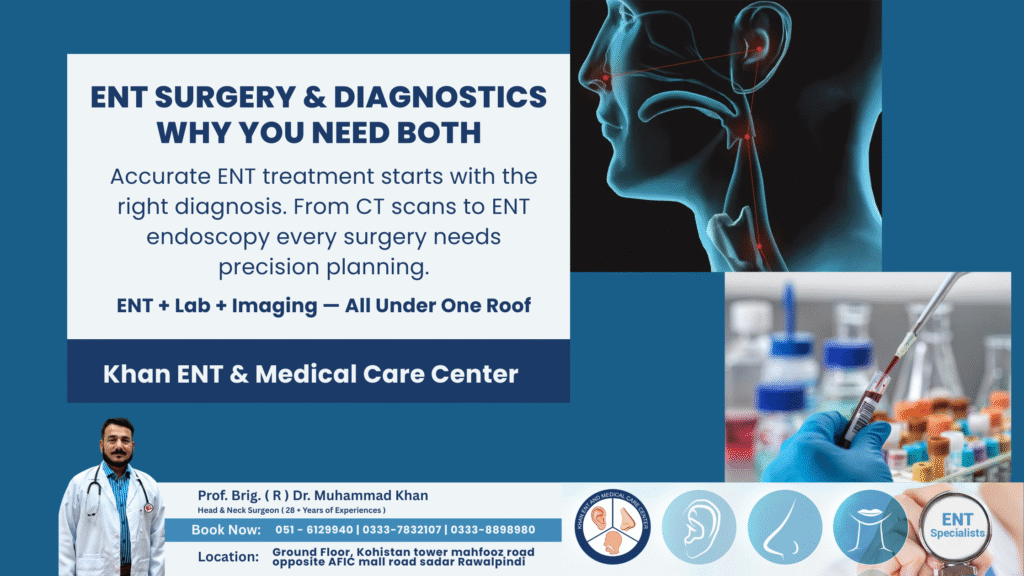
The Crucial Role of Combined ENT Surgery and Diagnostics
Accurate treatment in ENT (Ear, Nose, and Throat) care goes beyond identifying symptoms it requires precision diagnostics and expert surgical execution. In many cases, ENT disorders are complex, involving subtle anatomical or functional abnormalities that cannot be fully understood without advanced imaging and laboratory investigations.
At Khan ENT Clinic & Life Care Lab, we believe the integration of diagnostics and surgical expertise under one roof is not only efficient but also critical to delivering better patient outcomes. This guide will explore in detail why ENT surgery and diagnostics go hand-in-hand, covering multiple case examples, diagnostic technologies, surgical methods, patient education, recovery plans, and quality assurance.
Understanding ENT Conditions – From Simple to Complex
ENT disorders vary widely in severity, frequency, and type. While some are mild and self-limiting, others require surgical intervention.
Common ENT conditions include:
- Chronic tonsillitis
- Nasal polyps
- Deviated nasal septum
- Chronic sinusitis
- Ear infections and fluid build-up
- Eardrum perforations
- Benign tumors and cysts
- Voice disorders
When surgery becomes necessary:
- Failure of medical treatment
- Compromised daily function (e.g., breathing or hearing loss)
- Risk of permanent damage (e.g., recurrent ear infections causing hearing loss)
Proper diagnosis is the first step to determining if surgery is required.
Diagnostics – The Foundation of Effective ENT Treatment
Imaging Tools for ENT Diagnosis
CT Scans – Useful for sinus, nasal cavity, and middle ear evaluation.
X-rays – For basic nasal and throat imaging.
MRI – Occasionally used for head and neck tumors.
Ultrasound – For soft tissue structures, thyroid nodules, and lymph nodes.
Functional ENT Tests
Pure Tone Audiometry (PTA) – Measures hearing levels.
Impedance Audiometry – Evaluates middle ear function.
Nasendoscopy – Flexible camera used to visualize nasal and throat passages.
Laryngoscopy – Visual inspection of the vocal cords.
Lab Investigations
- Complete Blood Counts (CBC)
- Infection markers (CRP, ESR)
- Coagulation profile (important before surgery)
- Culture tests for bacterial infections
Having access to all of the above in one facility ensures timely diagnosis and eliminates the guesswork in treatment planning.
ENT Surgeries – Common Procedures & Why Precision Matters
Tonsillectomy
Removal of inflamed or infected tonsils. Diagnostic support helps ensure no other infection source is present.
FESS (Functional Endoscopic Sinus Surgery)
Minimally invasive sinus surgery guided by CT scan results.
Septoplasty
Corrects deviated septum for better airflow; pre-op CT and nasal endoscopy crucial.
Tympanoplasty
Surgical repair of eardrum perforations. Hearing tests help gauge severity before surgery.
Adenoidectomy
Often combined with tonsillectomy. Requires X-ray or nasal endoscopy for confirmation.
Case Studies – How Diagnostics Changed Outcomes
Hidden Sinus Polyps
Patient had recurring headaches and nasal blockage. Initial treatment failed. CT scan revealed multiple hidden polyps. FESS performed — full recovery.
Misdiagnosed Ear Discharge
Teen patient was treated for ear infection repeatedly. PTA and tympanometry showed middle ear fluid with eardrum perforation. Tympanoplasty resolved the issue.
Snoring Misunderstood
Middle-aged man with heavy snoring was thought to have sleep apnea. Nasal endoscopy showed enlarged adenoids and deviated septum. Septoplasty + adenoidectomy helped eliminate symptoms.
The Surgical Journey – From Diagnosis to Recovery
Pre-Surgical Workup
- ENT exam
- Blood tests
- ECG (if age >40 or with health risks)
- Imaging as needed
Surgery Day
- Brief fasting period
- General or local anesthesia
- Procedure lasting 30 min to 2 hours depending on type
Recovery
- Discharge same day or next morning
- Antibiotics and pain relief
- Follow-up check in 5–7 days
Integrated Facilities at Khan ENT Clinic & Life Care Lab
We bring ENT surgery and diagnostics together:
- ENT Consultation Rooms
- Audiology Testing Booth
- Lab Collection Center
- CT Scan & Ultrasound Units
- Minor OT for day procedures
All departments are electronically linked for fast coordination and reporting.
Patient Education & Post-Surgery Support
We educate patients on:
- What to expect before and after surgery
- Diet plans post-tonsillectomy or sinus surgery
- Ear care post-tympanoplasty
- When to seek urgent care
A 24/7 helpline is also available for all post-op queries.
Quality Control and Safety Protocols
We follow:
- WHO surgical safety checklist
- Daily sterilization logs
- Electronic health record access
- Cross-specialty referrals when needed
Your safety is our top priority every time.
Why One-Stop ENT + Lab Care Saves You Time & Risk
- No delays between tests and reports
- Easier insurance claims
- No risk of miscommunication between lab and surgeon
- Trusted under one name: Khan ENT & Life Care Lab
When to Visit an ENT + Diagnostic Expert
If you’re facing:
- Recurrent throat infections
- Chronic nasal blockage or discharge
- Hearing loss or ringing in ears
- Facial pain or pressure
- Snoring or voice changes
Don’t delay. Early diagnosis with expert evaluation can prevent complications and give you lasting relief.
Visit Khan ENT Clinic & Life Care Lab – Saddar, Rawalpindi