
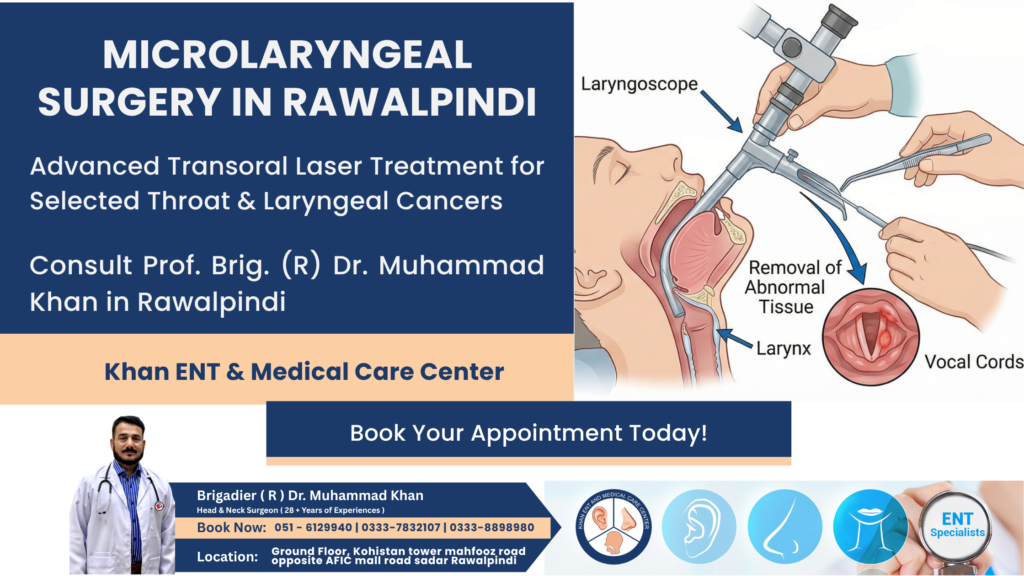
Microlaryngeal Surgery in Rawalpindi is a specialized procedure used to diagnose and treat problems affecting the vocal cords and larynx (voice box). It allows an ENT and head & neck surgeon to examine the vocal folds under magnification and, when necessary, remove abnormal tissue using delicate microsurgical instruments. The procedure is commonly considered for vocal cord polyps, cysts, nodules, Reinke’s edema, papillomas, suspicious lesions and selected laryngeal tumors.
For residents of Rawalpindi and Islamabad, choosing an experienced ENT and head & neck surgeon is particularly important when treatment involves the delicate vocal cords. Prof. Brig. (R) Dr. Muhammad Khan, Senior ENT & Head & Neck Surgeon at Khan ENT & Medical Care Center, Rawalpindi, provides specialized evaluation and surgical management of laryngeal and voice-related conditions.
Important: Microlaryngeal surgery is not appropriate for every voice problem. The recommended treatment depends on the diagnosis, vocal-fold findings, severity of symptoms and the patient’s overall health.
What Is Microlaryngeal Surgery?
Microlaryngeal surgery, also called microlaryngoscopy or microscopic laryngeal surgery, is a minimally invasive procedure performed through the mouth. The surgeon uses a laryngoscope to access the larynx and specialized magnification to examine the vocal folds in detail.
Unlike open neck surgery, microlaryngeal surgery generally does not require an external skin incision. Fine instruments can be introduced through the laryngoscope to biopsy, remove or treat selected abnormalities while aiming to preserve healthy vocal-fold tissue.
Microlaryngoscopy can be used for both diagnosis and treatment. If a suspicious lesion is found, a tissue sample may be sent for pathological examination to determine whether it is benign, precancerous or malignant.
Why Is Microlaryngeal Surgery Performed?
The vocal cords are delicate structures responsible for producing sound. Even a relatively small lesion can interfere with their vibration and cause persistent voice changes.
Microlaryngeal Surgery in Rawalpindi may be recommended when a structural problem cannot be adequately managed with conservative treatment or when a lesion requires surgical assessment.
Common reasons include:
- Persistent hoarseness or voice change
- Vocal cord polyps
- Vocal cord cysts
- Vocal cord nodules that do not respond adequately to conservative treatment
- Reinke’s edema
- Laryngeal papillomas
- Suspicious vocal-fold lesions
- Selected early laryngeal cancers
- Scar tissue or certain vocal-fold abnormalities
- Some airway-narrowing conditions
- Selected vocal-fold movement disorders
The exact indication should be established through an appropriate ENT examination rather than symptoms alone. Persistent hoarseness lasting more than a few weeks deserves medical assessment, particularly in smokers and people with other risk factors for laryngeal disease.
Conditions Treated With Microlaryngeal Surgery
Vocal Cord Polyps
Vocal cord polyps are benign lesions that can interfere with normal vocal-fold vibration. They may develop after vocal trauma, excessive voice use or irritation. Depending on their size and characteristics, treatment may involve voice therapy, medical management or surgical removal.
Vocal Cord Cysts
Vocal cord cysts are fluid-filled or keratin-containing lesions that can affect voice quality. Surgery may be recommended when a cyst causes persistent symptoms and does not respond to nonsurgical treatment.
Vocal Cord Nodules
Nodules are commonly associated with repeated vocal strain. Voice therapy and correction of vocal habits are often important first-line treatments. Surgery may be considered for selected persistent lesions when conservative treatment is unsuccessful.
Reinke’s Edema
Reinke’s edema causes swelling of the vocal-fold tissue and can produce a deep, rough or husky voice. Smoking and reflux may contribute to the condition. When significant swelling persists, microlaryngoscopy may be used to remove excess tissue. Addressing contributing factors remains important after surgery.
Laryngeal Papilloma
Papillomas are abnormal growths that can develop in the larynx. Depending on their location and extent, surgical removal may be necessary to improve the airway or voice and control disease.
Suspicious or Cancerous Lesions
Microlaryngoscopy can allow direct examination and biopsy of suspicious laryngeal lesions. When cancer is suspected, obtaining an accurate tissue diagnosis is an important part of treatment planning.
How Is Microlaryngeal Surgery Done?
In most cases, microlaryngeal surgery is performed under general anesthesia. The patient is asleep while the surgeon carefully introduces a laryngoscope through the mouth to obtain a direct view of the larynx.
The surgeon then uses magnification and specialized instruments to examine the vocal folds. Depending on the diagnosis, the surgeon may:
Examine the vocal cords under magnification.
Identify the abnormal tissue or lesion.
Take a biopsy when indicated.Remove a polyp, cyst, nodule or other lesion.
Treat selected abnormal tissue using an appropriate surgical technique.
Preserve as much healthy vocal-fold tissue as possible.
Send tissue for laboratory examination when required.
The procedure often takes less than an hour, although the actual operating time varies according to the condition and complexity of surgery. Many patients can return home the same day after recovery from anesthesia.
What Tests May Be Needed Before Surgery?
A detailed voice and laryngeal assessment helps determine whether surgery is appropriate. Depending on the patient’s symptoms, the ENT specialist may recommend:
- Flexible or video laryngoscopy
- Videostroboscopy for detailed assessment of vocal-fold vibration
- Voice assessment
- Imaging such as CT or MRI in selected cases
- Blood tests before surgery
- Anesthesia assessment
- Biopsy or other investigations when a suspicious lesion is present
A careful preoperative assessment is especially important when the patient has persistent hoarseness, swallowing problems, breathing difficulty or risk factors for laryngeal cancer.
What Should You Expect After Microlaryngeal Surgery?
Recovery varies depending on the lesion and the extent of surgery. Mild throat discomfort, temporary hoarseness and a change in voice quality can occur after the procedure.
Your surgeon may recommend a period of voice rest or reduced voice use. The duration depends on what was treated and how the vocal folds need to heal. Whispering should not be assumed to be safe during voice rest because it can also place strain on the voice.
Follow-up is important because the surgeon needs to assess healing and determine when normal voice use can resume.
Voice therapy may also be recommended. It can help patients develop healthier speaking techniques and reduce the risk of recurrent vocal-fold injury.
Benefits of Microlaryngeal Surgery
The main advantage of Microlaryngeal Surgery in Rawalpindi is the ability to treat selected laryngeal lesions through the mouth using precise instruments and magnification.
Potential benefits include:
- Precise visualization of the vocal folds
- Removal or biopsy of selected lesions
- No external neck incision for typical microlaryngoscopy
- Preservation of healthy vocal-fold tissue
- Improvement in voice quality when the lesion is responsible for dysphonia
- Treatment of selected airway problems
- Same-day discharge in many cases
- Less external tissue disruption than open laryngeal procedures
However, no surgical procedure can guarantee a particular voice outcome. Results depend on the underlying disease, vocal-fold condition, surgical findings, healing and postoperative voice care.
Risks and Possible Complications
Microlaryngeal surgery is generally considered a safe procedure when appropriately indicated, but complications are possible.
Potential risks include:
- Temporary sore throat
- Temporary hoarseness
- Dental or lip injury from instrumentation
- Tongue numbness or altered sensation
- Bleeding
- Infection
- Anesthesia-related complications
- Vocal-fold scarring
- Persistent or changed voice quality
- Recurrence of some lesions
- Rare airway complications
One of the important concerns in vocal-fold surgery is scarring because scar tissue can interfere with normal vibration. For this reason, experienced microsurgical technique and appropriate postoperative voice care are important.
Who Should Consider Microlaryngeal Surgery in Rawalpindi?
Patients in Rawalpindi and Islamabad may need an ENT evaluation if they have:
- Hoarseness that persists or repeatedly returns
- A diagnosed vocal cord polyp or cyst
- A vocal-fold lesion seen on laryngoscopy
- Unexplained voice loss
- Persistent throat symptoms associated with voice problems
- A suspicious laryngeal growth
- Breathing difficulty caused by a laryngeal lesion
- A lesion that has not improved with appropriate conservative treatment
Surgery should not be chosen simply because a patient has hoarseness. The underlying cause must first be identified.
Why Choose Prof. Brig. (R) Dr. Muhammad Khan?
For patients seeking Microlaryngeal Surgery in Rawalpindi, surgeon experience is an important consideration because the vocal cords are highly delicate structures where preservation of healthy tissue matters.
Prof. Brig. (R) Dr. Muhammad Khan, Senior ENT & Head & Neck Surgeon, provides specialized ENT and head & neck surgical care at Khan ENT & Medical Care Center, Rawalpindi.
Residents of Rawalpindi and Islamabad may consider him because:
- He is a senior ENT and head & neck surgeon.
- His practice includes specialized ENT and head & neck surgical care.
- Laryngeal and voice-related conditions can be assessed as part of comprehensive ENT care.
- Surgical treatment can be planned according to the patient’s diagnosis rather than using a one-size-fits-all approach.
- Patients from Rawalpindi, Islamabad and surrounding areas can receive specialist evaluation without traveling to another city for routine ENT surgical assessment.
For more information about ENT and head & neck services, visit at Khan ENT & Medical Care Center.
Microlaryngeal Surgery in Rawalpindi: When Should You Seek an ENT Specialist?
Do not ignore persistent voice changes. Hoarseness can result from simple causes such as laryngitis or vocal overuse, but persistent symptoms may also indicate a vocal-fold lesion or another laryngeal disorder.
An ENT specialist can determine whether observation, medication, voice therapy, further testing or Microlaryngeal Surgery in Rawalpindi is appropriate.
If you experience breathing difficulty, coughing up blood, significant swallowing difficulty, a neck mass or rapidly worsening symptoms, seek prompt medical assessment.
Frequently Asked Questions
What is microlaryngeal surgery?
Microlaryngeal surgery is a minimally invasive operation performed through the mouth to examine, biopsy or treat selected abnormalities of the larynx and vocal folds using magnification and specialized instruments.
Is microlaryngeal surgery painful?
Because the procedure is usually performed under general anesthesia, patients do not feel the operation itself. Mild throat discomfort or soreness may occur afterward and usually improves during recovery.
How long does microlaryngeal surgery take?
The duration varies according to the condition being treated. Many procedures take less than an hour, although more complex cases may require additional operating time.
Will I go home the same day?
Many microlaryngeal procedures are performed on an outpatient basis, allowing patients to go home after they have recovered adequately from anesthesia. Your surgical team will determine whether day-case treatment is appropriate.
How long should I rest my voice after surgery?
Voice-rest recommendations vary according to the procedure and the condition treated. Your surgeon will provide specific instructions. Some patients require complete voice rest for a short period followed by gradual return to speaking.
Can microlaryngeal surgery improve my voice?
It can improve voice quality when an identifiable lesion is interfering with normal vocal-fold vibration. The expected result depends on the diagnosis, lesion, vocal-fold tissue and healing.
Can vocal cord polyps and cysts be removed with microlaryngeal surgery?
Yes. Microlaryngoscopy is commonly used to remove selected vocal-fold polyps and cysts. The treatment plan depends on the size, location and characteristics of the lesion.
Is microlaryngeal surgery used to diagnose cancer?
Microlaryngoscopy can allow a surgeon to directly examine a suspicious lesion and take a biopsy. The tissue is then examined by a pathologist to establish the diagnosis.
Will I need voice therapy after microlaryngeal surgery?
Some patients benefit from voice therapy before or after surgery. Voice therapy can help improve vocal technique, support healing and reduce behaviors that may contribute to recurrent vocal-fold injury.
Where can I get Microlaryngeal Surgery in Rawalpindi?
Patients seeking Microlaryngeal Surgery in Rawalpindi can consult Prof. Brig. (R) Dr. Muhammad Khan at Khan ENT & Medical Care Center, Rawalpindi for specialist assessment and individualized treatment planning.