
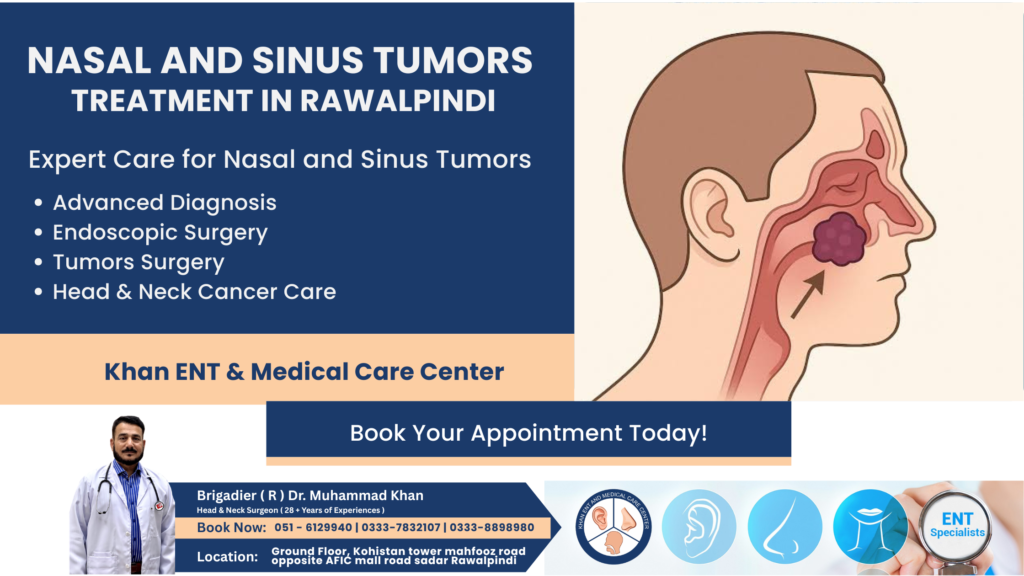
Nasal and Sinus Tumors are uncommon but potentially serious growths that develop inside the nasal cavity or the paranasal sinuses. While many nasal and sinus tumors are noncancerous (benign), some can be cancerous (malignant) and require prompt diagnosis and specialized treatment. Early recognition of symptoms and timely evaluation by an experienced ENT specialist significantly improve treatment outcomes.
If you have persistent nasal blockage, unexplained nosebleeds, facial pain, or one-sided nasal symptoms that do not improve with medication, it is important to seek medical attention immediately. At Khan ENT & Medical Care Center, Rawalpindi, Prof. Brig. (R) Dr. Muhammad Khan, one of the leading ENT and Head & Neck Surgeons in Pakistan, provides comprehensive diagnosis, advanced endoscopic evaluation, and surgical management of Nasal and Sinus Tumors for patients from Rawalpindi, Islamabad, and surrounding regions.
What Are Nasal and Sinus Tumors?
Nasal and Sinus Tumors are abnormal growths that develop inside:
- The nasal cavity (inside the nose)
- Maxillary sinuses
- Ethmoid sinuses
- Frontal sinuses
- Sphenoid sinuses
These tumors may be:
Benign (Non-Cancerous)
Benign tumors generally grow slowly and do not spread to other organs, although they can still block the nose or damage nearby structures.
Common benign tumors include:
- Nasal polyps
- Inverted papilloma
- Hemangioma
- Osteoma
- Fibroma
Malignant (Cancerous)
Cancerous Nasal and Sinus Tumors can invade surrounding tissues and spread to lymph nodes or distant organs if left untreated.
Common malignant tumors include:
- Squamous Cell Carcinoma
- Adenocarcinoma
- Adenoid Cystic Carcinoma
- Sinonasal Undifferentiated Carcinoma
- Esthesioneuroblastoma (Olfactory Neuroblastoma)
- Melanoma
- Sarcoma
- Lymphoma
How Common Are Nasal and Sinus Tumors?
Although Nasal and Sinus Tumors are rare, they account for approximately 3–5% of all head and neck cancers. Because early symptoms often resemble allergies or sinus infections, diagnosis is frequently delayed.
Early evaluation by an experienced ENT surgeon is essential for detecting these tumors before they spread.
What Causes Nasal and Sinus Tumors?
The exact cause of Nasal and Sinus Tumors is not always known. Most develop due to genetic mutations that cause abnormal cell growth.
Several risk factors increase the likelihood of developing these tumors.
Smoking
Cigarette smoking significantly increases the risk of several nasal cancers.
Occupational Exposure
People working with:
- Wood dust
- Leather dust
- Textile dust
- Flour dust
- Nickel
- Chromium
- Formaldehyde
- Industrial chemicals
- Solvents
have a higher risk of developing Nasal and Sinus Tumors.
Human Papillomavirus (HPV)
Some nasal cancers have been linked with HPV infection.
Air Pollution
Long-term exposure to polluted environments may contribute to tumor development.
Previous Radiation Exposure
Individuals previously treated with radiation to the head and neck have a slightly increased risk.
Symptoms of Nasal and Sinus Tumors
Many symptoms resemble chronic sinusitis, making diagnosis difficult during the early stages.
Common symptoms include:
- Persistent nasal blockage
- One-sided nasal obstruction
- Frequent nosebleeds
- Blood-stained nasal discharge
- Facial pain or pressure
- Chronic headaches
- Loss of smell
- Nasal discharge
- Postnasal drip
- Ear fullness
- Hearing changes
- Facial swelling
- Double vision
- Bulging eye
- Blurred vision
- Loose upper teeth
- Swelling inside the mouth
- Neck lump
- Difficulty opening the mouth
Persistent symptoms lasting more than three weeks should never be ignored.
Red Flag Symptoms That Require Immediate ENT Evaluation
Certain symptoms strongly suggest the possibility of Nasal and Sinus Tumors, especially when they affect only one side.
These include:
- One-sided nasal blockage
- Recurrent nosebleeds from one nostril
- Blood-stained nasal discharge
- Facial numbness
- Eye swelling
- Double vision
- Persistent facial pain
- Neck swelling
- Progressive headaches
- Loss of smell affecting one side
These symptoms warrant urgent assessment by an ENT specialist.
Benign vs Malignant Nasal and Sinus Tumors
| Benign Tumors | Malignant Tumors |
|---|---|
| Slow-growing | Faster growth |
| Usually localized | May spread to nearby tissues |
| Rarely life-threatening | Can become life-threatening |
| Surgical removal often curative | May require surgery, radiation, and chemotherapy |
How Are Nasal and Sinus Tumors Diagnosed?
Early diagnosis greatly improves treatment success.
Medical History
Your ENT specialist will ask about:
- Duration of symptoms
- Smoking history
- Occupational exposure
- Previous sinus disease
- Family history
ENT Examination
A complete examination of the nose, throat, ears, face, and neck is performed.
Nasal Endoscopy
Flexible or rigid nasal endoscopy allows direct visualization of the nasal cavity and sinuses.
This is one of the most important diagnostic tools for detecting Nasal and Sinus Tumors.
CT Scan
CT scanning evaluates:
- Bone destruction
- Tumor size
- Sinus involvement
- Extension into surrounding structures
MRI Scan
MRI provides excellent visualization of:
- Soft tissues
- Brain involvement
- Eye socket involvement
- Blood vessels
- Nerves
Biopsy
A biopsy confirms:
- Whether the tumor is cancerous
- Tumor type
- Tumor grade
Treatment planning depends on biopsy findings.
PET Scan
For advanced cancers, PET scanning helps detect spread to lymph nodes or distant organs.
Staging of Nasal and Sinus Tumors
Cancer staging determines disease extent.
Stage I
Tumor remains confined within the nasal cavity or sinus.
Stage II
Tumor extends locally but remains relatively limited.
Stage III
Cancer spreads into nearby bone, eye socket, or lymph nodes.
Stage IV
Cancer extends into the skull base, brain, major blood vessels, or distant organs.
Earlier stages have significantly better treatment outcomes.
Treatment of Nasal and Sinus Tumors
Treatment depends on:
- Tumor type
- Cancer stage
- Patient age
- General health
- Tumor location
Endoscopic Sinus Surgery
Many Nasal and Sinus Tumors can be removed using minimally invasive endoscopic techniques.
Benefits include:
- No external scar
- Less pain
- Faster recovery
- Short hospital stay
- Better visualization
Open Surgery
Large or advanced tumors may require open surgical approaches.
Head and Neck Cancer Surgery
Advanced cancers may require:
- Tumor excision
- Skull base surgery
- Neck dissection
- Reconstructive procedures
Radiation Therapy
Radiotherapy may be used:
- Before surgery
- After surgery
- As primary treatment when surgery is unsuitable
Chemotherapy
Chemotherapy is generally reserved for:
- Advanced cancers
- Aggressive tumors
- Combined chemoradiotherapy protocols
Targeted Therapy & Immunotherapy
Some advanced Nasal and Sinus Tumors may benefit from newer targeted drugs or immunotherapy depending on pathology.
Possible Complications if Left Untreated
Ignoring Nasal and Sinus Tumors may result in:
- Permanent nasal blockage
- Vision loss
- Brain invasion
- Skull base destruction
- Facial deformity
- Difficulty breathing
- Difficulty swallowing
- Spread to lymph nodes
- Distant metastasis
- Life-threatening complications
Recovery After Treatment
Recovery depends on:
- Tumor stage
- Surgical procedure
- Overall health
- Need for radiation or chemotherapy
Most patients require:
- Regular endoscopic follow-up
- Imaging studies
- Long-term monitoring for recurrence
Can Nasal and Sinus Tumors Be Prevented?
Although not all tumors are preventable, the following measures reduce risk:
- Avoid smoking
- Wear protective masks at work
- Reduce exposure to industrial chemicals
- Maintain good nasal health
- Seek early treatment for persistent nasal symptoms
- Receive HPV vaccination when appropriate
- Attend regular ENT check-ups if at high risk
Why Choose Prof. Brig. (R) Dr. Muhammad Khan for Nasal and Sinus Tumors?
When dealing with Nasal and Sinus Tumors, choosing an experienced ENT and Head & Neck Surgeon is essential because these tumors often involve complex anatomy close to the eyes, brain, and major blood vessels.
Residents of Rawalpindi, Islamabad, Wah Cantt, Taxila, Gujar Khan, Chakwal, Attock, Murree, and surrounding areas trust Prof. Brig. (R) Dr. Muhammad Khan for advanced ENT and head & neck care.
Why patients prefer him:
- Over 30 years of ENT and Head & Neck surgical experience
- Retired Brigadier and senior military consultant
- Former Professor of ENT
- Expertise in nasal endoscopy and sinus surgery
- Extensive experience in head & neck tumor surgery
- Modern diagnostic approach
- Personalized treatment plans
- Ethical, evidence-based patient care
- Advanced surgical techniques
- Convenient location at Khan ENT & Medical Care Center, Rawalpindi
Patients receive comprehensive care from diagnosis through surgery, follow-up, and long-term monitoring under one experienced specialist.
When Should You See an ENT Specialist?
Book an appointment immediately if you experience:
- Nasal blockage lasting longer than three weeks
- Frequent nosebleeds
- Persistent one-sided nasal symptoms
- Facial swelling
- Loss of smell
- Eye changes
- Double vision
- Chronic sinus symptoms that do not improve
- Recurrent headaches with nasal obstruction
- A lump in the neck associated with nasal symptoms
Early diagnosis can save vision, prevent cancer spread, and significantly improve survival.
Frequently Asked Questions (FAQs)
What are Nasal and Sinus Tumors?
Nasal and Sinus Tumors are abnormal growths that develop in the nasal cavity or paranasal sinuses. They may be benign or malignant.
Are Nasal and Sinus Tumors always cancer?
No. Many tumors are benign, but some are cancerous and require specialized treatment.
What is the first symptom of Nasal and Sinus Tumors?
Persistent one-sided nasal blockage is often one of the earliest warning signs.
Can chronic sinusitis be mistaken for Nasal and Sinus Tumors?
Yes. Early symptoms often resemble chronic sinus infections, which is why persistent or one-sided symptoms should be evaluated by an ENT specialist.
How are Nasal and Sinus Tumors diagnosed?
Diagnosis usually involves ENT examination, nasal endoscopy, CT scan, MRI, and biopsy.
Are Nasal and Sinus Tumors curable?
Many benign tumors are cured with surgery, and many cancers are highly treatable when diagnosed early.
What increases the risk of Nasal and Sinus Tumors?
Smoking, occupational exposure to wood or leather dust, industrial chemicals, air pollution, and HPV infection are important risk factors.
Do all Nasal and Sinus Tumors require surgery?
Most benign tumors and many malignant tumors require surgery, although some patients also need radiation therapy or chemotherapy.
Can Nasal and Sinus Tumors spread to the brain?
Advanced malignant tumors may extend into nearby structures, including the skull base and brain, if left untreated.
Who is the best doctor for Nasal and Sinus Tumors in Rawalpindi and Islamabad?
Patients seeking specialized diagnosis and treatment of Nasal and Sinus Tumors can consult Prof. Brig. (R) Dr. Muhammad Khan at Khan ENT & Medical Care Center, Rawalpindi, where comprehensive ENT, endoscopic sinus, and head & neck surgical care is provided using modern evidence-based techniques.