
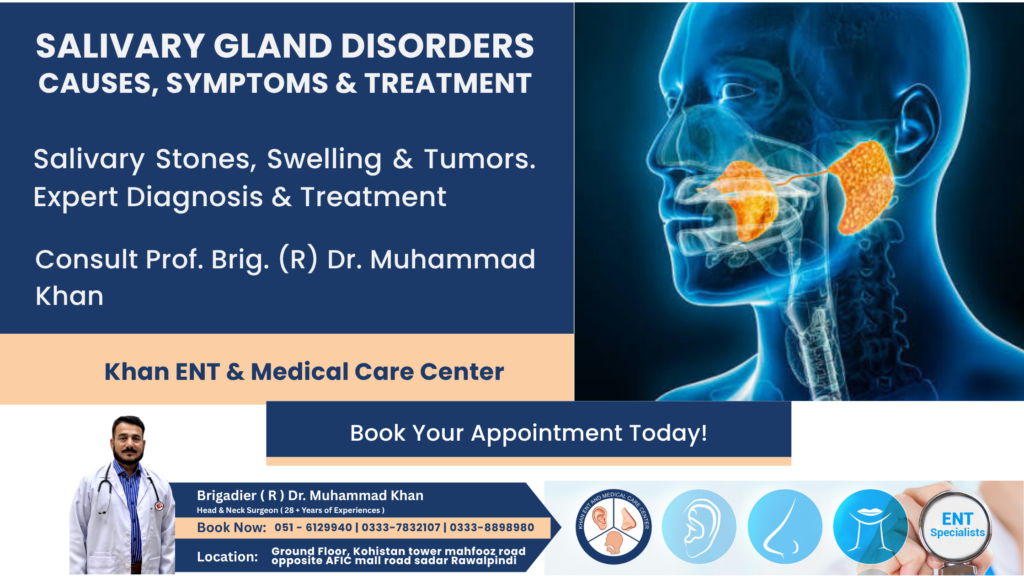
Salivary Gland Disorders – Ear, Nose, and Throat Disorders are conditions that affect the glands responsible for producing saliva and releasing it into the mouth. These disorders can develop because of salivary gland stones, infections, inflammation, autoimmune conditions, cysts, reduced saliva production, or tumors. Symptoms may include swelling, pain, dry mouth, a lump near the jaw or cheek, difficulty swallowing, fever, or a bad taste in the mouth.
Saliva is important for keeping the mouth moist, helping with chewing and swallowing, protecting teeth, and beginning the digestive process. When a salivary gland becomes blocked, infected, inflamed, or enlarged, it can interfere with normal saliva flow and cause uncomfortable symptoms.
For residents of Rawalpindi and Islamabad, persistent swelling, pain, or a lump around the cheek, jaw, or neck should be evaluated by an experienced ENT and head and neck specialist. Prof. Brig. (R) Dr. Muhammad Khan at Khan ENT & Medical Care Center, Rawalpindi, provides specialized evaluation and surgical care for salivary gland and other ENT conditions.
What Are Salivary Gland Disorders?
Salivary Gland Disorders – Ear, Nose, and Throat Disorders include a broad range of conditions affecting the major and minor salivary glands. The major glands include the parotid glands near the ears, the submandibular glands beneath the jaw, and the sublingual glands beneath the tongue.
Numerous smaller salivary glands are also distributed throughout the lips, cheeks, tongue, palate, throat, and other areas of the mouth.
These glands continuously produce saliva. Saliva helps moisten food, makes swallowing easier, supports oral health, and protects the mouth from harmful bacteria. Problems develop when saliva production is reduced or when saliva cannot flow normally through the salivary ducts.
Some salivary gland conditions are temporary and improve with appropriate treatment. Others, particularly persistent lumps or tumors, require detailed examination and sometimes surgical treatment.
Common Salivary Gland Disorders
Salivary Gland Disorders – Ear, Nose, and Throat Disorders can have different causes. The most common conditions include:
Salivary Gland Stones
Salivary gland stones, medically called sialolithiasis, are hardened deposits that develop within a salivary gland or its duct. They can block the normal flow of saliva.
Salivary stones commonly affect the submandibular glands. A person may notice pain and swelling beneath the jaw or inside the mouth, particularly around mealtimes. Symptoms can become more noticeable when eating sour foods because these foods stimulate saliva production while the blocked duct prevents saliva from flowing normally.
Small stones may sometimes pass naturally. Larger or deeply located stones may require minimally invasive treatment, endoscopic removal, or surgery.
Salivary Gland Infection
Sialadenitis is an infection and inflammation of a salivary gland. Bacterial infection can develop when saliva flow is reduced or a salivary stone blocks a duct.
Symptoms may include painful swelling, redness, tenderness, fever, chills, and an unpleasant or foul-tasting discharge into the mouth.
Prompt treatment is important because an untreated infection can sometimes lead to an abscess or spread into nearby tissues.
Viral Salivary Gland Infections
Viral infections can also cause salivary gland swelling. Mumps is a well-known viral infection associated with painful enlargement of the parotid glands.
Viral salivary gland inflammation may occur with fever, headache, body aches, fatigue, poor appetite, and facial swelling. Management usually focuses on supportive care unless another complication develops.
Salivary Gland Tumors
Salivary gland tumors may be benign or malignant. Many salivary gland tumors are noncancerous, but every persistent salivary gland lump deserves proper medical assessment.
A tumor may appear as a slowly growing lump near the ear, cheek, jaw, under the chin, tongue, or roof of the mouth. A painless lump does not necessarily mean that it is harmless.
Features such as rapid growth, pain, facial weakness, facial numbness, difficulty swallowing, or fixation to surrounding tissues may require urgent specialist evaluation.
Sjögren Disease
Sjögren disease is an autoimmune condition in which the immune system attacks moisture-producing glands, particularly the salivary and tear glands.
People may experience persistent dry mouth, dry eyes, difficulty swallowing dry foods, increased tooth decay, mouth discomfort, and salivary gland swelling.
Because Sjögren disease can affect other parts of the body, patients may require coordinated medical care.
Salivary Gland Cysts
A salivary gland cyst is a fluid-filled sac that can develop within or near a salivary gland. Some cysts develop after trauma, inflammation, duct blockage, or other salivary gland problems.
Small cysts may cause few symptoms, while larger cysts can create a visible lump or interfere with chewing, speaking, or swallowing.
Dry Mouth and Salivary Gland Dysfunction
Reduced saliva production can cause xerostomia, commonly known as dry mouth. It may occur because of certain medications, dehydration, autoimmune disease, previous radiation treatment, chemotherapy, or other medical conditions.
Persistent dry mouth can make eating and speaking uncomfortable and can increase the risk of tooth decay and gum disease.
Symptoms of Salivary Gland Disorders
The symptoms of Salivary Gland Disorders – Ear, Nose, and Throat Disorders depend on the underlying cause.
Common symptoms include:
- Swelling near the ear, cheek, jaw, or under the chin
- Pain or tenderness around a salivary gland
- Pain that becomes worse during eating
- A lump inside the mouth or around the jaw
- Dry mouth
- Difficulty chewing or swallowing
- Foul-tasting fluid or pus draining into the mouth
- Fever or chills
- Redness over an affected gland
- Recurrent swelling
- Difficulty opening the mouth
- Persistent mouth dryness
- Facial numbness or weakness
- A slowly growing lump
Pain and swelling that repeatedly occur around mealtimes can be particularly suggestive of a blocked salivary duct or salivary stone.
What Causes Salivary Gland Disorders?
There are several possible causes of Salivary Gland Disorders – Ear, Nose, and Throat Disorders.
Dehydration can make saliva thicker and may contribute to stone formation. Reduced food intake can decrease saliva stimulation. Certain medications can also reduce saliva production.
Other possible causes include bacterial or viral infections, autoimmune diseases, previous radiation treatment, duct narrowing, trauma, cysts, and salivary gland tumors.
Poor oral hygiene may also increase the risk of infection because bacteria from the mouth can enter the salivary ducts.
Smoking can negatively affect oral and salivary health and is best avoided.
How Are Salivary Gland Disorders Diagnosed?
Diagnosis begins with a detailed medical history and physical examination.
An ENT specialist examines the face, neck, mouth, jaw, and salivary glands. The doctor may gently massage the gland to determine whether saliva is flowing normally through the duct.
Depending on the symptoms, additional investigations may include ultrasound, CT scanning, MRI, X-rays, fine-needle aspiration, biopsy, or salivary duct examination.
Sialendoscopy is a specialized technique that uses a very small endoscope to examine the inside of a salivary duct. It may help identify stones, narrowing, inflammation, or other blockages and can sometimes allow the specialist to treat the problem during the same procedure.
When a salivary gland lump is present, imaging and tissue sampling may be recommended to determine whether it is benign or malignant.
Treatment for Salivary Gland Disorders
Treatment for Salivary Gland Disorders – Ear, Nose, and Throat Disorders depends entirely on the underlying cause.
For mild blockage or small salivary stones, increased fluid intake, gentle gland massage, warm compresses, and stimulation of saliva may help. However, persistent or larger stones may require specialist removal.
Bacterial infections are commonly treated with appropriate antibiotics, hydration, warm compresses, and measures that encourage saliva flow. An abscess may require drainage.
Dry mouth treatment focuses on improving oral moisture and protecting the teeth. Patients may be advised to drink fluids regularly, maintain excellent dental hygiene, use saliva substitutes, and discuss medication-related dry mouth with their doctor.
Benign salivary gland tumors may require surgical removal. Malignant tumors often require specialist head and neck cancer treatment, which may include surgery and additional treatment depending on the tumor type, location, and stage.
The most appropriate treatment should be selected after proper diagnosis rather than treating every salivary gland swelling in the same way.
Salivary Gland Surgery
Some Salivary Gland Disorders – Ear, Nose, and Throat Disorders require surgical treatment.
Salivary gland surgery may be considered for persistent stones, recurrent infections, cysts, suspicious masses, benign tumors, or malignant tumors.
Modern ENT and head and neck surgery aims to remove the underlying problem while preserving important nearby structures whenever possible. The exact surgical approach depends on which gland is affected and the nature of the condition.
Parotid gland surgery requires particular attention to the facial nerve because this nerve passes through the parotid gland. This is one reason why evaluation and treatment by an experienced ENT and head and neck surgeon are important.
Why Choose Prof. Brig. (R) Dr. Muhammad Khan in Rawalpindi?
Residents of Rawalpindi and Islamabad can benefit from specialist evaluation when they develop persistent salivary gland swelling, a jaw or cheek lump, recurrent gland infections, salivary stones, or unexplained symptoms affecting the mouth and neck.
Prof. Brig. (R) Dr. Muhammad Khan is a senior ENT and head and neck surgeon providing specialized ENT and surgical care at Khan ENT & Medical Care Center, Rawalpindi.
Patients may prefer his specialist care because salivary gland problems can involve delicate anatomical structures and sometimes require advanced diagnostic assessment or surgery. An experienced ENT and head and neck surgeon can evaluate the location, nature, and cause of a salivary gland problem and recommend an appropriate treatment pathway.
For people living in Rawalpindi, Islamabad, and surrounding areas, receiving assessment from a dedicated ENT and head and neck specialist can also help avoid unnecessary delays when a persistent lump or swelling needs further investigation.
When Should You See an ENT Specialist?
You should arrange an ENT assessment if salivary gland swelling persists, repeatedly returns, or is associated with pain or a lump.
Seek prompt medical attention if you develop fever, chills, severe pain, rapidly increasing swelling, difficulty opening your mouth, difficulty swallowing, breathing difficulty, facial weakness, facial numbness, or pus draining into the mouth.
A persistent lump should never be ignored simply because it is painless. Salivary gland tumors can initially present as painless swellings, so proper assessment is important.
How Can Salivary Gland Disorders Be Prevented?
Not every salivary gland condition can be prevented, but several healthy habits can support normal salivary function.
Stay adequately hydrated, maintain good oral hygiene, brush and floss regularly, avoid smoking, and attend routine dental examinations.
People taking medications that cause dry mouth should discuss persistent symptoms with their healthcare professional rather than stopping prescribed medicines on their own.
Vaccination also helps reduce the risk of viral infections such as mumps.
Frequently Asked Questions About Salivary Gland Disorders
What are Salivary Gland Disorders – Ear, Nose, and Throat Disorders?
Salivary Gland Disorders – Ear, Nose, and Throat Disorders are conditions affecting the salivary glands or their ducts. They include salivary stones, infections, inflammation, cysts, dry mouth, autoimmune conditions, and tumors.
What is the most common symptom of a salivary gland problem?
Swelling or pain around the cheek, jaw, or under the chin is a common symptom. Pain that becomes worse while eating can suggest a blocked salivary duct or salivary stone.
Can salivary gland stones go away on their own?
Small stones may sometimes pass naturally. However, stones that remain trapped, cause recurrent symptoms, or lead to infection may require specialist treatment or removal.
Are salivary gland tumors cancerous?
Many salivary gland tumors are benign, but some are malignant. A persistent or enlarging salivary gland lump should be evaluated by an ENT or head and neck specialist.
What causes swelling under the jaw?
Swelling under the jaw can result from a salivary stone, salivary gland infection, enlarged lymph nodes, cysts, dental problems, or other conditions. A specialist examination can help determine the cause.
Why does my salivary gland swell when I eat?
Swelling that occurs during meals can happen when a salivary duct is blocked. Eating stimulates saliva production, but a stone or narrowing may prevent saliva from flowing normally.
Can dehydration cause salivary gland stones?
Dehydration can make saliva more concentrated and may contribute to conditions that encourage stone formation. Adequate hydration supports normal saliva flow.
Can salivary gland infections be treated without surgery?
Many infections improve with appropriate medical treatment, including antibiotics when a bacterial infection is present, hydration, and measures that encourage saliva flow. Surgery may be necessary if an abscess or persistent blockage develops.
Which doctor treats salivary gland disorders?
An ENT specialist or head and neck surgeon evaluates and treats many salivary gland disorders. Dentists and other specialists may also be involved depending on the cause.
When should I see an ENT specialist for a salivary gland lump?
You should see an ENT specialist if a lump or swelling persists, grows, becomes painful, repeatedly returns, or is associated with facial weakness, numbness, difficulty swallowing, fever, or other concerning symptoms.