
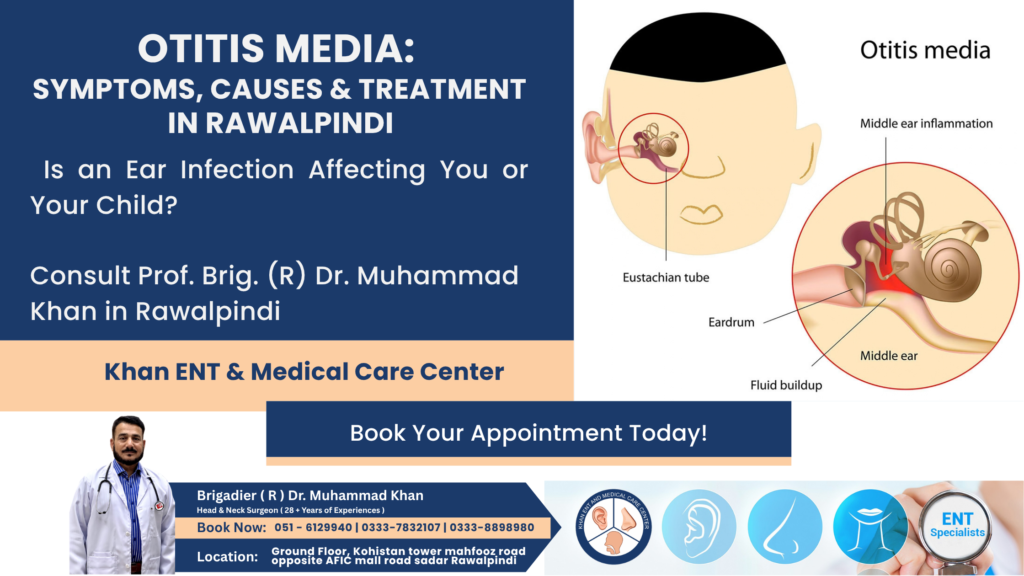
Otitis Media: Symptoms, Causes & Treatment in Rawalpindi is an important topic for parents and adults experiencing ear pain, blocked hearing, pressure, fever, or fluid coming from the ear. Otitis media is a middle ear infection that develops in the space behind the eardrum, often after a cold or upper respiratory infection. Although it is particularly common in children, adults can also develop middle ear infections.
At Khan ENT & Medical Care Center, Rawalpindi, residents of Rawalpindi and Islamabad can seek evaluation for ear infections, recurrent ear problems, hearing changes, and other ENT conditions. Prof. Brig. (R) Dr. Muhammad Khan provides ENT assessment and management at the center, helping patients understand the cause of their symptoms and the appropriate treatment approach.
What Is Otitis Media?
Otitis media is an infection or inflammation affecting the middle ear, the air-filled area located behind the eardrum. It commonly develops when fluid becomes trapped in the middle ear and viruses or bacteria grow in that fluid.
The Eustachian tube connects the middle ear with the back of the nose and throat. Its role includes helping equalize pressure and allowing fluid to drain from the middle ear. When this tube becomes swollen or blocked during a cold, flu, allergy, or other respiratory illness, fluid can accumulate behind the eardrum.
This trapped fluid can become infected, resulting in symptoms such as earache, pressure, reduced hearing and sometimes drainage from the ear.
Otitis media is particularly common in young children because their Eustachian tubes are smaller and positioned differently from those of adults. However, recurrent or persistent otitis media can also affect adults and may require assessment by an ENT specialist.
Otitis Media Symptoms
Recognizing otitis media symptoms early can help patients receive appropriate medical assessment. Symptoms may develop suddenly, particularly following a cold or upper respiratory infection.
Common symptoms include:
- Ear pain or earache
- A feeling of fullness or pressure inside the ear
- Muffled or reduced hearing
- Fever
- Headache
- Irritability in young children
- Difficulty sleeping
- Loss of appetite
- Balance problems
- Fluid or discharge from the ear
Young children may not be able to explain that their ear hurts. Instead, parents may notice that the child repeatedly pulls or rubs the ear, becomes unusually irritable, cries more than usual, has difficulty sleeping, or does not respond to sounds as normally as before.
If the eardrum becomes perforated because of pressure and infection, fluid, pus, or blood may come from the ear. A perforated eardrum often heals naturally, but medical evaluation is important to determine whether further treatment or monitoring is required.
What Causes Otitis Media?
Otitis media can be caused by viruses, bacteria, or a combination of factors that result in infected fluid behind the eardrum.
A common sequence begins with a cold or another upper respiratory infection. Swelling around the Eustachian tube can interfere with normal drainage from the middle ear. Fluid then becomes trapped behind the eardrum, creating an environment where infection can develop.
Bacteria associated with middle ear infections include Streptococcus pneumoniae, Haemophilus influenzae and Moraxella catarrhalis.
Other factors can also increase the likelihood of developing an ear infection. These include exposure to cigarette smoke, frequent respiratory infections, group childcare exposure, a family history of recurrent ear infections and conditions that affect immune function.
In children, enlarged or swollen adenoids can also contribute to Eustachian tube blockage and recurrent middle ear problems.
Why Are Children More Likely to Develop Otitis Media?
Children experience otitis media more frequently than adults because their Eustachian tubes are smaller and less effective at draining middle ear fluid.
Young children also commonly encounter respiratory infections through school, daycare and other group environments. When a cold causes inflammation around the Eustachian tubes, fluid can remain trapped behind the eardrum.
This is why parents should pay attention to repeated ear infections, persistent hearing difficulties, speech concerns or changes in a child’s response to sound.
Repeated middle ear infections or persistent fluid can temporarily reduce hearing. In young children, ongoing hearing difficulties may interfere with communication and speech development, making timely assessment particularly important.
Otitis Media in Adults
Although otitis media is more common in children, adults can develop middle ear infections as well.
In adults, an ear infection may occur after a cold, flu, allergy or another condition that interferes with normal Eustachian tube function. Persistent Eustachian tube blockage can cause fluid to remain behind the eardrum.
Adults with repeated or unexplained middle ear infections should have an ENT assessment. Recurrent symptoms may require evaluation of the ear, nose, throat and Eustachian tube to identify an underlying cause.
How Is Otitis Media Diagnosed?
Diagnosis usually begins with a discussion of symptoms and a physical examination of the ear.
An ENT specialist may use an otoscope to examine the ear canal and eardrum. Signs such as inflammation, swelling, fluid behind the eardrum or changes in the appearance of the eardrum can help establish the diagnosis.
Depending on the symptoms and history, additional testing may be appropriate.
Tympanometry can help assess middle ear function and identify fluid or pressure abnormalities behind the eardrum. A hearing test may also be recommended when hearing loss is present, particularly when infections are recurrent or fluid remains in the middle ear.
For children with repeated infections or persistent hearing concerns, an audiological evaluation can provide useful information about hearing function.
Otitis Media Treatment in Rawalpindi
Otitis Media: Symptoms, Causes & Treatment in Rawalpindi can vary considerably from one patient to another. Treatment depends on factors such as the patient’s age, severity of symptoms, duration of the infection, whether fluid remains behind the eardrum and whether complications are present.
Many uncomplicated middle ear infections improve without antibiotics. In appropriate cases, healthcare professionals may initially recommend observation and symptom management.
Pain and fever can often be managed with medicines recommended by a healthcare professional. Parents should always follow age-appropriate dosing advice and should not give medicines to children without appropriate medical guidance.
Antibiotics may be recommended when the clinical assessment indicates that they are appropriate. Antibiotics are not automatically required for every ear infection because many infections can improve without them, and unnecessary antibiotic use can cause side effects and contribute to antibiotic resistance.
For children with repeated infections or persistent middle ear fluid associated with hearing problems, an ENT specialist may consider additional treatment options. In selected cases, ear tubes may be recommended to help ventilate the middle ear and allow fluid to drain.
Treatment should therefore be based on an examination rather than simply assuming that every earache is an ear infection.
Can Otitis Media Cause Hearing Loss?
Yes. Temporary hearing reduction can occur when fluid or inflammation affects the middle ear.
In many cases, hearing improves as the infection and fluid resolve. However, recurrent infections, persistent fluid, eardrum damage or problems involving the middle ear structures can result in more prolonged hearing difficulties.
Hearing concerns are especially important in young children because hearing plays an important role in speech and language development.
If a child continues to have difficulty responding to sounds after an ear infection, a hearing assessment may help determine whether fluid or another middle ear problem is affecting hearing.
Possible Complications of Otitis Media
Most cases of otitis media resolve without serious complications. However, persistent or recurrent infections can sometimes lead to problems.
Possible complications include persistent middle ear fluid, eardrum perforation and hearing loss.
A rare but serious complication is mastoiditis, an infection involving the bone behind the ear. Redness, swelling, significant pain behind the ear or an ear that appears pushed forward requires urgent medical assessment.
Repeated infections and persistent fluid should also be evaluated because ongoing hearing difficulties may affect communication and, in children, speech development.
When Should You See an ENT Specialist?
You should arrange an ENT evaluation if ear pain persists, hearing becomes reduced, fluid or pus comes from the ear, infections repeatedly return, or symptoms are becoming worse.
Parents should also seek medical advice when a child becomes unusually irritable after a cold, has difficulty sleeping because of ear discomfort, appears not to hear normally, develops fever, or repeatedly pulls at the ear.
Urgent medical attention is particularly important when there is severe illness, significant swelling or redness behind the ear, facial weakness, severe balance problems, or blood or pus draining from the ear.
Why Consider Prof. Brig. (R) Dr. Muhammad Khan in Rawalpindi?
For residents searching for Otitis Media: Symptoms, Causes & Treatment in Rawalpindi, choosing an appropriate ENT setting is important because ear infections can have different causes and may sometimes be confused with other ear conditions.
Prof. Brig. (R) Dr. Muhammad Khan provides ENT consultation at Khan ENT & Medical Care Center, Rawalpindi. Patients from Rawalpindi and Islamabad can consider an ENT evaluation when they need assessment of persistent ear pain, recurrent middle ear infections, hearing changes, ear discharge or suspected Eustachian tube problems.
An ENT consultation can help determine whether symptoms are consistent with otitis media and whether further examination, hearing assessment, tympanometry, medical treatment or follow-up is appropriate.
Khan ENT & Medical Care Center serves patients seeking ENT care in Rawalpindi, including people coming from surrounding areas of Rawalpindi and Islamabad. The clinic’s online presence is available through entspecialistrawalpindi.com and khanentmedicalcare.com.
How Can Otitis Media Be Prevented?
Not every ear infection can be prevented, but several measures may reduce the risk, particularly in children.
Avoiding exposure to secondhand smoke is important. Good hand hygiene can reduce the spread of respiratory infections. Keeping vaccinations up to date can also help prevent illnesses associated with ear infections.
Breastfeeding may provide additional protection against ear infections. For bottle-fed babies, keeping the baby upright during feeding rather than feeding while lying flat may also reduce risk.
Parents should also discuss recurrent ear infections with an ENT specialist rather than repeatedly treating symptoms without identifying why infections keep returning.
Frequently Asked Questions About Otitis Media
What is otitis media?
Otitis media is an infection or inflammation of the middle ear, the space behind the eardrum. It commonly occurs when fluid becomes trapped in the middle ear and becomes infected.
What are the common symptoms of otitis media?
Common symptoms include ear pain, pressure or fullness, reduced hearing, fever and sometimes fluid or discharge from the ear. Children may also become irritable, have trouble sleeping or repeatedly pull at their ears.
What causes otitis media?
Otitis media can result from viruses or bacteria. It often follows a cold or upper respiratory infection that causes swelling and blockage of the Eustachian tube, allowing fluid to collect behind the eardrum.
Is otitis media common in children?
Yes. Otitis media is particularly common in young children because their Eustachian tubes are smaller and less effective at draining middle ear fluid.
Can adults get otitis media?
Yes. Adults can develop middle ear infections, particularly when Eustachian tube function is affected by respiratory infections, allergies or other causes of blockage.
Does otitis media cause hearing loss?
Otitis media can cause temporary hearing loss when fluid or inflammation affects the middle ear. Hearing commonly improves as the infection and fluid resolve, but persistent or recurrent problems should be evaluated.
Do all ear infections require antibiotics?
No. Some middle ear infections improve without antibiotics. Whether antibiotics are appropriate depends on the patient’s age, symptoms, severity, examination findings and clinical circumstances.
Can otitis media go away on its own?
Many uncomplicated cases improve naturally. However, persistent symptoms, worsening pain, hearing problems, recurrent infections or ear discharge should be assessed by a healthcare professional.
When should I see an ENT specialist for otitis media?
An ENT consultation is appropriate for recurrent ear infections, persistent hearing difficulties, ongoing ear pain, fluid or discharge from the ear, suspected eardrum problems or symptoms that do not improve.
Where can I get otitis media treatment in Rawalpindi?
Patients looking for Otitis Media: Symptoms, Causes & Treatment in Rawalpindi can consult Prof. Brig. (R) Dr. Muhammad Khan at Khan ENT & Medical Care Center, Rawalpindi, for ENT assessment and appropriate management of ear-related conditions.