
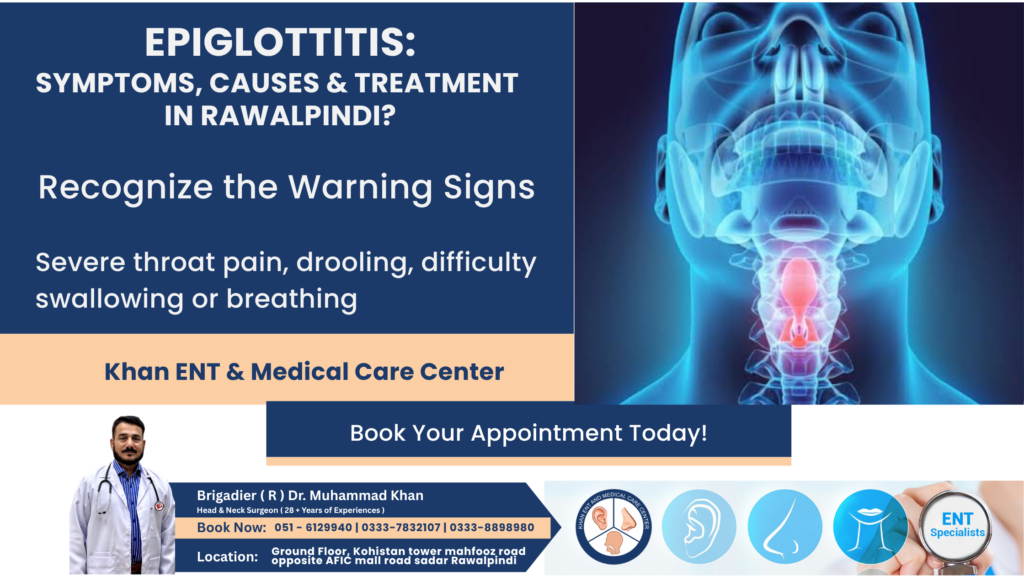
Epiglottitis: Symptoms, Causes & Treatment is an important topic because epiglottitis is a rare but potentially life-threatening condition that can cause sudden swelling of the epiglottis and nearby tissues. The swollen epiglottis can narrow or completely block the upper airway, making breathing difficult. Because airway obstruction can develop rapidly, suspected epiglottitis requires urgent medical assessment and emergency treatment.
The epiglottis is a small, flexible flap of cartilage located above the larynx. It helps prevent food and liquids from entering the windpipe during swallowing. When the epiglottis becomes inflamed and swollen, normal airflow can be affected. Epiglottitis can occur in children and adults, although widespread Haemophilus influenzae type b (Hib) vaccination has made Hib-related childhood disease much less common.
Emergency warning: Severe difficulty breathing, difficulty swallowing, drooling, stridor, a muffled voice, or rapidly worsening throat symptoms may indicate a dangerous airway problem. Do not attempt to examine the throat at home. Epiglottitis Symptoms, Causes & Treatment emergency medical care immediately.
What Is Epiglottitis?
Epiglottitis is inflammation and swelling of the epiglottis and, particularly in adults, surrounding supraglottic tissues. The condition is sometimes called supraglottitis because inflammation may involve structures around the epiglottis.
The epiglottis normally moves during swallowing and helps protect the airway. When infection, trauma, heat, chemicals or another inflammatory process causes it to swell, the airway may become progressively narrower. Severe swelling can result in respiratory distress or complete airway obstruction.
Unlike an ordinary sore throat, epiglottitis should never be treated as a minor throat infection when breathing or swallowing is affected.
Epiglottitis Symptoms
Recognizing epiglottitis symptoms early is critical because the condition can worsen quickly.
Common symptoms include:
- Severe sore throat
- Painful swallowing
- Difficulty swallowing
- Drooling because swallowing saliva becomes difficult
- Fever
- Hoarse or muffled voice
- Difficulty breathing
- Stridor, which is a high-pitched sound when breathing in
- Anxiety, restlessness or distress
- Difficulty lying flat
- Sitting upright or leaning forward to breathe
Adults may initially experience severe throat pain and difficulty swallowing without obvious throat findings. Symptoms can develop over several hours or days. Children, particularly those with smaller airways, can deteriorate more rapidly.
The 3 Ds of Epiglottitis
In children, a classic warning pattern is sometimes described as the 3 Ds:
- Drooling
- Dysphagia — difficulty swallowing
- Distress — difficulty breathing or significant respiratory distress
Stridor, fever, a muffled voice and sitting forward may also occur.
What Epiglottitis: Symptoms, Causes & Treatment?
The most common cause of epiglottitis is infection, particularly bacterial infection. However, noninfectious causes can also produce significant swelling.
Bacterial Infections
Historically, Haemophilus influenzae type b (Hib) was a major cause of childhood epiglottitis. Routine Hib vaccination has dramatically reduced Hib-related epiglottitis in vaccinated populations.
Other bacteria that can be associated with epiglottitis or supraglottitis include:
- Streptococcus pneumoniae
- Staphylococcus aureus
- Streptococcal species
- Other respiratory and oral bacteria
In adults, non-Hib bacterial infections are more frequently involved.
Other Causes
Possible noninfectious causes include:
- Burns from very hot liquids
- Smoke or thermal injury
- Physical trauma to the throat
- Foreign-body injury
- Chemical or caustic burns
- Smoking or vaping-related irritation
- Certain infections in people with weakened immune systems
The exact cause may differ from one patient to another, so medical evaluation is important.
Who Is at Risk of Epiglottitis?
Epiglottitis can affect anyone, but certain factors may increase risk.
These include:
- Incomplete Hib vaccination
- A weakened immune system
- Diabetes or other conditions that increase susceptibility to infection
- Throat trauma
- Exposure to chemical or thermal injury
- Smoking or vaping
- Certain bacterial or viral infections
Although childhood Hib epiglottitis has become uncommon where vaccination coverage is high, adults can still develop infectious supraglottitis.
Is Epiglottitis an Emergency?
Yes. Epiglottitis is a medical emergency.
The greatest danger is sudden airway obstruction. A person who initially appears relatively stable can deteriorate as swelling increases.
Seek emergency care immediately if someone develops:
- Difficulty breathing
- Stridor
- Severe difficulty swallowing
- Drooling
- A rapidly worsening sore throat
- A muffled or abnormal voice
- Blue or gray lips or skin
- Severe anxiety or respiratory distress
- Difficulty speaking because of breathing problems
Keep the person calm and upright if that is more comfortable for breathing. Do not force them to lie down and do not put fingers, instruments or food into the mouth to inspect the throat. Emergency assessment should take priority.
How Is Epiglottitis Diagnosed?
Diagnosis depends on the patient’s age, symptoms, airway stability and clinical condition.
The first priority is always to determine whether the airway is safe. In a stable adult, an ENT specialist may use flexible fiberoptic nasopharyngoscopy or laryngoscopy to examine the supraglottic structures. Blood tests and cultures may help identify infection. Imaging, including neck X-ray or CT, may be considered in selected stable patients.
Important Safety Point
A person with suspected epiglottitis should not undergo unnecessary throat manipulation, particularly when airway obstruction is suspected. In children with significant symptoms, examination or procedures that cause agitation may worsen airway compromise. Airway management should be performed by appropriately trained emergency, anesthesia and ENT teams.
Epiglottitis Treatment
The main goals of epiglottitis treatment are to protect the airway and treat the underlying cause.
Airway Management
If swelling is compromising breathing, doctors may provide oxygen and secure the airway with endotracheal intubation. In rare, severe situations where conventional intubation is not possible, an emergency surgical airway such as tracheostomy may be required.
Airway decisions are individualized, particularly in adults, because not every patient requires immediate intubation. However, patients with significant airway compromise require urgent specialist management.
Antibiotics
When bacterial infection is suspected, intravenous broad-spectrum antibiotics are commonly started promptly. Treatment can later be adjusted according to culture results and the suspected organism.
Hospital Monitoring
Patients with epiglottitis generally require close hospital observation because airway swelling can change quickly. Some patients require intensive care monitoring, particularly when breathing is compromised.
Treatment of the Underlying Cause
If swelling results from trauma, chemical exposure, thermal injury or another noninfectious cause, treatment is directed toward that specific problem.
Can Epiglottitis Be Prevented?
Not every case can be prevented, but the risk of certain types can be reduced.
Hib Vaccination
Keeping children up to date with recommended Hib vaccination is one of the most important preventive measures against invasive Hib disease, including Hib-related epiglottitis.
Reduce Throat Injury
Avoid extremely hot liquids and situations that can cause direct throat injury or chemical burns.
Practice Good Hygiene
Regular handwashing and sensible infection-control practices can reduce exposure to respiratory infections.
Avoid Smoking and Vaping
Smoking and vaping can irritate the upper airway and may contribute to inflammatory airway problems.
Possible Complications of Epiglottitis
Without rapid treatment, epiglottitis can cause serious complications, including:
- Severe airway obstruction
- Respiratory failure
- Low blood oxygen levels
- Epiglottic abscess
- Pneumonia
- Bloodstream infection
- Sepsis
- Cardiac arrest
- Death
The good news is that most patients who receive timely and appropriate treatment recover well.
Epiglottitis vs. a Severe Sore Throat
A simple sore throat commonly causes pain, irritation and difficulty swallowing. Epiglottitis is different because swelling can threaten the airway.
A particularly concerning combination is:
Severe throat pain + difficulty swallowing + drooling + muffled voice + breathing difficulty or stridor.
This combination warrants emergency assessment rather than routine home treatment.
Why Choose an ENT Specialist in Rawalpindi for Epiglottitis: Symptoms, Causes & Treatment?
For residents of Rawalpindi and Islamabad for Epiglottitis: Symptoms, Causes & Treatment, access to an experienced ENT and Head & Neck Surgeon can be valuable when serious throat, airway or swallowing symptoms require specialist evaluation.
Prof. Brig. (R) Dr. Muhammad Khan, Senior ENT & Head & Neck Surgeon, provides ENT and head & neck surgical care at Khan ENT & Medical Care Center, Rawalpindi. His background as a retired military consultant and former professor, together with extensive ENT and head & neck surgical experience, supports a specialist approach to complex ear, nose, throat and head & neck conditions.
Residents of Rawalpindi and Islamabad may consider his practice when they need experienced ENT assessment, particularly for persistent swallowing problems, voice and airway disorders, throat conditions or conditions requiring surgical evaluation.
For Epiglottitis: Symptoms, Causes & Treatment routine ENT consultation and specialist information, visit Khan ENT & Medical Care Center, Rawalpindi.
Frequently Asked Questions About Epiglottitis
What is epiglottitis?
Epiglottitis is inflammation and swelling of the epiglottis and surrounding upper-airway tissues. Severe swelling can obstruct breathing, making the condition a medical emergency.
What are the most common symptoms of epiglottitis?
Common symptoms include severe sore throat, painful or difficult swallowing, drooling, fever, muffled or hoarse voice, stridor and difficulty breathing.
Is epiglottitis life-threatening?
Yes. Severe swelling can block the airway and cause respiratory failure. Immediate medical assessment is essential when epiglottitis is suspected.
What causes epiglottitis?
Bacterial infections are important causes. Hib was historically a major cause in children, while other bacteria commonly contribute to adult disease. Trauma, burns, chemical injury and other inflammatory causes can also produce epiglottic swelling.
Can adults get epiglottitis?
Yes. Epiglottitis and supraglottitis can affect adults. Adults may develop symptoms over a longer period, but the condition can still progress to dangerous airway obstruction.
Can children still get epiglottitis?
Yes, although Hib vaccination has made Hib-related childhood epiglottitis much less common in vaccinated populations. Other organisms and noninfectious causes can still cause epiglottic inflammation.
How is epiglottitis diagnosed?
After assessing airway safety, doctors may use flexible laryngoscopy, blood tests, cultures and selected imaging studies. The specific approach depends on the patient’s age and clinical stability.
How is epiglottitis treated?
Treatment focuses first on protecting the airway. Oxygen, airway support or intubation may be required. When bacterial infection is suspected, intravenous antibiotics are commonly administered.
Can epiglottitis be treated at home?
No. Suspected epiglottitis should not be managed at home because airway swelling can worsen rapidly. Emergency medical evaluation is required, especially when breathing or swallowing is difficult.
When should I see an ENT specialist for throat or swallowing problems?
Persistent difficulty swallowing, recurrent throat problems, voice changes or other ENT symptoms should be evaluated by an appropriate medical professional. However, difficulty breathing, stridor, drooling or rapidly worsening swallowing difficulty requires emergency care immediately, rather than waiting for a routine ENT appointment.