
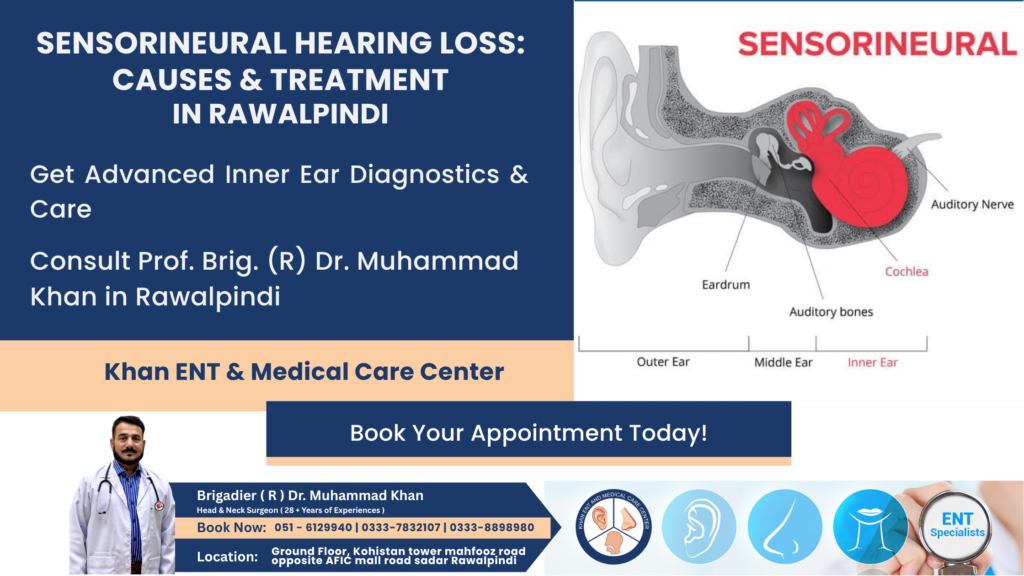
Sensorineural Hearing Loss: Causes and Treatment in Rawalpindi begins with understanding how inner ear damage affects auditory perception, speech comprehension, and quality of life. Sensorineural Hearing Loss: Causes and Treatment in Rawalpindi requires specialized medical expertise, accurate diagnostic technology, and personalized clinical management to manage inner ear and auditory nerve impairments effectively. For individuals residing in Rawalpindi and Islamabad, seeking Sensorineural Hearing Loss: Causes and Treatment in Rawalpindi is essential to prevent long-term communication barriers and social isolation. At Khan ENT & Medical Care Center in Rawalpindi, comprehensive evaluations help identify whether hearing degradation stems from structural inner ear damage, noise exposure, aging, or underlying medical conditions. Accessing top-tier Sensorineural Hearing Loss: Causes and Treatment in Rawalpindi ensures patients receive timely intervention, whether through medical management, sound amplification, or advanced surgical solutions.
Understanding Sensorineural Hearing Loss
Sensorineural hearing loss, frequently abbreviated as SNHL, is a permanent type of hearing impairment resulting from damage to the delicate microscopic hair cells inside the cochlea or along the vestibulocochlear nerve pathways. When these hair cells or nerve fibers suffer injury, they lose their ability to convert mechanical sound vibrations into electrical signals destined for the brain. Consequently, sounds lack clarity, speech becomes difficult to comprehend, and environmental awareness declines.
Unlike conductive hearing loss—which involves physical blockages or mechanical issues in the outer or middle ear—sensorineural hearing loss directly impacts the neural pathways of hearing. In some instances, patients present with mixed hearing loss, combining both conductive and sensorineural components. Seeking specialized consultation for Sensorineural Hearing Loss: Causes and Treatment in Rawalpindi allows patients to obtain an exact diagnosis differentiating these conditions.
Types of Sensorineural Hearing Loss
Sensorineural hearing impairment presents in several distinct forms based on onset, symmetry, and lateral distribution:
- Unilateral Sensorineural Hearing Loss: Affects only one ear, impairing sound localization and understanding speech in background noise.
- Bilateral Sensorineural Hearing Loss: Occurs in both ears simultaneously, impacting overall communication capabilities.
- Asymmetrical Sensorineural Hearing Loss: Involves hearing loss in both ears, but one ear exhibits noticeably worse auditory degradation than the other.
- Sudden Sensorineural Hearing Loss: A medical emergency characterized by rapid hearing loss occurring within a brief timeframe, often requiring immediate medical intervention.
Navigating these variations requires tailored expertise in Sensorineural Hearing Loss: Causes and Treatment in Rawalpindi to preserve residual hearing and improve patient outcomes.
Primary Causes of Sensorineural Hearing Loss
Understanding the root causes of hearing impairment is crucial for creating effective treatment strategies. Prominent factors leading to inner ear damage include:
- Age-Related Deterioration (Presbycusis): Natural aging leads to progressive degeneration of inner ear hair cells, primarily affecting high-frequency sound perception.
- Acoustic Trauma and Excessive Noise Exposure: Prolonged exposure to loud industrial noise, firearms, or high-volume sound devices damages cochlear structures.
- Ototoxic Medications: Specific pharmaceutical compounds, including certain antibiotics, chemotherapy agents, and anti-inflammatory drugs, can harm inner ear sensory cells.
- Viral Infections and Autoimmune Conditions: Infections such as meningitis, mumps, measles, or herpes zoster, along with autoimmune inner ear diseases, cause severe inflammation and neural damage.
- Acoustic Neuroma and Tumors: Benign growths along the vestibulocochlear nerve can disrupt sound transmission from the ear to the brain.
- Systemic Diseases and Vascular Disorders: Conditions such as diabetes, hypertension, and cardiovascular diseases impair microvascular blood flow to the inner ear, compromising hair cell function.
- Head Injury and Trauma: Skull fractures or direct acoustic trauma can rupture inner ear membranes or damage nerve fibers.
Because identifying the root cause determines the success of management, obtaining early evaluation for Sensorineural Hearing Loss: Causes and Treatment in Rawalpindi is highly recommended.
Recognizable Symptoms and Warning Signs
Recognizing early warning signs allows individuals to seek professional evaluation for Sensorineural Hearing Loss: Causes and Treatment in Rawalpindi before severe impairment develops. Key symptoms include:
- Difficulty understanding speech in noisy environments or social gatherings.
- Feeling as though other people are mumbling or slurring their words.
- Persistent ringing, buzzing, or roaring noises in the ears (tinnitus). Facebook
- Inability to hear high-pitched sounds, such as children’s voices or doorbell chimes.
- Needing to turn up the volume on televisions or audio devices higher than others prefer.
- Occasional dizziness, lightheadedness, or balance instability. Facebook
Modern Diagnostic Techniques for Inner Ear Health
Effective management of Sensorineural Hearing Loss: Causes and Treatment in Rawalpindi depends on precise diagnostic evaluations. At Khan ENT & Medical Care Center, state-of-the-art audiological testing equipment ensures detailed clinical evaluation.
Facebook+ 1
- Video Otoscopy: Examines the ear canal and eardrum to rule out mechanical blockages, cerumen impaction, or middle ear fluid.
- Pure Tone Audiometry (PTA): Measures hearing sensitivity across various frequencies to identify the exact thresholds and severity of hearing loss.
- Tympanometry and Acoustic Reflex Testing: Evaluates middle ear function and stapedial muscle responses to loud sound stimulation.
- Speech Audiometry: Assesses word recognition and speech discrimination abilities in quiet and noisy settings.
- Auditory Brainstem Response (ABR) and Otoacoustic Emissions (OAE): Analyzes neural signaling from the cochlea to the brainstem, essential for pediatric and non-verbal evaluations.
- Imaging Modalities (MRI/CT Scans): Helps visualize internal auditory canals and rule out acoustic neuromas or structural anomalies.
Evidence-Based Treatment Options in Rawalpindi
While inner ear hair cell damage is typically permanent, modern medical interventions offer substantial rehabilitation. Comprehensive options for Sensorineural Hearing Loss: Causes and Treatment in Rawalpindi include:
Digital Hearing Aids
Advanced digital hearing aids amplify specific compromised sound frequencies while reducing background noise. Customized programming based on Pure Tone Audiometry results ensures natural sound perception and improved speech clarity.
Cochlear Implants and Surgical Solutions
For severe to profound bilateral sensorineural hearing loss where conventional hearing aids provide minimal benefit, cochlear implants bypass damaged sensory hair cells to directly stimulate the auditory nerve. Bone-anchored hearing systems (BAHA) offer alternative solutions for single-sided deafness.
Pharmacological Interventions
Sudden sensorineural hearing loss requires immediate medical attention. Timely administration of corticosteroids—orally or via intratympanic injections—can reduce inner ear inflammation and promote potential hearing recovery.
Assistive Listening Devices and Tinnitus Management
Complementary devices, sound generators, and auditory rehabilitation programs assist patients in managing tinnitus and navigating complex acoustic environments.
Receiving customized care for Sensorineural Hearing Loss: Causes and Treatment in Rawalpindi ensures each patient receives the ideal intervention for their specific lifestyle and clinical needs.
Khan ENT And Medical Care Center
Why Choose Prof. Brig. (R) Dr. Muhammad Khan at Khan ENT & Medical Care Center?
When seeking world-class Sensorineural Hearing Loss: Causes and Treatment in Rawalpindi, residents across Rawalpindi and Islamabad trust Prof. Brig. (R) Dr. Muhammad Khan. Located centrally at Khan ENT & Medical Care Center (Ground Floor, Kohistan Tower, Mahfooz Road, opposite AFIC, Saddar, Rawalpindi), his clinic stands out for several reasons:
- Decades of Clinical and Military Excellence: As a retired Brigadier from the Army Medical Corps and former Professor at Armed Forces Postgraduate Medical Institute, Dr. Khan brings vast clinical experience in otolaryngology and head & neck surgery. ENT specialist
- Comprehensive Professional Qualifications: Holding MBBS, FCPS (Oto-Rhino-Laryngology), MCPS, and Diplomat AFPGMI, Dr. Khan delivers precise diagnostic evaluations and surgical expertise. ENT specialist
- State-of-the-Art Diagnostic Center: Khan ENT & Medical Care Center is equipped with modern audiological evaluation tools, pure tone audiometry, video otoscopy, and microsuction facilities. Facebook
- Central and Accessible Location: Situated in Saddar Rawalpindi, near CMH and Mega Medical Complex, the clinic offers convenient access for patients from Rawalpindi Cantt, Chaklala, Bahria Town, DHA, and Islamabad. entspecialistrawalpindi.com
- Patient-Centered Approach: Dedicated to personalized care, Prof. Brig. (R) Dr. Muhammad Khan ensures every patient receives thorough explanations, accurate diagnoses, and individualized rehabilitation plans.
Residents of Rawalpindi and Islamabad seeking reliable Sensorineural Hearing Loss: Causes and Treatment in Rawalpindi benefit from Dr. Khan’s disciplined military precision, surgical expertise, and empathetic approach.
Frequently Asked Questions (FAQs)
What is sensorineural hearing loss?
Sensorineural hearing loss occurs due to damage within the inner ear cochlea or the auditory nerve pathways connecting the ear to the brain. It impairs sound signal conversion and neural transmission, causing reduced sound clarity and speech comprehension difficulties.
Is sensorineural hearing loss reversible or permanent?
In most cases, sensorineural hearing loss is permanent because damaged sensory hair cells inside the inner ear cannot regenerate naturally. However, treatments like hearing aids, cochlear implants, and timely corticosteroid therapy for sudden cases can significantly restore hearing function.
What is the difference between sensorineural and conductive hearing loss?
Sensorineural hearing loss involves damage to the inner ear hair cells or hearing nerve. Conductive hearing loss occurs when physical obstacles—such as earwax buildup, fluid, or eardrum perforation—block sound waves from passing through the outer or middle ear.
What causes sudden sensorineural hearing loss?
Sudden sensorineural hearing loss can result from viral infections, vascular compromise, autoimmune disorders, inner ear membrane ruptures, acoustic trauma, or head injuries. It is considered a medical emergency requiring immediate evaluation by an ENT specialist.
How is sensorineural hearing loss diagnosed?
Diagnosis involves a complete medical history, physical exam with video otoscopy, and comprehensive audiological evaluations including Pure Tone Audiometry (PTA), tympanometry, speech discrimination tests, and occasionally imaging studies like MRI.
Can hearing aids help sensorineural hearing loss?
Yes, modern digital hearing aids are the primary non-surgical treatment for mild to severe sensorineural hearing loss. They amplify sound frequencies tailored to the individual’s specific audiogram results.
Who is a candidate for cochlear implants?
Individuals with severe to profound bilateral sensorineural hearing loss who receive minimal benefit from properly fitted digital hearing aids are evaluated as candidates for surgical cochlear implantation.
Where can I get Sensorineural Hearing Loss: Causes and Treatment in Rawalpindi?
Patients can receive specialized diagnostic evaluation and treatment at Khan ENT & Medical Care Center in Saddar, Rawalpindi, under the expert guidance of Prof. Brig. (R) Dr. Muhammad Khan.
Why should patients consult Prof. Brig. (R) Dr. Muhammad Khan?
Prof. Brig. (R) Dr. Muhammad Khan possesses vast clinical and surgical experience, advanced military medical background, FCPS qualifications, and leads a fully equipped ENT care facility located near CMH in Rawalpindi.
ENT specialist
How can I prevent sensorineural hearing loss?
Preventive strategies include avoiding loud sound exposure, using certified ear protection in noisy environments, avoiding ototoxic medications when safe alternatives exist, and obtaining regular ENT checkups.