
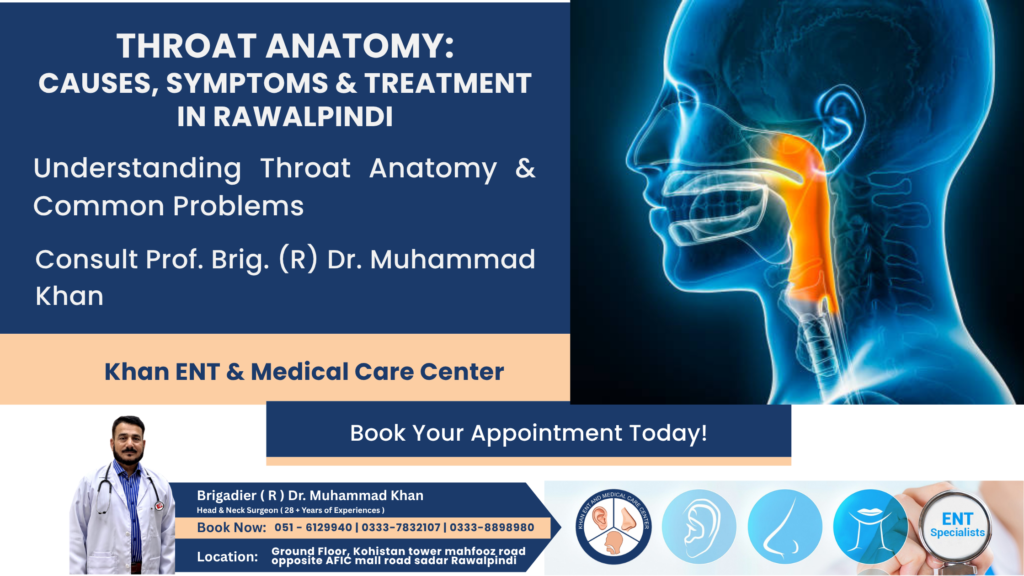
Throat Anatomy: Causes, Symptoms and Treatment in Rawalpindi is an important topic for anyone experiencing throat pain, difficulty swallowing, voice changes, breathing problems, tonsil infections, or other ENT symptoms. The throat is a complex passage connecting the nose and mouth with the breathing and digestive systems. Understanding throat anatomy helps explain how common throat conditions develop and why timely evaluation by an experienced ENT specialist can be important.
For residents searching for Throat Anatomy: Causes, Symptoms and Treatment in Rawalpindi, it is useful to understand that the throat is not a single structure. It contains the pharynx, larynx, tonsils, epiglottis, vocal folds, muscles, nerves, blood vessels and lymphatic tissues. These structures work together for breathing, swallowing, voice production and airway protection.
What Is the Throat?
The throat, medically called the pharynx, is a muscular passage located behind the nose and mouth. It connects the upper airway with the larynx and the esophagus. The pharynx carries air toward the larynx and food and liquids toward the esophagus.
The throat has three major regions: the nasopharynx, oropharynx and laryngopharynx. Each region has a different location and function, although they work together during breathing, swallowing and speech.
This detailed anatomy explains why Throat Anatomy: Causes, Symptoms and Treatment in Rawalpindi is relevant to many ENT complaints. A problem affecting one area can sometimes produce symptoms in another nearby structure.
Anatomy of the Throat
Nasopharynx
The nasopharynx is the upper part of the pharynx located behind the nose. It extends from the base of the skull to the soft palate.
It primarily participates in breathing and contains the openings of the Eustachian tubes, which connect the throat with the middle ears. The adenoids, also known as the pharyngeal tonsils, are located in this region. Enlargement of the adenoids can contribute to nasal blockage, mouth breathing, snoring and certain ear problems, particularly in children.
Oropharynx
The oropharynx is the middle part of the throat, located behind the mouth. It contains structures such as the soft palate, tonsils and back portion of the tongue.
The oropharynx plays an important role in swallowing. It also forms part of the passage used by air during breathing. Infections affecting this region can cause sore throat, tonsillitis, redness, swelling and painful swallowing.
Laryngopharynx
The laryngopharynx, also called the hypopharynx, is the lower portion of the throat. It lies behind the larynx and provides an important junction between the respiratory and digestive pathways.
At this level, swallowed food and liquids are directed toward the esophagus, while air travels toward the larynx and trachea. Proper coordination of the pharyngeal muscles, larynx and upper esophageal sphincter helps protect the airway during swallowing.
Larynx and Voice Box
The larynx, commonly called the voice box, sits between the pharynx and trachea. It contains the vocal folds, which vibrate as air passes from the lungs to produce voice.
The larynx has several important functions. It helps produce speech, maintains the airway and protects the lungs from food and liquids during swallowing. The vocal folds open during breathing and come together during voice production.
Problems involving the larynx can cause hoarseness, voice fatigue, throat discomfort, coughing or breathing difficulties.
Epiglottis and Airway Protection
The epiglottis is a flexible structure near the entrance of the larynx. During swallowing, coordinated movement of the larynx and surrounding structures helps protect the airway from swallowed material.
The vocal folds also close as part of the body’s airway-protection mechanism. This carefully coordinated process helps direct food and liquids toward the esophagus instead of the trachea.
Tonsils and Adenoids
Tonsils are lymphoid tissues located around the throat. The palatine tonsils can be seen on either side at the back of the mouth. Lingual tonsillar tissue is found near the base of the tongue, while the adenoids are located in the nasopharynx.
These tissues participate in immune defense by helping recognize substances entering through the mouth and nose. However, tonsils and adenoids can become enlarged or infected, resulting in symptoms such as sore throat, difficulty swallowing, snoring and breathing problems.
Muscles of the Throat
The pharynx contains muscles that coordinate swallowing. The pharyngeal constrictor muscles contract sequentially to move food and liquids toward the esophagus.
Other muscles help elevate and shorten the pharynx and larynx during swallowing. This complex muscular coordination is essential for moving food safely while protecting the airway.
Because swallowing involves several muscles and nerves working together, persistent swallowing difficulty should not simply be attributed to a minor throat infection.
Common Throat Problems
Understanding Throat Anatomy: Causes, Symptoms and Treatment in Rawalpindi also means understanding the conditions that can affect these structures.
Sore Throat
A sore throat can result from viral infections, bacterial infections, irritation, allergies, reflux and other causes. Symptoms may include pain, scratchiness, redness and difficulty swallowing.
Most acute sore throats are not serious, but persistent or severe symptoms require appropriate medical assessment.
Tonsillitis
Tonsillitis occurs when the tonsils become inflamed, commonly because of an infection. Symptoms may include throat pain, swollen tonsils, fever, difficulty swallowing and tender neck lymph nodes.
Repeated or severe tonsil infections may require assessment by an ENT specialist to determine whether medical treatment or tonsil surgery is appropriate.
Laryngitis and Hoarseness
Laryngitis involves inflammation of the larynx and can cause hoarseness, a weak voice or temporary voice loss. Viral infections and voice overuse are common causes, although other conditions can also affect the vocal folds.
Hoarseness lasting longer than a few weeks should be evaluated, particularly when it occurs without an obvious cold or flu. NIDCD recommends medical assessment for persistent hoarseness and highlights symptoms such as swallowing difficulty, neck lumps, breathing difficulty and coughing up blood as reasons to seek medical attention.
Dysphagia
Dysphagia means difficulty swallowing. A person may feel that food sticks in the throat, experience coughing while eating or drinking, or have difficulty moving food from the mouth toward the esophagus.
Because swallowing involves the mouth, pharynx, larynx, nerves and esophagus, persistent dysphagia requires proper evaluation rather than self-treatment.
Throat Reflux
Stomach contents can sometimes travel upward and irritate the throat and larynx. This condition is commonly referred to as laryngopharyngeal reflux.
Possible symptoms include throat clearing, chronic cough, hoarseness, throat irritation and a sensation of something being stuck in the throat.
Snoring and Sleep-Related Breathing Problems
Nasal obstruction, enlarged tonsils, enlarged adenoids, tongue position and other upper-airway factors can contribute to snoring and sleep-related breathing problems.
An ENT assessment can help determine whether the nose, throat or another part of the upper airway is contributing to the problem.
Throat and Neck Masses
A lump or swelling in the throat or neck may have many possible causes, including infections, enlarged lymph nodes, thyroid disorders and benign growths. In some cases, persistent masses may require investigation for head and neck cancer.
The National Cancer Institute notes that persistent sore throat, difficulty swallowing, voice changes and a neck lump can occur with head and neck cancers, although these symptoms can also result from less serious conditions.
Symptoms That May Indicate a Throat Problem
Symptoms vary depending on the structure involved. Common complaints include:
- Throat pain or irritation
- Difficulty or pain when swallowing
- Feeling of something stuck in the throat
- Hoarseness or voice change
- Chronic throat clearing
- Persistent cough
- Enlarged or painful tonsils
- Bad breath associated with tonsil problems
- Snoring
- Mouth breathing
- Neck swelling or a neck lump
- Breathing difficulty
- Recurrent throat infections
The combination of symptoms, their duration and examination findings helps an ENT specialist identify the likely cause.
How Throat Problems Are Diagnosed
Diagnosis begins with a detailed medical history and ENT examination. The doctor may examine the mouth, tonsils, tongue, throat, nose and neck.
Depending on the symptoms, further evaluation may include flexible nasopharyngoscopy or laryngoscopy, throat testing, imaging, blood tests or other specialized investigations.
A flexible endoscopic examination can allow an ENT specialist to inspect areas of the nose, throat and larynx that cannot be adequately viewed during a routine mouth examination.
The purpose of diagnosis is not simply to identify an infection. It is also to distinguish inflammatory, structural, neurological, reflux-related and potentially serious conditions.
Treatment for Throat Problems in Rawalpindi
Treatment depends on the underlying cause. Viral throat infections may improve with supportive care, while selected bacterial infections may require antibiotics prescribed by a doctor.
Tonsillitis, enlarged tonsils, adenoid problems, chronic sinus-related throat symptoms, vocal cord disorders and structural abnormalities may require specialized ENT treatment.
For persistent hoarseness, swallowing difficulty, breathing problems, recurrent tonsillitis or suspicious throat or neck findings, specialist assessment is particularly important.
When surgery is necessary, the procedure depends on the specific condition. ENT surgery may include tonsillectomy, adenoidectomy, vocal cord procedures, airway procedures or surgery for selected head and neck conditions.
Throat Anatomy: Causes, Symptoms and Treatment in Rawalpindi at Khan ENT & Medical Care Center
For patients searching for Throat Anatomy: Causes, Symptoms and Treatment in Rawalpindi, expert ENT evaluation can help identify the actual source of symptoms instead of treating throat discomfort without understanding its cause.
Prof. Brig. (R) Dr. Muhammad Khan is a senior ENT and head and neck surgeon providing specialized ENT care at Khan ENT & Medical Care Center, Rawalpindi. His clinical expertise covers disorders involving the ear, nose, throat, voice, airway and head and neck.
Residents of Rawalpindi and Islamabad may prefer an experienced ENT and head and neck surgeon when symptoms are persistent, recurrent, complicated or potentially require a procedure. Specialist assessment is especially valuable when throat complaints involve swallowing difficulty, persistent hoarseness, breathing problems, recurrent infections or a neck lump.
Patients can learn more about ENT services and specialist care through Khan ENT & Medical Care Center.
When Should You See an ENT Specialist?
You should consider an ENT evaluation when throat symptoms persist, repeatedly return or interfere with eating, drinking, speaking, breathing or sleeping.
Urgent medical attention is appropriate for significant breathing difficulty, rapidly increasing throat or neck swelling, inability to swallow fluids, severe airway symptoms or other potentially serious symptoms.
Persistent hoarseness, especially when accompanied by difficulty swallowing, a neck lump, breathing difficulty or coughing up blood, should be medically evaluated.
Frequently Asked Questions About Throat Anatomy
What is the anatomy of the throat?
The throat, or pharynx, is a muscular passage behind the nose and mouth. It consists of the nasopharynx, oropharynx and laryngopharynx and connects the upper airway with the larynx and digestive tract.
What are the main parts of the throat?
The main regions are the nasopharynx, oropharynx and laryngopharynx. Nearby structures include the tonsils, tongue base, epiglottis, larynx, vocal folds, trachea and esophagus.
What does the throat do?
The throat has important roles in breathing, swallowing and speech. It directs air toward the airway and food and liquids toward the esophagus while helping protect the lungs during swallowing.
Why does my throat hurt when I swallow?
Painful swallowing can occur because of infections such as viral pharyngitis or tonsillitis, inflammation, irritation, reflux and other conditions. Persistent or severe symptoms should be evaluated by an ENT specialist.
What causes persistent throat irritation?
Persistent irritation may be related to reflux, allergies, postnasal drainage, chronic inflammation, voice overuse, smoking or other environmental irritants. An ENT examination can help identify the underlying cause.
Why do I have difficulty swallowing?
Difficulty swallowing can have several causes involving the mouth, throat, larynx, nerves or esophagus. Persistent dysphagia should be assessed medically because treatment depends on the underlying cause.
Can throat problems cause hoarseness?
Yes. Conditions affecting the larynx and vocal folds can cause hoarseness. Persistent hoarseness should be assessed, particularly when it occurs with swallowing difficulty, breathing problems or a neck lump.
Can tonsils cause throat problems?
Yes. Enlarged or infected tonsils can cause throat pain, difficulty swallowing, bad breath, recurrent infections and sometimes snoring or breathing problems.
When should I see an ENT specialist for a throat problem?
You should seek ENT evaluation for persistent throat pain, recurrent tonsillitis, ongoing hoarseness, swallowing difficulty, unexplained neck swelling, breathing problems or symptoms that do not improve as expected.
Who can treat throat problems in Rawalpindi?
Prof. Brig. (R) Dr. Muhammad Khan at Khan ENT & Medical Care Center, Rawalpindi, provides specialist ENT and head and neck care. Patients from Rawalpindi and Islamabad can seek professional assessment for persistent or complex throat, voice and airway problems.