
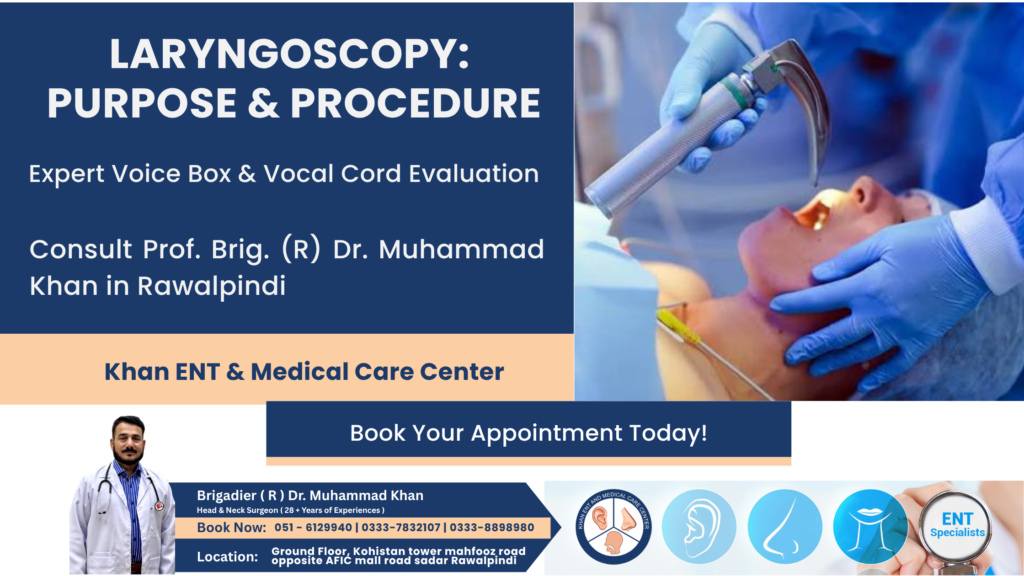
Laryngoscopy: Purpose & Procedure is an important topic for anyone experiencing persistent hoarseness, voice changes, difficulty swallowing, chronic cough, throat discomfort, or breathing problems. Laryngoscopy is an ENT procedure used to examine the larynx, vocal cords, throat, and nearby structures. It helps an ENT specialist identify the cause of symptoms, detect abnormal tissue, assess vocal cord movement, take a biopsy when necessary, and treat certain voice box conditions.
For residents of Rawalpindi and Islamabad, understanding Laryngoscopy: Purpose & Procedure can help you recognize when professional evaluation may be necessary. An experienced ENT and Head & Neck Surgeon can determine whether a flexible office examination is appropriate or whether a more detailed surgical laryngoscopy is required.
What Is Laryngoscopy?
Laryngoscopy is a diagnostic and sometimes therapeutic procedure used to examine the larynx, commonly known as the voice box. The larynx is located between the throat and windpipe and contains the vocal cords, which are responsible for producing your voice.
During Laryngoscopy: Purpose & Procedure, an ENT specialist uses a laryngoscope containing a light, camera, or optical system to obtain a clear view of the larynx and surrounding throat structures.
Depending on the symptoms and suspected condition, laryngoscopy may be performed in an ENT clinic or operating room. A flexible laryngoscope can usually be used while the patient is awake, whereas a rigid laryngoscope may require general anesthesia.
Laryngoscopy can help investigate conditions affecting the vocal cords, larynx, throat, and upper airway. It may also allow the specialist to collect tissue samples or remove certain abnormal growths.
Why Is Laryngoscopy Performed?
Understanding the purpose of laryngoscopy is an important part of Laryngoscopy: Purpose & Procedure. Your ENT specialist may recommend the examination when symptoms persist or when a closer examination of the voice box is needed.
Common reasons for laryngoscopy include:
- Persistent hoarseness or voice changes
- Weak, breathy, or strained voice
- Difficulty swallowing
- Persistent throat discomfort
- Chronic cough
- Breathing difficulty
- A sensation of something stuck in the throat
- Recurrent throat symptoms
- Vocal cord problems
- Suspected vocal cord nodules or polyps
- Vocal cord paralysis or weakness
- Abnormal throat or laryngeal findings
- Suspected tumors or throat cancer
- Unexplained coughing up of blood
- Evaluation of an abnormal area found on imaging
Laryngoscopy can also help an ENT specialist assess how the vocal cords move during speaking and breathing.
Laryngoscopy: Purpose & Procedure Explained
The exact Laryngoscopy: Purpose & Procedure depends on the type of examination required. Your ENT specialist will select the appropriate technique according to your symptoms, medical history, and suspected condition.
Flexible Laryngoscopy
Flexible laryngoscopy is commonly performed in an ENT clinic. A thin, flexible tube with a small camera and light is gently passed through the nose toward the throat.
Before the procedure, the ENT specialist may apply a local numbing spray and, when appropriate, a nasal decongestant. This helps make the examination more comfortable and allows the scope to pass smoothly.
The specialist then examines the nasal passage, throat, vocal cords, and larynx. You may be asked to speak, breathe, swallow, or make specific sounds so that vocal cord movement can be assessed.
Flexible laryngoscopy generally takes only a short time and usually does not require general anesthesia.
Rigid Laryngoscopy
Rigid laryngoscopy provides a more detailed examination of the larynx and is generally performed in an operating room. It may be recommended when a deeper examination is needed, when tissue must be collected for laboratory analysis, or when treatment is required.
The patient is usually under general anesthesia. The rigid laryngoscope is introduced through the mouth, allowing the surgeon to obtain a detailed view of the larynx and vocal cords.
Special instruments can be passed through the laryngoscope to take a biopsy, remove abnormal tissue, or treat selected lesions.
What Can Laryngoscopy Detect?
A major benefit of Laryngoscopy: Purpose & Procedure is that it provides direct visualization of the larynx and vocal cords.
Laryngoscopy may help identify:
- Laryngitis
- Vocal cord nodules
- Vocal cord polyps
- Vocal cord cysts
- Vocal cord paralysis
- Vocal cord inflammation
- Laryngeal swelling
- Abnormal tissue
- Foreign bodies
- Laryngeal lesions
- Airway narrowing
- Some early laryngeal cancers
- Other structural or functional abnormalities
Finding the cause of persistent voice or throat symptoms early can help guide appropriate treatment.
Is Laryngoscopy Painful?
Many patients are concerned about discomfort when reading about Laryngoscopy: Purpose & Procedure. Flexible laryngoscopy may cause temporary discomfort, pressure, sneezing, coughing, or a gagging sensation.
A numbing spray can reduce discomfort during flexible examination. The procedure is generally quick, and most patients tolerate it well.
Rigid laryngoscopy is performed under anesthesia, so the patient does not experience the procedure while it is being performed.
Afterward, some patients may experience temporary throat irritation, mild soreness, coughing, or hoarseness. Your ENT specialist will provide specific aftercare instructions.
How Should You Prepare for Laryngoscopy?
Preparation depends on the type of laryngoscopy being performed.
For flexible laryngoscopy performed in the clinic, extensive preparation is usually not necessary. Your doctor should know about your medications, allergies, previous medical conditions, and any previous reactions to anesthetic medicines.
If rigid laryngoscopy is planned, you may need to avoid food and drinks for a period before the procedure because general anesthesia is used. You may also need to arrange transportation home after the procedure.
Always follow the preparation instructions provided by your ENT specialist.
What Happens After Laryngoscopy?
Recovery depends on the type of Laryngoscopy: Purpose & Procedure performed.
After flexible laryngoscopy, you can generally return to normal activities according to your doctor’s advice. If your throat or nose has been numbed, you may be asked to wait until the sensation returns before eating or drinking.
After rigid laryngoscopy, you may experience mild throat soreness or temporary hoarseness. If a biopsy or tissue removal was performed, additional instructions may be provided.
If tissue was collected, the sample is sent to a laboratory for examination. Your ENT specialist will explain when the results are expected and whether additional treatment or testing is needed.
What Are the Risks of Laryngoscopy?
Laryngoscopy is generally considered a safe procedure when performed by a qualified specialist. However, temporary side effects can occur.
Possible effects include:
- Mild throat discomfort
- Temporary hoarseness
- Coughing
- Nasal irritation
- Minor nosebleed
- Sore throat
- Gagging or discomfort during flexible examination
More significant complications are uncommon but may occur with surgical laryngoscopy. These can include bleeding, infection, dental injury, tissue injury, or breathing-related complications.
Your ENT specialist will explain the potential risks based on the specific procedure recommended for you.
When Should You See an ENT Specialist?
Persistent voice or throat symptoms should not always be ignored. If hoarseness continues, swallowing becomes difficult, breathing is affected, or a throat symptom repeatedly returns, an ENT assessment may be appropriate.
Laryngoscopy can be particularly useful when symptoms cannot be adequately explained through a routine throat examination.
Early assessment is also important when there are concerning symptoms such as unexplained blood in saliva, persistent neck swelling, progressive swallowing difficulty, unexplained weight loss, or ongoing voice changes.
Laryngoscopy in Rawalpindi and Islamabad
Patients searching for Laryngoscopy: Purpose & Procedure in Rawalpindi and Islamabad should choose an ENT specialist with appropriate experience in voice, airway, and head and neck conditions.
Prof. Brig. (R) Dr. Muhammad Khan is a Senior ENT & Head & Neck Surgeon at Khan ENT & Medical Care Center, Rawalpindi. His experience in ENT and Head & Neck Surgery makes him a suitable specialist for patients requiring evaluation of voice, throat, airway, and laryngeal conditions.
Residents of Rawalpindi and Islamabad may prefer consultation with Prof. Brig. (R) Dr. Muhammad Khan when they need specialist assessment because accurate diagnosis is an important part of managing persistent voice and throat symptoms. His surgical ENT expertise also allows patients to receive assessment and guidance when further procedures or surgical treatment may be required.
For patients looking for an ENT specialist in Rawalpindi, laryngoscopy can provide valuable information that may not be available through a routine examination alone.
Laryngoscopy: Purpose & Procedure at Khan ENT & Medical Care Center
At Khan ENT & Medical Care Center, Rawalpindi, patients can seek specialist evaluation for a wide range of ENT and Head & Neck conditions. Laryngoscopy may be recommended when symptoms suggest a problem involving the vocal cords, larynx, throat, or upper airway.
Prof. Brig. (R) Dr. Muhammad Khan can assess your symptoms and determine whether laryngoscopy or another diagnostic examination is appropriate. The goal is to identify the underlying cause and recommend treatment based on the individual patient’s condition.
Patients from Islamabad, Rawalpindi, and surrounding areas can visit the center for specialist ENT and Head & Neck evaluation.
Frequently Asked Questions About Laryngoscopy
What is laryngoscopy used for?
Laryngoscopy is used to examine the larynx, vocal cords, and nearby throat structures. It can help identify the causes of hoarseness, swallowing difficulty, chronic cough, breathing problems, vocal cord abnormalities, and suspicious lesions.
How long does a laryngoscopy take?
Flexible laryngoscopy is usually a short office procedure. The exact duration depends on the examination and findings. Surgical laryngoscopy takes longer because it may involve anesthesia, detailed examination, biopsy, or treatment.
Is laryngoscopy painful?
Flexible laryngoscopy may cause temporary discomfort, coughing, or a gagging sensation. Numbing medicine can make the examination more comfortable. Surgical laryngoscopy is performed under anesthesia.
Can laryngoscopy detect throat cancer?
Laryngoscopy can help an ENT specialist identify suspicious areas or abnormal tissue in the larynx and throat. If necessary, a biopsy can be performed so the tissue can be examined in a laboratory.
Can I eat before flexible laryngoscopy?
Preparation varies according to the procedure and the specialist’s instructions. Many office-based flexible examinations require little preparation, but your ENT specialist should provide specific instructions.
Can laryngoscopy detect vocal cord problems?
Yes. Laryngoscopy allows an ENT specialist to directly examine the vocal cords and assess their appearance and movement. It can help identify nodules, polyps, inflammation, paralysis, and other abnormalities.
What should I expect after laryngoscopy?
You may experience temporary throat irritation, coughing, mild soreness, or hoarseness. Symptoms are generally short-lived, although recovery depends on the type of procedure performed.
Is laryngoscopy safe?
Laryngoscopy is generally safe. Minor temporary discomfort can occur, while significant complications are uncommon. Your ENT specialist will discuss procedure-specific risks before treatment.
Which doctor performs laryngoscopy?
Laryngoscopy is commonly performed by an ENT specialist, also known as an otolaryngologist. Head and Neck Surgeons and specialists with expertise in laryngeal disorders may also perform the procedure.
Where can I get laryngoscopy in Rawalpindi?
Patients seeking laryngoscopy in Rawalpindi can consult Prof. Brig. (R) Dr. Muhammad Khan at Khan ENT & Medical Care Center. The specialist can evaluate symptoms and determine whether laryngoscopy is appropriate for diagnosing a voice, throat, or laryngeal problem.