
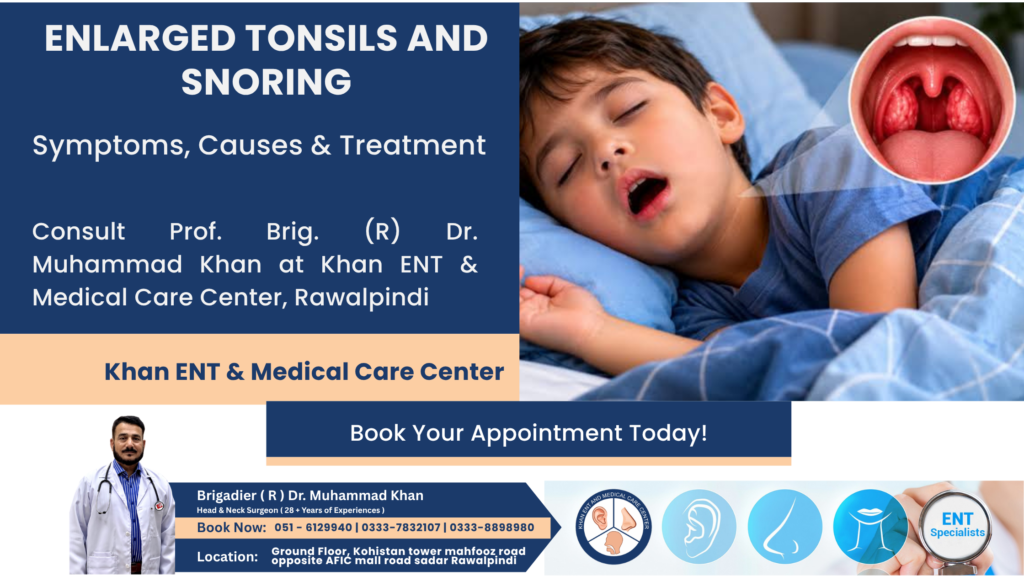
Enlarged Tonsils and Snoring: Causes and Treatment is an important topic for parents, children, teenagers, and adults who experience loud snoring, mouth breathing, disturbed sleep, or difficulty breathing at night. Enlarged tonsils can narrow the airway and make normal breathing more difficult, particularly during sleep. In some people, enlarged tonsils are temporary and related to an infection, while persistent tonsil enlargement may contribute to chronic snoring and sleep-disordered breathing.
For residents of Rawalpindi and Islamabad, persistent snoring should not simply be considered a normal sleeping habit. When snoring occurs regularly, especially when accompanied by pauses in breathing, restless sleep, daytime tiredness, mouth breathing, or difficulty swallowing, an ENT evaluation can help identify the underlying cause.
At Khan ENT & Medical Care Center, Rawalpindi, Prof. Brig. (R) Dr. Muhammad Khan provides specialist ENT assessment for patients experiencing throat, tonsil, airway, and breathing-related concerns.
What Are Enlarged Tonsils?
Tonsils are two areas of lymphatic tissue located at the back of the throat. They are part of the body’s immune system and help respond to germs entering through the mouth and nose.
Sometimes tonsils become enlarged because of infections or inflammation. In children, tonsils may remain relatively large even after an infection has resolved. This is known as tonsillar hypertrophy.
Enlarged tonsils do not always require treatment. If they are not causing symptoms, doctors may simply monitor them. However, when enlarged tonsils narrow the airway, they may contribute to snoring, mouth breathing, swallowing difficulties, recurrent throat problems, or obstructive sleep apnea.
Understanding the relationship between enlarged tonsils and snoring is therefore important when deciding whether medical assessment is necessary.
How Do Enlarged Tonsils Cause Snoring?
Snoring occurs when airflow through the nose and throat becomes partially restricted during sleep. As the muscles of the throat relax, tissues can vibrate as air passes through the narrowed airway, producing the familiar sound of snoring.
Large tonsils can occupy significant space at the back of the throat. During sleep, this reduced airway space can become more noticeable because the surrounding muscles relax.
This is one reason Enlarged Tonsils and Snoring: Causes and Treatment is particularly relevant to children. A child with enlarged tonsils may breathe normally during the day but develop loud or irregular breathing at night.
Snoring may be mild and occasional, particularly during a cold. However, regular loud snoring can sometimes indicate sleep-disordered breathing and should not automatically be ignored.
Symptoms Associated With Enlarged Tonsils and Snoring
The symptoms of enlarged tonsils vary from person to person. Common symptoms may include:
- Loud or persistent snoring
- Breathing through the mouth
- Difficulty breathing during sleep
- Restless or disturbed sleep
- Frequent waking during the night
- Pauses in breathing while asleep
- Gasping or choking during sleep
- Dry mouth in the morning
- Bad breath
- Sore throat
- Difficulty swallowing
- Changes in voice
- Trouble eating or feeding in younger children
- Daytime tiredness or irritability
- Difficulty concentrating
- Recurrent throat infections
Parents may notice symptoms before the child does. Sleeping with the mouth open, unusual sleeping positions, sweating during sleep, frequent movement, or noisy breathing can all be reasons to discuss the child’s symptoms with an ENT specialist.
Common Causes of Enlarged Tonsils
Several factors can contribute to enlarged tonsils. Repeated upper respiratory infections are a common cause, particularly in children. Viral infections can cause temporary inflammation, while bacterial throat infections may also result in significant tonsil swelling.
Other possible contributing factors include:
- Recurrent tonsillitis
- Viral or bacterial throat infections
- Chronic inflammation
- Exposure to smoke and other irritants
- Allergic conditions
- Chronic nasal obstruction
- Acid reflux in some patients
- Naturally larger tonsils
Sometimes the tonsils remain enlarged after repeated infections even when there is no active infection.
The cause is important because treatment for an active infection is different from treatment for persistent tonsillar enlargement associated with airway obstruction or sleep-disordered breathing.
Enlarged Tonsils, Snoring and Sleep Apnea
One of the most important concerns associated with enlarged tonsils and snoring is obstructive sleep apnea.
Obstructive sleep apnea occurs when the upper airway repeatedly becomes blocked during sleep. Enlarged tonsils and adenoids are important contributors to airway obstruction in children.
A child with sleep apnea may snore loudly, stop breathing briefly, gasp, move frequently, or sleep in unusual positions. Poor-quality sleep can affect daytime behavior, concentration, mood, and school performance.
Adults can also experience airway obstruction associated with enlarged tonsils. Persistent snoring, witnessed breathing pauses, morning headaches, excessive daytime sleepiness, or waking up feeling unrefreshed warrant medical assessment.
Not everyone who snores has sleep apnea, but persistent or disruptive snoring deserves appropriate evaluation.
When Should Enlarged Tonsils Be Evaluated?
Occasional enlarged tonsils during a cold or throat infection are generally not a reason for alarm. The situation becomes more important when symptoms continue after the illness has resolved or begin affecting normal activities.
An ENT evaluation is particularly appropriate when there is:
- Persistent loud snoring
- Breathing difficulty during sleep
- Repeated pauses in breathing
- Gasping or choking at night
- Difficulty swallowing
- Recurrent tonsil infections
- Significant mouth breathing
- Poor-quality sleep
- Daytime fatigue or behavioral changes
- Poor weight gain or feeding difficulties in children
- Persistent or significant one-sided tonsil enlargement
Urgent medical attention is appropriate if a person develops severe difficulty breathing, cannot swallow saliva, has rapidly worsening throat swelling, or appears seriously unwell.
How Are Enlarged Tonsils Diagnosed?
Diagnosis usually begins with a detailed medical history and physical examination.
An ENT specialist may examine the tonsils, throat, nose, ears, and neck and ask about snoring, sleep quality, recurrent infections, swallowing problems, and breathing difficulties.
The size of the tonsils is considered, but size alone does not determine whether treatment is necessary. Symptoms and their impact on breathing, sleep, swallowing, and general health are equally important.
Depending on the patient’s symptoms, the doctor may recommend additional assessment for sleep-disordered breathing or other conditions affecting the airway.
Enlarged Tonsils and Snoring: Treatment Options
Treatment for Enlarged Tonsils and Snoring: Causes and Treatment depends on the underlying cause, severity of symptoms, age, and overall health.
If enlarged tonsils are related to an infection, the appropriate treatment may be recommended after clinical assessment. Allergy or nasal problems may require medical management when they contribute to mouth breathing or airway symptoms.
For patients with mild symptoms, observation and follow-up may sometimes be appropriate.
When enlarged tonsils repeatedly cause significant problems, an ENT specialist may discuss surgical treatment. Tonsillectomy involves removing the tonsils, while other surgical approaches may be considered depending on the patient’s condition.
If enlarged adenoids are also contributing to airway obstruction, the ENT specialist may assess whether treatment of the adenoids is appropriate.
Surgery is not automatically required simply because tonsils appear large. The decision should be based on symptoms, examination findings, recurrent infections, airway obstruction, sleep-related breathing problems, and the patient’s individual circumstances.
Why Choose Prof. Brig. (R) Dr. Muhammad Khan in Rawalpindi?
Residents of Rawalpindi and Islamabad looking for evaluation of enlarged tonsils and snoring can consider an experienced ENT specialist who can assess both the throat and the broader upper airway.
Prof. Brig. (R) Dr. Muhammad Khan at Khan ENT & Medical Care Center, Rawalpindi, provides specialist ENT assessment for throat, tonsil, nose, ear, and airway-related concerns.
For patients searching locally for an ENT specialist in Rawalpindi, choosing a specialist-led evaluation can help distinguish between simple snoring, recurrent tonsillitis, enlarged tonsils, adenoid problems, nasal obstruction, and possible sleep-disordered breathing.
The clinic’s location in Saddar, Rawalpindi, also makes specialist ENT care accessible for patients traveling from Rawalpindi, Islamabad and surrounding areas.
Enlarged Tonsils and Snoring: Causes and Treatment in Rawalpindi
If you are searching for Enlarged Tonsils and Snoring: Causes and Treatment in Rawalpindi, persistent symptoms should be assessed rather than managed solely with home remedies.
At Khan ENT & Medical Care Center, patients can discuss symptoms such as chronic snoring, enlarged tonsils, recurrent throat infections, difficulty swallowing, mouth breathing, and nighttime breathing problems with an ENT specialist.
A proper evaluation can help determine whether monitoring, medical treatment, further investigation, or surgical treatment may be appropriate.
Frequently Asked Questions About Enlarged Tonsils and Snoring
Can enlarged tonsils cause snoring?
Yes. Enlarged tonsils can reduce the space available for airflow through the throat. When the airway becomes narrower during sleep, surrounding tissues may vibrate and cause snoring.
Is snoring always caused by enlarged tonsils?
No. Snoring can have several causes, including nasal blockage, enlarged adenoids, allergies, obesity, sleep position, structural airway differences, and other conditions. An ENT assessment can help identify the likely cause.
Are enlarged tonsils dangerous?
Enlarged tonsils are often harmless, particularly when they do not cause symptoms. They can become clinically important when they interfere with breathing, swallowing, sleep, or general health.
Can enlarged tonsils cause sleep apnea?
Yes. Large tonsils can contribute to narrowing of the upper airway and may play a role in obstructive sleep apnea, particularly in children.
Do enlarged tonsils always need surgery?
No. Surgery is not necessary for every patient with enlarged tonsils. Treatment depends on symptoms, recurrent infections, airway obstruction, sleep-related breathing problems, and the findings of an ENT evaluation.
Can children outgrow enlarged tonsils?
In some children, enlarged tonsils and adenoids become smaller as they grow. However, persistent symptoms such as loud snoring or breathing pauses should still be evaluated.
What are the signs that a child may have sleep apnea?
Loud regular snoring, pauses in breathing, gasping, restless sleep, mouth breathing, unusual sleeping positions, daytime behavioral changes, difficulty concentrating, or excessive tiredness can be warning signs.
Can enlarged tonsils cause difficulty swallowing?
Yes. When tonsils are significantly enlarged, they can interfere with the available space in the throat and make swallowing uncomfortable or difficult.
Should adults with one enlarged tonsil see an ENT specialist?
Persistent or significant one-sided tonsil enlargement should be assessed by an ENT specialist, particularly when it is accompanied by other concerning symptoms. An examination can help determine the underlying cause.
When should I see an ENT specialist for snoring?
Consider an ENT evaluation when snoring is persistent, very loud, associated with breathing pauses or choking, affects sleep quality, or occurs with enlarged tonsils, recurrent throat infections, difficulty swallowing, or daytime symptoms.