
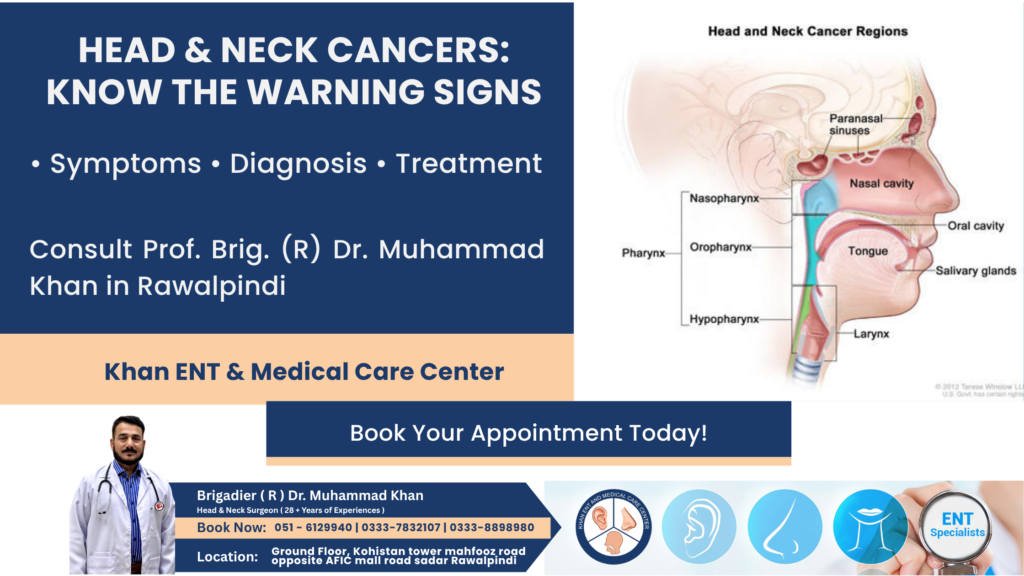
Head and Neck Cancers: Symptoms & Treatment in Rawalpindi is an important topic for people experiencing persistent throat, mouth, nose, ear, voice or neck problems. Head and neck cancers include several cancers that can develop in the mouth, throat, voice box, nasal cavity, sinuses and salivary glands. Early evaluation by an experienced ENT and Head & Neck Surgeon can help identify suspicious symptoms and guide timely diagnosis and treatment.
For residents searching for Head and Neck Cancers: Symptoms & Treatment in Rawalpindi, understanding warning signs is especially important. A persistent sore throat, unexplained neck lump, difficulty swallowing, voice change, non-healing mouth ulcer or unexplained ear pain should not be ignored, particularly when symptoms continue or become progressively worse.
What Are Head and Neck Cancers?
Head and neck cancers are a group of cancers that develop in different structures of the head and neck. Most commonly, these cancers begin in the squamous cells lining the moist surfaces of the mouth, throat, nasal cavity and voice box. However, cancers can also develop in the salivary glands, sinuses and other tissues in this region.
Head and neck cancers may involve:
- Oral cavity, including the lips, gums, tongue and inner cheeks
- Oropharynx, including the tonsils and base of the tongue
- Nasopharynx, located behind the nose
- Hypopharynx, located in the lower throat
- Larynx or voice box
- Nasal cavity and paranasal sinuses
- Major and minor salivary glands
Because these structures are responsible for important functions such as breathing, swallowing, speaking, hearing and facial movement, treatment requires careful planning.
Head and Neck Cancer Symptoms You Should Not Ignore
One of the most important aspects of Head and Neck Cancers: Symptoms & Treatment in Rawalpindi is recognizing symptoms early.
Many symptoms of head and neck cancer can initially resemble common infections or other less serious conditions. However, persistent or unexplained symptoms deserve professional assessment.
Possible warning signs include:
- A sore throat that does not go away
- A lump or swelling in the neck
- A mouth or throat ulcer that does not heal
- Difficulty or pain when swallowing
- Persistent hoarseness or voice changes
- Unexplained ear pain, particularly when the ear appears normal
- Difficulty breathing or speaking
- Persistent pain in the face, jaw or neck
- A white or red patch inside the mouth
- Unexplained bleeding from the mouth or nose
- Blood in saliva or phlegm
- Persistent nasal blockage
- Recurrent nosebleeds
- Facial swelling
- Numbness or weakness affecting part of the face
- Unexplained weight loss
- Problems moving the tongue or opening the mouth
These symptoms do not automatically mean cancer. Many can occur because of infections, allergies, acid reflux, dental problems or other benign conditions. However, symptoms that persist should be evaluated rather than repeatedly treated without finding the underlying cause.
Neck Lump and Head and Neck Cancer
An unexplained neck lump can sometimes be an early indication of head and neck cancer. A lump may develop because cancer has spread to a lymph node, even when the original tumor is difficult to see.
This is why a persistent neck swelling should receive an appropriate ENT and Head & Neck examination. Depending on the findings, the specialist may recommend imaging, endoscopic examination or tissue sampling.
Early specialist assessment can help distinguish an infection or benign swelling from a potentially serious condition.
What Causes Head and Neck Cancer?
Several factors can increase the risk of developing head and neck cancer. Tobacco remains one of the major preventable risk factors. Smoking and smokeless tobacco can damage cells lining the mouth, throat and voice box.
Alcohol is another important risk factor. Using tobacco and alcohol together can substantially increase the risk of certain head and neck cancers.
Other factors may include:
- Human papillomavirus, particularly high-risk HPV types
- Paan, betel quid and areca nut use
- Long-term exposure to certain occupational substances
- Previous radiation exposure involving the head and neck
- Epstein-Barr virus in specific cancers
- Certain inherited genetic conditions
- Poor oral health and other contributing factors
HPV is particularly associated with cancers of the oropharynx, including cancers involving the tonsils and base of the tongue. HPV-related oropharyngeal cancers can occur in people without a history of tobacco or heavy alcohol use.
Head and Neck Cancer Diagnosis in Rawalpindi
Accurate diagnosis is a critical part of Head and Neck Cancers: Symptoms & Treatment in Rawalpindi.
A specialist usually begins with a detailed medical history and examination of the mouth, throat, nose, ears and neck. If an abnormality is identified, further investigations may be required.
Diagnostic evaluation may include:
ENT and Head & Neck Examination
The doctor carefully examines the mouth, throat, nose, ears and neck for suspicious lesions, swellings or lymph nodes.
Endoscopic Examination
Flexible or rigid endoscopy may allow the specialist to examine areas of the nose, throat and larynx that cannot be adequately assessed through a routine examination.
Imaging
Depending on the suspected location and extent of disease, CT, MRI, ultrasound or PET imaging may be recommended.
Biopsy
A biopsy involves taking a tissue sample for examination by a pathologist. Tissue diagnosis is essential for confirming many head and neck cancers.
HPV Testing
For appropriate oropharyngeal cancers, testing for HPV-related disease may help with classification, prognosis and treatment planning.
Head and Neck Cancer Treatment in Rawalpindi
Head and Neck Cancers: Symptoms & Treatment in Rawalpindi requires an individualized approach. Treatment depends on the exact location and type of cancer, its stage, whether lymph nodes are involved, overall health and other patient-specific factors.
Treatment may involve surgery, radiation therapy, chemotherapy, targeted therapy, immunotherapy or a combination of these approaches.
Surgery for Head and Neck Cancer
Surgery may be recommended when a tumor can be safely removed. Depending on the cancer location, surgery may involve removal of the primary tumor, affected lymph nodes or involved tissues.
Modern head and neck surgery aims not only to control cancer but also to preserve important functions such as swallowing, speech, breathing and facial appearance whenever medically possible.
For suitable patients, surgery may be part of a broader treatment plan involving radiation therapy or systemic treatment.
Radiation Therapy
Radiation therapy uses high-energy radiation to destroy cancer cells. It may be used after surgery, instead of surgery in selected cancers, or alongside other treatments.
The choice depends on the type, location and extent of cancer.
Chemotherapy
Chemotherapy uses medicines to destroy or control cancer cells. It may be combined with radiation or used when disease is advanced or has spread.
Targeted Therapy and Immunotherapy
Some advanced head and neck cancers may benefit from targeted medicines or immunotherapy. These treatments are selected according to the cancer’s biological characteristics and the patient’s individual circumstances.
Why Early Treatment Matters
Early evaluation is one of the most important messages in Head and Neck Cancers: Symptoms & Treatment in Rawalpindi.
Head and neck cancer can sometimes be easier to treat when identified before it has extensively invaded surrounding tissues or spread to distant areas. Early diagnosis can also improve the possibility of preserving important functions such as speech, swallowing and breathing.
However, prognosis varies considerably according to the cancer type, location, stage, HPV status and overall health. Therefore, patients should avoid assuming that a particular symptom automatically means cancer or that cancer will have the same outcome in every person.
Why Choose Prof. Brig. (R) Dr. Muhammad Khan in Rawalpindi?
For patients searching for Head and Neck Cancers: Symptoms & Treatment in Rawalpindi, specialist experience matters because cancers of the head and neck involve anatomically complex areas responsible for essential functions.
Prof. Brig. (R) Dr. Muhammad Khan is a Senior ENT & Head & Neck Surgeon providing specialized ENT and head and neck surgical care at Khan ENT & Medical Care Center, Rawalpindi.
Residents of Rawalpindi and Islamabad may prefer an experienced ENT and Head & Neck Surgeon when they need evaluation of a persistent neck lump, suspicious mouth or throat lesion, voice change, swallowing difficulty, salivary gland swelling or other concerning symptoms.
Specialist assessment can help with:
- Detailed ENT and head and neck examination
- Evaluation of suspicious neck swellings
- Assessment of mouth and throat lesions
- Evaluation of persistent voice changes
- Assessment of salivary gland swellings
- Evaluation of suspected head and neck tumors
- Surgical planning when cancer surgery is indicated
- Appropriate referral and coordination for additional cancer treatment when required
The focus should always be on an accurate diagnosis and a treatment plan appropriate to the individual patient.
For information about ENT and head and neck surgical services, visit Prof. Brig. (R) Dr. Muhammad Khan.
Prevention of Head and Neck Cancer
Not every head and neck cancer can be prevented. However, several measures can reduce risk.
Avoiding tobacco in all forms is one of the most important preventive steps. Limiting or avoiding alcohol can also reduce risk. People should also avoid paan, betel quid and areca nut products because of their established association with oral cancers.
HPV vaccination can help protect against HPV-related cancers. Maintaining good oral hygiene and having regular dental and medical examinations can also help identify suspicious changes earlier.
People who have previously been treated for head and neck cancer should also maintain regular follow-up because recurrence or a new primary cancer can sometimes develop.
When Should You See a Head and Neck Surgeon?
You should consider specialist evaluation if you have a persistent neck lump, non-healing mouth ulcer, unexplained throat pain, ongoing swallowing difficulty, persistent hoarseness, unexplained ear pain, recurrent nosebleeds or another unusual symptom that does not resolve.
Do not wait for severe pain before seeking medical attention. Some cancers can cause relatively few symptoms during their early stages. Persistent symptoms deserve assessment even when they are not painful.
Head and Neck Cancers: Symptoms & Treatment in Rawalpindi – FAQs
What are the common symptoms of head and neck cancer?
Common symptoms can include a persistent sore throat, neck lump, non-healing mouth ulcer, difficulty swallowing, hoarseness, unexplained ear pain, nasal blockage, nosebleeds, mouth patches and persistent facial or neck pain.
Is every neck lump a sign of head and neck cancer?
No. Neck lumps can result from infections, enlarged lymph nodes, thyroid problems, salivary gland conditions and other causes. However, an unexplained or persistent neck lump should be assessed by an experienced specialist.
Can a sore throat be a symptom of head and neck cancer?
Yes. A persistent sore throat can be associated with head and neck cancer, although infections, allergies, reflux and other common conditions are much more frequent causes. A sore throat that does not improve should be evaluated.
Does smoking increase the risk of head and neck cancer?
Yes. Tobacco use is a major risk factor for several head and neck cancers. Smokeless tobacco can also increase the risk of cancers affecting the mouth.
Can HPV cause head and neck cancer?
High-risk HPV, particularly HPV associated with the oropharynx, can contribute to certain head and neck cancers. HPV-related cancers commonly involve areas such as the tonsils and base of the tongue.
How is head and neck cancer diagnosed?
Diagnosis may involve an ENT examination, endoscopy, imaging studies and biopsy. A biopsy is often required to confirm whether suspicious tissue contains cancer cells.
What treatments are available for head and neck cancer?
Treatment may include surgery, radiation therapy, chemotherapy, targeted therapy, immunotherapy or combinations of these treatments. The appropriate approach depends on the cancer type, location, stage and individual patient factors.
Is surgery always required for head and neck cancer?
No. Surgery is an important treatment for selected cancers, but some patients may receive radiation, chemotherapy, immunotherapy, targeted therapy or a combination of treatments instead. Treatment must be individualized.
Can head and neck cancer be cured?
Many head and neck cancers can be successfully treated, particularly when detected and managed appropriately. The outlook depends on the cancer type, location, stage, biological characteristics and response to treatment.
Where can I get Head and Neck Cancer treatment in Rawalpindi?
Patients seeking Head and Neck Cancers: Symptoms & Treatment in Rawalpindi can consult Prof. Brig. (R) Dr. Muhammad Khan, Senior ENT & Head & Neck Surgeon, at Khan ENT & Medical Care Center, Rawalpindi, for specialist assessment and surgical management when indicated.