
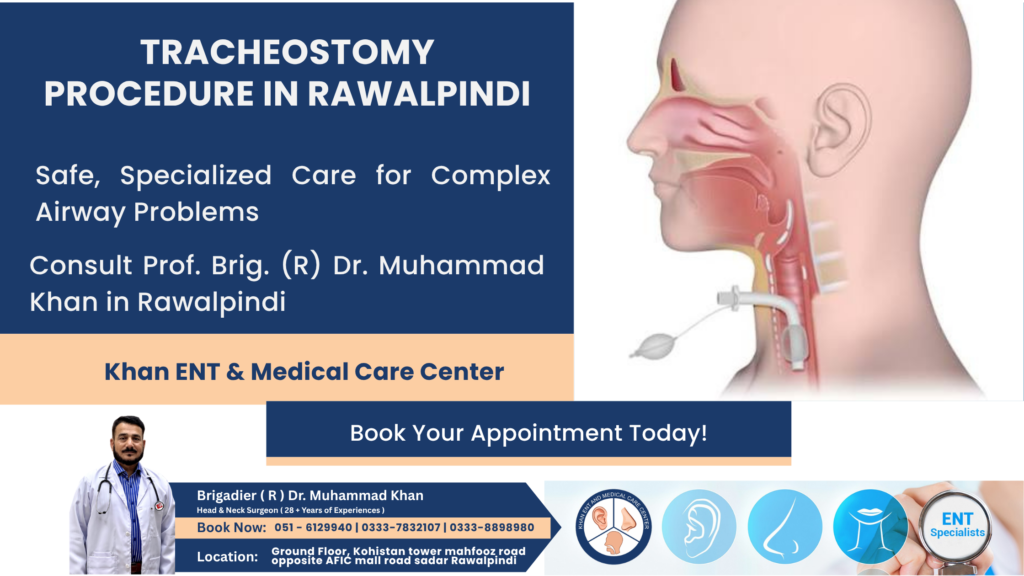
Tracheostomy Procedure in Rawalpindi is a specialized airway surgery used to create a secure breathing passage through the front of the neck into the trachea, or windpipe. It may be recommended when a person has a blocked upper airway, requires prolonged ventilator support, has difficulty clearing airway secretions, or needs long-term airway management. At Khan ENT & Medical Care Center, Rawalpindi, Prof. Brig. (R) Dr. Muhammad Khan provides specialized ENT and head and neck surgical assessment for patients who may require tracheostomy.
A tracheostomy can be temporary or permanent, depending on the underlying medical condition. The decision to perform the procedure requires careful evaluation of the airway, breathing status, general health, cause of obstruction, expected recovery and long-term airway needs.
What Is a Tracheostomy?
A tracheostomy is a surgical procedure in which an opening is created in the front of the neck and connected directly to the trachea. A tracheostomy tube is then placed through this opening to provide a stable airway.
Unlike normal breathing through the nose and mouth, a tracheostomy allows air to enter the lungs directly through the neck. This can be particularly important when the upper airway is narrowed, blocked or unable to provide a safe route for breathing.
The terms tracheostomy and tracheotomy are often used interchangeably. Tracheotomy generally refers to creating the opening, while tracheostomy describes the resulting airway opening and its management.
Why Is a Tracheostomy Procedure Needed?
A Tracheostomy Procedure in Rawalpindi may be considered when other methods of maintaining the airway are unsuitable or when long-term airway support is expected.
Common reasons include:
- Severe upper airway obstruction
- Airway narrowing or stenosis
- Head and neck tumors affecting the airway
- Swelling following major head and neck surgery
- Severe facial or neck trauma
- Prolonged dependence on mechanical ventilation
- Neuromuscular conditions affecting breathing
- Difficulty clearing mucus and respiratory secretions
- Recurrent aspiration in selected patients
- Severe airway disorders requiring long-term access
- Certain complex laryngeal or throat conditions
- Selected patients with severe obstructive sleep apnea when other treatments are unsuccessful
The exact indication varies from patient to patient. An experienced ENT and head and neck surgeon should assess whether tracheostomy is appropriate and whether the airway problem can be treated by another approach.
Emergency and Planned Tracheostomy
A Tracheostomy Procedure in Rawalpindi can be performed as an emergency or as a planned operation.
An emergency tracheostomy may be required when a serious airway obstruction makes conventional airway management difficult or impossible. Causes can include severe swelling, extensive facial or neck trauma, advanced airway disease and certain head and neck emergencies.
A planned tracheostomy is more commonly performed when a patient is expected to require prolonged ventilator support, long-term airway access or postoperative airway protection.
Whenever possible, planned procedures allow the medical team to evaluate the airway, review imaging and medical history, assess bleeding risk and prepare the appropriate equipment.
Who May Need Tracheostomy?
Not every patient with breathing difficulty requires a tracheostomy.
A patient may be considered for tracheostomy when the expected benefits of establishing a direct airway outweigh the potential risks. The decision may involve an ENT surgeon, anesthesiologist, intensivist, pulmonologist, respiratory therapist, nursing team and other specialists depending on the patient’s condition.
Important factors include:
- The cause of airway difficulty
- Severity and location of airway obstruction
- Expected duration of ventilator dependence
- Ability to protect the airway
- Ability to clear respiratory secretions
- General medical condition
- Previous neck or airway surgery
- Anatomical characteristics of the neck
- Bleeding risk
- Expected recovery and quality of life
Surgical Tracheostomy
A surgical tracheostomy is generally performed by an experienced surgeon in a controlled hospital environment.
The patient is positioned appropriately, the neck is prepared and the surgical team identifies important anatomical landmarks. An incision is made in the lower front portion of the neck, allowing the surgeon to reach the trachea safely.
The surgeon creates an opening in the tracheal wall and places an appropriately sized tracheostomy tube. The tube is then secured to prevent accidental movement.
The exact surgical approach depends on the patient’s anatomy, airway condition, previous surgery and clinical circumstances.
Percutaneous Tracheostomy
Percutaneous tracheostomy is a minimally invasive approach that may be performed in selected critically ill patients, commonly in an intensive care setting.
Instead of creating a larger surgical exposure, the trachea is accessed through a small opening and the tract is gradually enlarged to accommodate the tracheostomy tube.
Bronchoscopic guidance and, when appropriate, ultrasound can help the medical team identify the airway and surrounding structures and improve procedural safety.
The choice between surgical and percutaneous tracheostomy depends on the patient’s condition, anatomy, clinical setting and surgeon’s assessment.
Benefits of Tracheostomy
A properly selected Tracheostomy Procedure in Rawalpindi can provide several important benefits.
It may:
- Establish a reliable airway
- Bypass an upper airway obstruction
- Facilitate mechanical ventilation
- Make airway suctioning easier
- Help remove respiratory secretions
- Improve comfort compared with prolonged oral intubation in appropriate patients
- Facilitate ventilator weaning in selected patients
- Support long-term respiratory care
- Provide a secure airway following complex head and neck procedures
Tracheostomy does not treat every underlying disease. Instead, it provides an alternative route for breathing and airway management while the primary condition is treated or managed.
Risks and Possible Complications
Although tracheostomy is an established surgical procedure, it carries potential risks. The risk may be greater during emergency procedures or in patients with difficult anatomy, severe illness or bleeding disorders.
Possible complications include:
- Bleeding
- Infection
- Tube displacement
- Tube blockage
- Injury to nearby structures
- Air leakage into tissues around the neck
- Pneumothorax
- Tracheal injury
- Tracheal narrowing or stenosis
- Granulation tissue
- Difficulty swallowing
- Tracheoesophageal fistula
- Rare but potentially life-threatening vascular complications
Regular follow-up and appropriate tracheostomy care are essential for reducing complications.
Tracheostomy Tube Care
Patients who leave the hospital with a tracheostomy require careful education and follow-up.
Tracheostomy care may include:
- Keeping the tube clean
- Suctioning secretions when required
- Maintaining appropriate humidification
- Monitoring for mucus blockage
- Checking the skin around the stoma
- Following instructions regarding tube changes
- Maintaining appropriate tube security
- Recognizing signs of infection
- Keeping emergency airway equipment available when advised
Patients and caregivers should receive clear instructions before discharge. A multidisciplinary team may help with airway care, communication, swallowing and respiratory management.
Can You Speak After a Tracheostomy?
Speech can be affected because normal airflow through the vocal cords may be reduced or interrupted.
However, many patients can regain the ability to communicate verbally depending on their underlying condition, vocal cord function, type of tracheostomy tube and overall recovery.
Speech-language professionals can assess communication and swallowing. Selected patients may benefit from speaking valves or other communication strategies when medically appropriate.
Can You Eat After a Tracheostomy?
Some patients can eat and drink normally after recovery, while others may experience swallowing difficulties.
The ability to swallow safely depends primarily on the underlying illness, neurological function, laryngeal function and overall condition rather than the presence of a tracheostomy alone.
A swallowing assessment may be recommended before oral feeding in patients at risk of aspiration.
Recovery After Tracheostomy
Recovery varies according to the reason for the procedure and the patient’s overall health.
After surgery, the medical team monitors breathing, oxygenation, tube position, secretions and the surgical site. Patients may initially experience neck discomfort, coughing or increased mucus production.
As healing progresses, patients and caregivers learn appropriate tracheostomy care. Communication and swallowing may also be assessed when necessary.
If the airway problem resolves and the patient no longer needs the tracheostomy, the medical team may consider decannulation, which means removing the tracheostomy tube.
Decannulation should only be performed after careful assessment confirms that the patient can maintain a safe airway and breathe adequately without the tube.
When Should You Seek Urgent Medical Help?
A person with a tracheostomy requires urgent medical attention if there is:
- Sudden difficulty breathing
- Severe bleeding
- A blocked tracheostomy tube
- Accidental tube displacement
- Significant swelling around the neck
- Blue or grey discoloration of the lips or skin
- Sudden deterioration in consciousness
- Severe respiratory distress
- Signs of serious infection
Tracheostomy emergencies can become life-threatening quickly. Patients and caregivers should follow their healthcare team’s emergency instructions.
Why Choose Prof. Brig. (R) Dr. Muhammad Khan in Rawalpindi?
Choosing an experienced ENT and head and neck surgeon is particularly important when a patient requires complex airway surgery.
Prof. Brig. (R) Dr. Muhammad Khan, Senior ENT & Head and Neck Surgeon at Khan ENT & Medical Care Center, Rawalpindi, provides specialized evaluation and surgical care for complex ENT and airway conditions.
Residents of Rawalpindi and Islamabad may prefer an experienced specialist because tracheostomy decisions require more than simply creating an airway opening. Proper patient selection, evaluation of the cause of airway obstruction, consideration of surrounding anatomy, surgical planning and postoperative management are all important.
Patients seeking a Tracheostomy Procedure in Rawalpindi can benefit from consultation with a specialist who focuses on ENT and head and neck surgical conditions.
At Khan ENT & Medical Care Center, assessment can help determine whether tracheostomy is appropriate, whether another airway treatment may be suitable and what postoperative care may be required.
Tracheostomy Procedure in Rawalpindi for Airway Obstruction
Airway obstruction can occur at different levels and may have many causes. Tumors, swelling, scarring, trauma, vocal cord disorders and structural abnormalities can compromise breathing.
A Tracheostomy Procedure in Rawalpindi may provide a bypass around an obstructed upper airway when other options are unsuitable.
However, the underlying cause should always be investigated. In some patients, treating the obstruction itself may eventually allow the tracheostomy tube to be removed.
Tracheostomy and Head & Neck Surgery
Tracheostomy may sometimes be required before, during or after major head and neck surgery.
Patients undergoing extensive procedures involving the throat, larynx, oral cavity, neck or surrounding structures may have temporary airway swelling or other factors that make normal breathing difficult.
In carefully selected cases, a tracheostomy provides a controlled airway while postoperative swelling decreases and the patient recovers.
Frequently Asked Questions
What is a tracheostomy?
A tracheostomy is a surgical opening created through the neck into the trachea to provide a direct route for breathing.
Is a tracheostomy permanent?
Not always. A tracheostomy can be temporary or permanent depending on the underlying condition and whether the patient’s normal airway function can be restored.
Why would someone need a tracheostomy?
It may be required for severe airway obstruction, prolonged ventilator dependence, difficulty clearing secretions, certain neurological conditions, trauma or major head and neck surgery.
Is tracheostomy a major surgery?
Tracheostomy is an established surgical procedure, but it requires careful airway planning and appropriate medical expertise because important blood vessels, nerves and other structures are located near the trachea.
Is tracheostomy painful?
The procedure is performed using appropriate anesthesia. Some soreness or discomfort around the neck can occur during recovery and is generally managed according to the healthcare team’s instructions.
Can a person talk with a tracheostomy?
Some patients can speak after recovery. Speech depends on vocal cord function, airway anatomy, the type of tube and the patient’s overall condition. Speaking valves may help selected patients.
Can a person eat normally with a tracheostomy?
Some patients can eat normally, while others need swallowing assessment or temporary alternative nutrition. The decision depends on the patient’s swallowing ability and risk of aspiration.
How long does a tracheostomy stay in place?
There is no single duration. Some patients require a tracheostomy for a short period, while others need long-term or permanent airway support.
What are the complications of tracheostomy?
Potential complications include bleeding, infection, tube blockage or displacement, airway injury, pneumothorax, granulation tissue, tracheal narrowing and abnormal connections involving the trachea and esophagus or nearby blood vessels.
Where can I get a Tracheostomy Procedure in Rawalpindi?
Patients seeking a Tracheostomy Procedure in Rawalpindi can consult Prof. Brig. (R) Dr. Muhammad Khan at Khan ENT & Medical Care Center, Rawalpindi for specialist evaluation and individualized airway management.